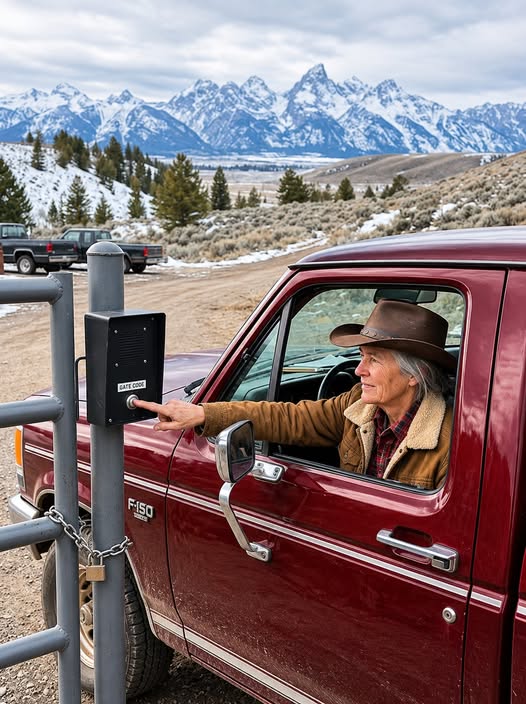
“We tried.”
“No. You talked. I said no. There’s a difference.”
He sighed loudly.
“Look, you sign the papers, you get a comfortable allowance, and you don’t have to worry about anything.”
An allowance.
I opened my eyes.
“Did you just tell me you’d give me an allowance?”
“Dolores, don’t twist my words.”
“On my own ranch?”
“We’re trying to help.”
I’d heard those words before.
Usually from somebody helping themselves.
I looked toward the house again.
Russ’s house.
My house.
The place where we’d brought our babies home.
Where I’d cooked Christmas dinners for twenty people and Thanksgiving dinners for thirty.
Where Russ had once carried a newborn calf into the kitchen during a March blizzard because the barn heater failed.
Where we’d laughed.
Argued.
Prayed.
Grown old.
And now I couldn’t get past the front gate.
“Open it,” I said.
“I’m sorry, Mom,” Kristy answered.
“You’ll understand eventually.”
The speaker went silent.
I sat there for another full minute.
Then I shifted the truck into reverse.
I backed away from the gate and parked beneath the big cottonwood beside the county road.
Russ used to park the stock trailer there.
He said the shade kept the tires from cooking in August.
I turned off the engine.
The silence settled around me.
A meadowlark called somewhere beyond the fence.
Wind whispered through the yellow leaves.
My groceries were warming on the passenger seat.
I took the ham sandwich I’d bought at Safeway out of its paper wrapper.
Then I ate it.
Slowly.
One bite at a time.
I wasn’t hungry.
But I’d lived long enough to know that panic was easier to manage with something in your stomach.
As I chewed, I thought about the first time I’d met Brett.
Kristy brought him home twelve years earlier.
He wore polished boots that had never seen manure and a belt buckle nearly as big as his face.
He sold farm equipment in Billings.
He talked a great deal about investments, opportunities, and knowing the right people.
Russ listened to him for an entire Sunday dinner.
Afterward, while we washed the dishes, my husband said, “That boy spends money in his head before he earns it with his hands.”
I laughed.
“He’s ambitious.”
“Ambition’s good,” Russ said. “But there’s a difference between wanting to build something and wanting to own what somebody else built.”
I remembered those words now.
And I remembered something else.
Last November.
A cold afternoon on the drive home from dialysis.
Russ had been unusually quiet.
We were somewhere outside Kaycee when the sun began sinking behind the Bighorn Mountains.
His face looked thin in the orange light.
His hands rested in his lap.
Suddenly he said, “Dolly, if anybody ever locks you off this place, you call Amos.”
I laughed.
“Who in the world would lock me off my own ranch?”
Russ didn’t smile.
“I’m serious.”
“Amos Redcloud?”
“Yes.”
“Why would I call Amos?”
“Because he’ll know what to do.”
I glanced at him.
“Russ, you’re worrying about things that aren’t going to happen.”
He turned toward me.
His eyes were steady.
“Promise me.”
Something about his voice made me stop smiling.
“All right,” I said. “I promise.”
He leaned back against the seat.
“Don’t call the girls first. Don’t argue. Don’t sign anything. Call Amos.”
I hadn’t understood then.
Sitting beneath that cottonwood seven months after burying him, I finally did.
I took my little phone from my purse.
Amos Redcloud had lived on the adjoining property to the south for fifty years.
He was eighty-four now.
A quiet man with thick silver hair, weathered hands, and the habit of answering questions only after he’d decided they were worth answering.
