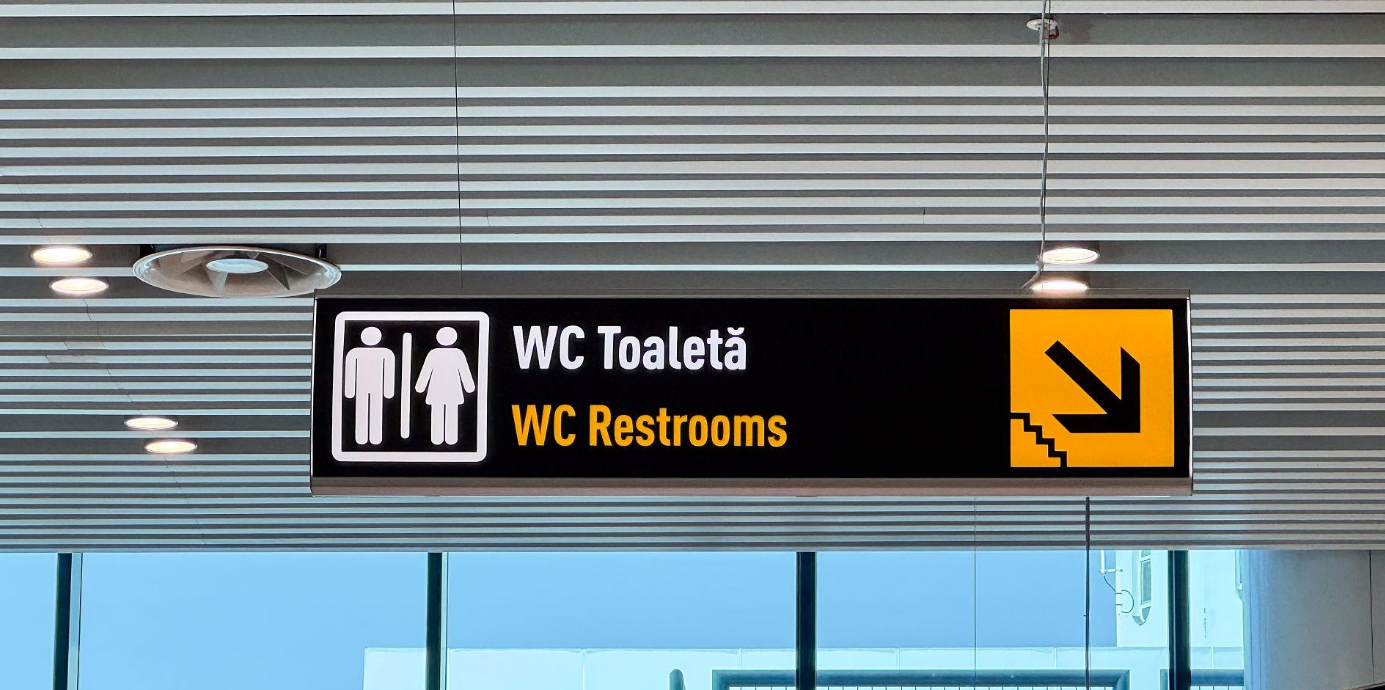
You’ve probably seen the letters “WC” on a bathroom door at some point—especially while traveling through an airport, hotel, restaurant or train station.
For many Americans, the meaning isn’t immediately obvious.
Is it another word for bathroom? Does the “W” stand for washroom? And why would anyone use two letters when a simple restroom sign would do?
The answer is surprisingly old-fashioned.
WC stands for “water closet.”
Today, the term sounds strange. But it makes much more sense when you look back at a time when having a flushing toilet inside your home was still something worth distinguishing from an ordinary bathing room.
What Does WC Actually Mean?
The letters WC are an abbreviation for water closet.
Traditionally, a water closet referred to a small room or enclosed space containing a flushing toilet.
The term emerged during an era when bathing and using the toilet weren’t necessarily activities performed in the same room.
Today, WC is generally understood simply as a sign indicating a toilet or restroom.
You’ll encounter it particularly often in parts of Europe and elsewhere around the world.
For international travelers, those two letters can be extremely useful once you know what they mean.
But Why Call It a “Water Closet”?
To modern ears, “water closet” sounds almost as confusing as WC itself.
There’s no closet full of water waiting behind the door.
The terminology makes more sense historically.
A “closet” could refer to a small private room, not merely the storage space where we hang clothes today.
As flushing toilets became more common, the term water closet was used for a small private room containing a toilet connected to a water-based flushing system.
Over time, the full phrase was shortened to the much simpler WC.
And although the expression sounds old-fashioned in everyday American English, the abbreviation survived on signs around the world.
Why Don’t Americans Usually Say WC?
In the United States, you’re much more likely to hear someone ask:
“Where’s the bathroom?”
or:
“Where’s the restroom?”
Canadians commonly use washroom, while British English has its own collection of terms, including toilet and loo.
Then there’s lavatory, another term frequently associated with public facilities and transportation.
The funny thing is that if you interpret these words literally, almost none of them makes perfect sense.
A public bathroom frequently contains no bath.
You don’t normally rest in a restroom.
You probably aren’t doing much washing in a washroom beyond washing your hands.
And a modern WC usually doesn’t look much like what Americans would call a closet.
Language doesn’t always follow logic.
A Viral Conversation Highlighted Just How Strange Our Bathroom Words Are
The differences became a source of amusement online when a couple named Shelby and Dylan discussed the word “washroom” in a social media video.
Dylan questioned what exactly people were supposed to be washing in a washroom.
Then came the obvious counterargument:
Do people actually rest in a restroom?
Not really.
The exchange highlighted something most of us rarely think about.
We’ve heard these terms since childhood, so they sound completely normal.
It’s only when someone takes them literally that they start sounding ridiculous.
Bathroom vs. Restroom vs. Washroom
In American English, bathroom is perhaps the most familiar everyday term.
Someone visiting another person’s home will commonly ask where the bathroom is—even if they’re only looking for the toilet.
Restroom is particularly common for public facilities.
You’ll see it on signs in restaurants, stores, theaters and other public buildings.
In Canada, washroom is extremely common.
None of these differences changes the basic purpose of the room.
They’re simply regional conventions that developed over time.
And Then There’s the “Loo”
Anyone who has spent time in Britain has probably encountered another famous term:
