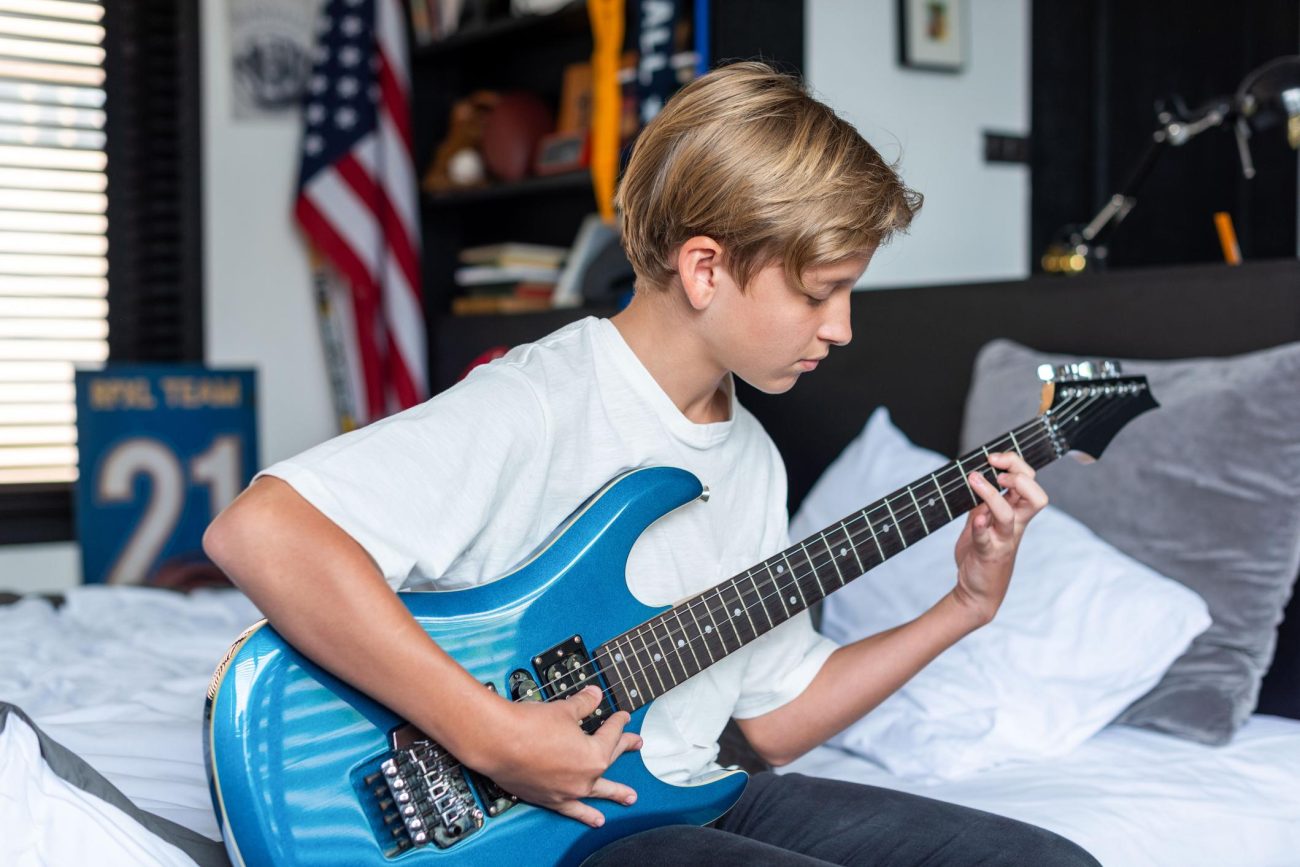
At seven o’clock on a Thursday morning, two police officers knocked on my front door and asked to speak with my thirteen-year-old son.
“Mrs. Vance?” the taller officer asked.
“Yes?”
“I’m Officer Daniels. This is Officer Cooper. We need to talk to you about Julian.”
My stomach dropped.
Julian was standing behind me in his pajamas, holding a half-eaten piece of toast.
The moment he saw the uniforms, his face turned pale.
“Mom,” he whispered, “what’s going on?”
I reached for his hand.
“Has my son done something wrong?” I asked.
Officer Daniels shook his head.
“Not that we’re aware of, ma’am. But something happened yesterday involving a wheelchair, and there’s information we think you should hear.”
I looked at Julian.
Just the evening before, he’d admitted that he’d sold his beloved Fender Stratocaster, his PlayStation, and nearly everything he’d saved to buy a $1,400 wheelchair for a girl in his eighth-grade class.
I’d gone to bed feeling proud of him.
Now two police officers were standing on my porch.
And I couldn’t understand why.
Officer Cooper glanced toward Julian.
“Your son made a purchase yesterday. The girl’s father contacted us afterward.”
My heart began pounding.
“Is Maya okay?”
“She is,” Officer Daniels said. “But her father has something important to tell you.”
Then he paused.
“And there’s another person who wants to meet your son.”
I had no idea that by the end of that morning, I’d be sitting in a room full of strangers, watching my son discover that a single act of kindness had reached people he’d never met.
The Guitar That Meant Everything to Julian
My name is Sarah Vance, and Julian is my only child.
He’s thirteen, quiet around people he doesn’t know, and happiest when he’s doing something with his hands.
For years, that meant music.
His father, Mark, taught him his first three guitar chords when he was eight.
At the time, Julian could barely stretch his fingers across the strings.
He practiced anyway.
At first, the sounds coming from his bedroom were difficult to recognize as music.
There were missed notes, awkward pauses, and the same short melody repeated until I thought I’d lose my mind.
But Julian never seemed frustrated for long.
He’d stop, adjust his fingers, and try again.
By eleven, he could play songs I recognized.
By twelve, he was watching guitar tutorials and talking about pickups, amplifiers, and different playing styles.
For his thirteenth birthday, Mark and I decided to buy him the guitar he’d been dreaming about.
A custom Fender Stratocaster.
It wasn’t cheap.
We saved for months.
Mark took extra weekend jobs, and I set aside money from every paycheck.
On Julian’s birthday, we carried the case into the living room.
He stared at it.
“Is that what I think it is?”
Mark smiled.
“Open it.”
Julian knelt beside the case and lifted the lid.
For a moment, he didn’t say anything.
Then he looked at us with tears in his eyes.
“Are you serious?”
We nodded.
He hugged us both.
That guitar became his most treasured possession.
Or so I thought.
The Empty Guitar Stand
One Wednesday afternoon, I went into Julian’s bedroom carrying a basket of clean laundry.
His room looked the way it usually did.
Schoolbooks on the desk.
A hoodie hanging from the chair.
Music posters on the wall.
But something was missing.
The guitar stand beside his window was empty.
I stopped.
I looked around the room.
The case wasn’t under the bed.
It wasn’t in the closet.
His amplifier was still there, with the cable neatly coiled beside it.
But the guitar was gone.
