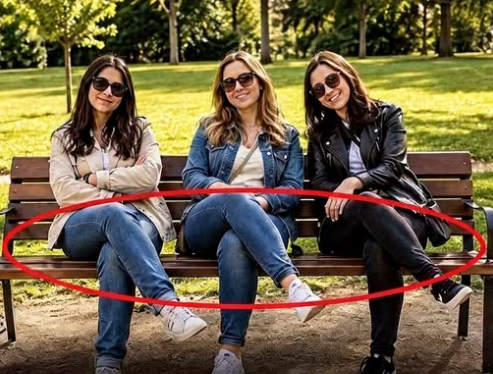
At first glance, there’s nothing particularly unusual about this picture.
Three women are sitting together outdoors, apparently enjoying a peaceful moment in a park. Their expressions seem relaxed, their poses look natural, and the setting is familiar.
It looks like the kind of ordinary photograph you might scroll past without giving it a second thought.
But there’s a problem.
Something important in this picture is missing, and it’s hiding in plain sight.
The interesting part is that you might look directly at the mistake without realizing anything is wrong.
Before reading further, take another look at the image.
Can you find it?
Take 10 Seconds and Examine the Picture
Most people naturally begin by looking at the three women.
We notice their faces, clothing, and body language before examining the objects around them.
That’s a normal part of how human attention works.
Faces are especially effective at attracting our attention, so other details in a photograph can receive less scrutiny.
But this puzzle isn’t really about the women.
The mistake is somewhere else.
Try looking at the object they’re sitting on.
Does everything appear to be in the right place?
Or is there something missing that should be obvious?
<text color=”secondary” italic={true}>Pause here and look at the picture again before revealing the answer.</text>
Here’s a Small Hint
Think about what makes a park bench functional.
A typical bench has a supporting structure and a surface where people sit.
You may also expect to see a backrest, depending on its design.
Now look carefully at the area directly beneath the women.
Don’t focus on their expressions or clothing.
Look at the bench itself.
Can you see the problem now?
The Hidden Mistake Is the Missing Bench Seat
The unusual detail is that the wooden seating surface of the bench appears to be missing.
The supporting structure is visible, but the part of the bench that should be directly beneath the women isn’t apparent.
Yet all three women appear to be sitting comfortably.
That’s what makes the picture so puzzling.
Our eyes recognize the familiar arrangement of people sitting together in a park, and our brains interpret the scene as normal.
We don’t necessarily stop to verify whether every component of the bench is actually visible.
The puzzle takes advantage of that assumption.
Once you notice the missing seating surface, it’s difficult to look at the image in quite the same way again.
Why Didn’t You Notice It Immediately?
The answer has a lot to do with how visual perception works.
Our brains don’t process every detail in a scene with equal attention.
Instead, they use familiar patterns, previous experiences, and visual clues to interpret what we’re seeing.
When you look at a picture of people sitting in a park, your brain already has a strong expectation about what should be there.
People sitting together usually have something supporting them.
If the image contains the recognizable structure of a bench, you may assume the seat is present without examining it closely.
Psychologists describe related processes using concepts such as perceptual organization and top-down processing.
In simple terms, what we already know about the world can influence how we interpret new visual information.
This is useful in everyday life.
It allows us to recognize familiar scenes quickly.
But it can also make certain visual puzzles surprisingly effective.
The Difference Between Looking and Noticing
There’s an important difference between seeing something and paying attention to it.
You can look at a photograph for several seconds without consciously examining every object.
Your attention may settle on the most visually interesting elements.
In this picture, the women naturally attract attention.
