He’d stayed silent.
He was ashamed.
And he’d carried that shame for decades.
The Apology I’d Never Expected
Russell’s voice became quiet.
“I should’ve said something.”
I didn’t answer immediately.
“I knew something was wrong,” he continued. “I didn’t know everything, but I knew enough to ask questions.”
I stared at the kitchen wall.
For years, I’d thought Russell simply didn’t care.
Now I understood that he’d been avoiding his own guilt.
That didn’t erase what he’d done.
But it explained part of the distance between us.
Then he said, “I’m sorry, Linda.”
No excuses.
No attempt to blame Mama.
No insistence that he was young and didn’t know better.
Just an apology.
I let the silence remain for a moment.
Then I said, “Thank you for telling me.”
We talked for nearly an hour.
About Wayne.
About Mama.
About our father.
And about the years we’d spent avoiding difficult conversations.
When we hung up, I felt exhausted.
But something between us had changed.
The Flour Tin in My Kitchen
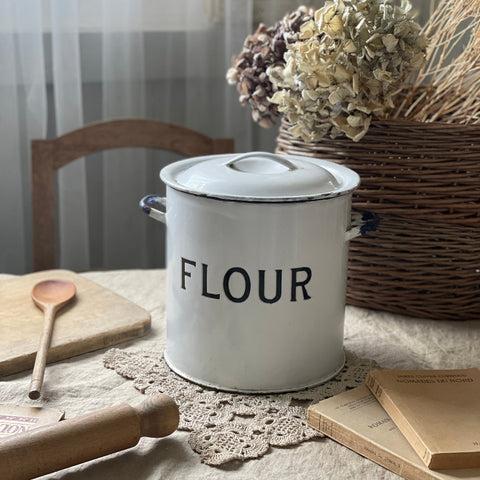
I kept the tin.
I cleaned it carefully.
The chipped blue pattern was still visible around the rim.
I placed it on my kitchen counter.
At first, I thought about using it for flour.
Then I decided not to.
It had held too much.
Money.
Secrets.
Regret.
And a mother’s attempt to repair something she couldn’t undo.
Sometimes I looked at it and felt angry.
Other times, I felt sad.
Occasionally, I felt grateful.
I didn’t try to force myself to choose one emotion.
They were all real.
The Question My Daughter Asked
My daughter was twenty-six and living in Atlanta.
We spoke most Sundays.
Eventually, I told her the entire story.
The accident.
Wayne.
The settlement.
Mama’s letters.
The flour tin.
She listened carefully.
Then she asked, “Do you forgive Grandma?”
I was quiet for a long time.
Finally, I said, “I think I understand her better than I forgive her.”
My daughter considered that.
“Isn’t that the same thing?”
“No,” I said. “Not exactly.”
I explained that understanding why someone made a decision didn’t mean the decision stopped hurting.
Mama had been afraid.
She’d wanted stability.
She’d worried about losing her marriage and her home.
I understood those fears.
But she had also failed to protect me when I needed her.
Both things could be true.
My daughter was quiet.
Then she asked, “Do you think Grandma knew you’d understand?”
I looked toward the tin.
“I think she hoped I would.”
The Biscuits I Hadn’t Made in Years
One Sunday morning, I opened Mama’s old recipe box.
Inside was the biscuit recipe she’d used when I was little.
The card was stained.
The corners were worn.
Her handwriting filled both sides.
I hadn’t made those biscuits in decades.
Part of me had always associated them with the morning she’d slapped my hand away from the flour tin.
But that morning, I decided to try.
I measured the flour.
Added baking powder.
Cut cold butter into small pieces.
Followed her instructions carefully.
When the biscuits came out of the oven, the kitchen smelled like childhood.
I broke one open.
It was warm and soft.
Almost exactly as I remembered.
I sat at the table and ate it slowly.
Then I thought about Mama making cocoa after she’d frightened me.
I remembered her hand resting on my hair.
Her apology.
Her sadness.
I hadn’t understood it then.
Now I did.
What Mama Really Kept
My mother wasn’t perfect.
She had made a serious mistake.
She’d protected a man who had taken money meant for her injured daughter.
Then she’d hidden the truth for decades.
Nothing could erase that.
But she’d also spent years trying to correct what she could.
She’d saved small amounts of money.
Gathered documents.
Met with a bank manager.
Consulted an attorney.
Written letters.
And arranged for me to discover the truth after she was gone.
She couldn’t give me back the opportunities I’d lost.
She couldn’t restore the years.
But she could leave me the evidence.
And the truth.
Russell and I speak more often now.
My daughter knows the story.
And I try to have difficult conversations before they become secrets.
The flour tin remains on my kitchen counter.
Some mornings, I look at it and feel grief.
Some mornings, I feel anger.
And some mornings, I feel something close to peace.
Not because everything was made right.
But because I finally understand what Mama had been carrying.
She kept $18,940 hidden in an old flour tin.
But what she was really trying to preserve was the chance to tell me the truth.
THE END.
