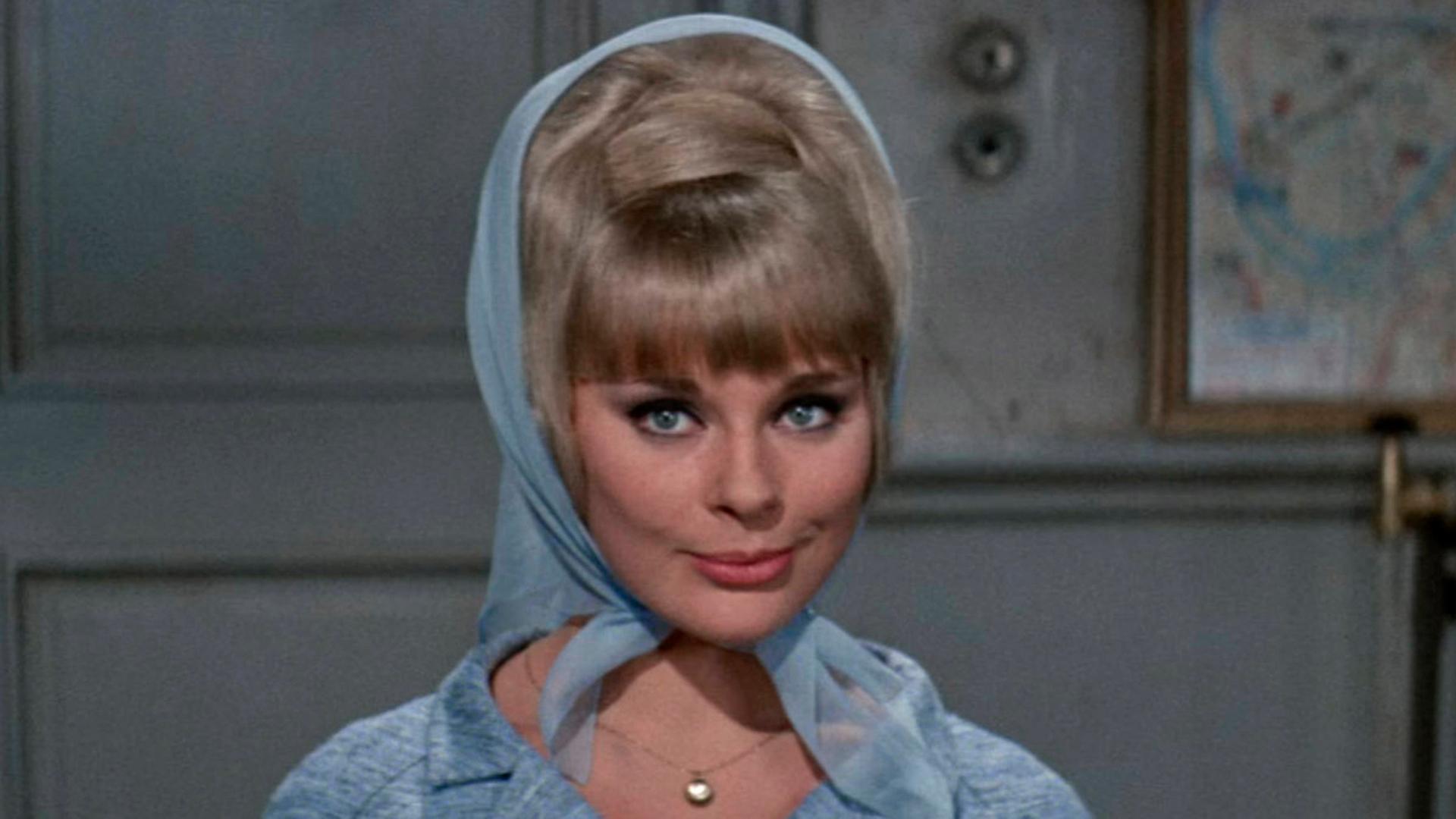
She starred in the Bob Hope comedy Boy, Did I Get a Wrong Number!
She appeared in The Wrecking Crew with Dean Martin and Sharon Tate.
Her filmography stretched well beyond Hollywood as she continued working in European productions and television.
She Was More Than the ‘Blonde Bombshell’ Image
Hollywood frequently promoted Sommer for her beauty.
She became associated with the glamorous European stars who arrived in American cinema during the 1960s.
Photographers loved her.
Studios emphasized her appearance.
Magazines treated her as an international sex symbol.
But Sommer didn’t believe physical beauty alone explained her success.
Her career required something far more durable.
She could perform comedy.
She could work in multiple languages.
She could move between American and European productions.
And she maintained a career that lasted far beyond the initial period when Hollywood marketed her primarily for glamour.
Painting Eventually Became Another Major Part of Her Life
Sommer had another serious artistic passion.
Painting.
As her screen appearances became less frequent, she devoted increasing attention to visual art.
By the 1990s, painting had become a significant part of her creative life.
It wasn’t merely a celebrity hobby.
Sommer exhibited and sold her work and increasingly defined herself through art as well as acting.
For someone who had spent decades being photographed, filmed and judged largely through her physical appearance, painting offered another form of expression.
Her Private Life Included Two Marriages
Sommer married writer and journalist Joe Hyams in 1964.
Their marriage ended in divorce in 1981.
Years later, she met German hotelier Wolf Walther.
The two married in 1993.
Their marriage lasted more than three decades.
As Sommer grew older and withdrew from much of public life, Walther remained at the center of her private world.
Then, in 2026, he died after an illness.
His death profoundly affected her.
Wolf Walther Died Only Months Before Elke
Walther died during the summer of 2026.
Sommer had previously spoken openly about how deeply connected she felt to her husband.
After more than 30 years together, losing him was devastating.
German reports following Sommer’s death emphasized how difficult her final months had become after Walther was gone.
She had also experienced her own health problems and had largely retreated from public life.
Only a few months separated their deaths.
Her Final Wish Brought Her Back to Germany
Despite becoming an international star and spending much of her life in the United States, Sommer never completely severed her connection to Germany.
Marloffstein, near Erlangen in Bavaria, remained particularly meaningful to her.
Reports following her death said Sommer wished to be laid to rest in the family grave there.
It was a deeply personal conclusion for someone whose life had carried her from wartime Germany to Italy, Hollywood and international fame.
After decades of traveling the world, the final resting place she wanted was connected to home.
She Never Forgot Where She Came From
Sommer maintained connections to both California and Germany.
German reports noted that she had homes reflecting that dual life.
Even after achieving the kind of Hollywood success that relatively few German performers of her generation managed, she continued identifying with the country and region where she’d grown up.
Her story therefore wasn’t simply one of leaving Europe for Hollywood.
She belonged to both worlds.
That international quality became part of what made her career distinctive.
Her Career Extended Far Beyond One Famous Movie
For casual viewers, A Shot in the Dark may be the first title associated with Elke Sommer.
But reducing her career to a single film misses much of what made her unusual.
She worked across decades.
