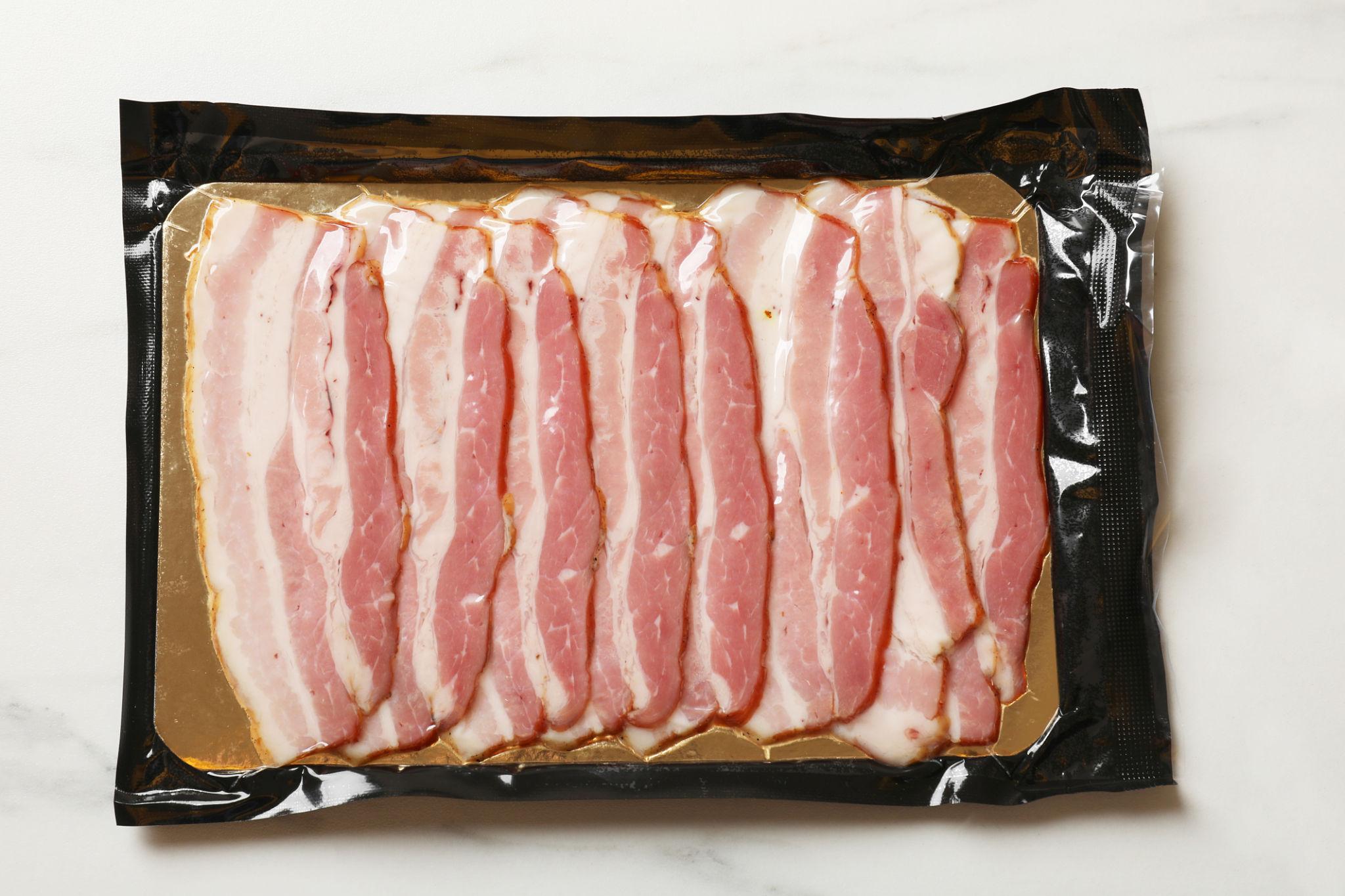
But animal tissue is more complicated than that.
Depending on the cut and processing, meat products may contain connective tissue and other natural structures.
Some connective tissues can feel firmer or more elastic than the surrounding meat.
Cartilage, in particular, is a tough, flexible tissue found in animals.
When I compared the descriptions with the material in my bacon, I began to wonder whether that might explain what I was seeing.
It was a possibility I hadn’t considered.
Maybe the unusual piece wasn’t plastic.
Maybe it was a natural part of the animal that had remained in the cut during processing.
The idea was less frightening than some of the explanations I had encountered online.
But it still wasn’t proof.
I couldn’t identify an unfamiliar substance simply by looking at photographs on a screen.
And I couldn’t assume it was safe to eat.
Why Bacon Doesn’t Always Look Exactly the Same
Bacon is commonly made from pork belly in the United States, although other cuts may also be used for certain products.
Pork belly contains layers of muscle and fat.
Those layers can vary from one animal to another and from one section of the cut to another.
The meat is typically cured and may be smoked before being sliced and packaged.
Because bacon comes from animal tissue, natural variations in appearance and texture can occur.
Some strips have more fat.
Others contain more lean meat.
The thickness and firmness can also vary.
However, ordinary variation is not the same as finding an unidentified foreign object.
If something appears completely inconsistent with the product, consumers should not assume it is harmless.
The material may need to be examined by the retailer, manufacturer, or an appropriate food-safety professional.
What I Wish I Had Done First
Looking back, I spent too much time searching for frightening explanations and not enough time taking practical steps.
The sensible response would have been straightforward.
First, I should have stopped preparing the affected bacon.
Then I should have kept the packaging and recorded the product information.
The brand name, barcode, lot number, and use-by date could all help identify the product.
A clear photograph of the unusual material would also have been useful.
Most importantly, I should have contacted the store or manufacturer rather than relying on strangers online to identify it.
If the material appeared potentially hazardous, the appropriate food-safety authority could provide further guidance.
An unidentified object in food is not something that should be tasted or handled repeatedly in an attempt to determine what it is.
And cooking the product would not necessarily resolve the concern.
The Difference Between a Natural Tissue and a Foreign Object
One reason unusual findings in meat can be confusing is that not everything unfamiliar is necessarily artificial.
Animal products naturally contain different tissues.
Muscle, fat, tendons, membranes, and cartilage can have different textures and appearances.
Some may be noticeably tougher than others.
But consumers generally purchase bacon expecting a recognizable, properly prepared food product.
If a piece appears hard, unusually rigid, or completely different from the surrounding meat, it is reasonable to question it.
The important distinction is between a possible explanation and a confirmed identification.
A photograph might suggest that something resembles cartilage.
It cannot establish the material’s identity with certainty.
And even if a substance is biological, that alone does not establish that the particular product is suitable for consumption.
Why Food Packaging Creates a Sense of Security
Standing in my kitchen, I began thinking about how different grocery shopping is from the way earlier generations obtained food.
Many people once bought meat directly from local butchers.
