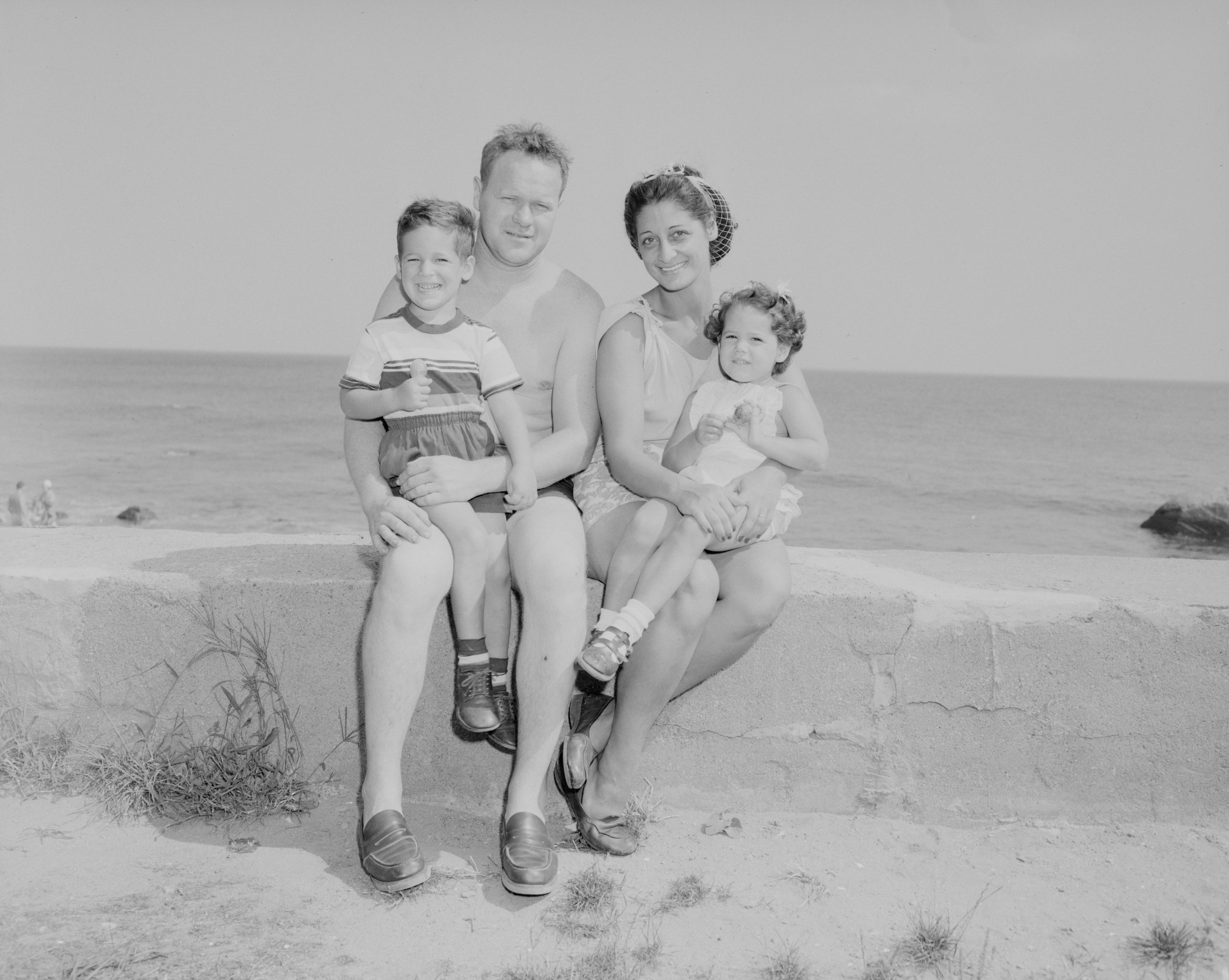
The hairstyles also stood out.
During the 1970s, American hairstyles reflected a wide range of influences.
Long hair remained popular among many men and women.
Layered cuts became fashionable.
Feathered hairstyles gained attention.
Afros were an important expression of style and identity.
And many people experimented with different lengths, textures, and shapes.
Not everyone followed the same trend, of course.
Family photographs often reveal a mixture of fashionable styles and more traditional appearances.
That variety is part of what makes them interesting.
You can sometimes see several generations standing together, each with a different idea of what looked stylish.
The Detail That Made Me Look Twice
After admiring the clothing and hairstyles, I began examining the rest of the photograph.
I looked at the house.
The windows.
The objects people were holding.
And the space around the group.
Everything seemed ordinary.
Then my attention returned to the edge of the picture.
Something in the background looked unusual.
At first, I thought it might be a shadow.
But the longer I looked, the less certain I became.
I couldn’t confidently identify it.
And because the image was old, the faded colors and limited detail made the object even harder to interpret.
I wondered whether I was looking at a reflection.
An ordinary household object.
Or simply an effect created by the camera.
I didn’t know.
That’s when I asked my husband to take a closer look.
“Look at the Background”
My husband studied the photograph.
At first, he didn’t see anything strange.
“It’s just an old family picture,” he said.
“Look near the edge.”
He leaned closer.
Then he paused.
“Wait…”
I watched his expression change.
He had noticed the same area that had caught my attention.
But we couldn’t agree on what we were seeing.
We discussed several possibilities.
Could it be a reflection?
Was part of an object hidden behind someone?
Had the camera captured an unusual angle?
Or was it something perfectly normal for the 1970s that looked unfamiliar today?
Without a clearer view, we couldn’t be certain.
But that didn’t stop us from talking about it.
I Sent the Photograph to Friends
Eventually, I shared the picture with a few friends.
I didn’t tell them exactly where to look.
I simply asked:
“Do you notice anything unusual?”
The responses were entertaining.
Some people immediately focused on the clothing.
Others commented on the hairstyles.
A few examined the background.
One friend insisted that the photograph must have been altered.
But I had no evidence that it had been edited.
Another friend said the supposed mystery might simply be an ordinary object viewed from an unusual angle.
That was entirely possible.
The photograph didn’t provide enough information to settle the disagreement.
Still, it had become an unexpected conversation starter.
Why Old Photographs Can Be So Deceptive
Vintage photographs can be difficult to interpret for several reasons.
Film grain can obscure small details.
Colors may fade or shift over time.
Shadows can make familiar objects appear unusual.
And an object partly hidden behind a person may be difficult to recognize.
The angle of the camera also matters.
Something that looks strange in a still photograph might have appeared completely ordinary to someone standing at the scene.
Modern viewers also bring their own expectations.
When we see something we don’t immediately recognize, we may try to connect it with familiar objects from our own time.
That can lead to mistaken interpretations.
A mysterious-looking detail doesn’t necessarily mean anything mysterious happened.
Sometimes it simply means the photograph lacks enough visual information to identify the object confidently.
What Vintage Photographs Reveal About Everyday Life
The more I looked at the picture, the more I appreciated the ordinary details.
