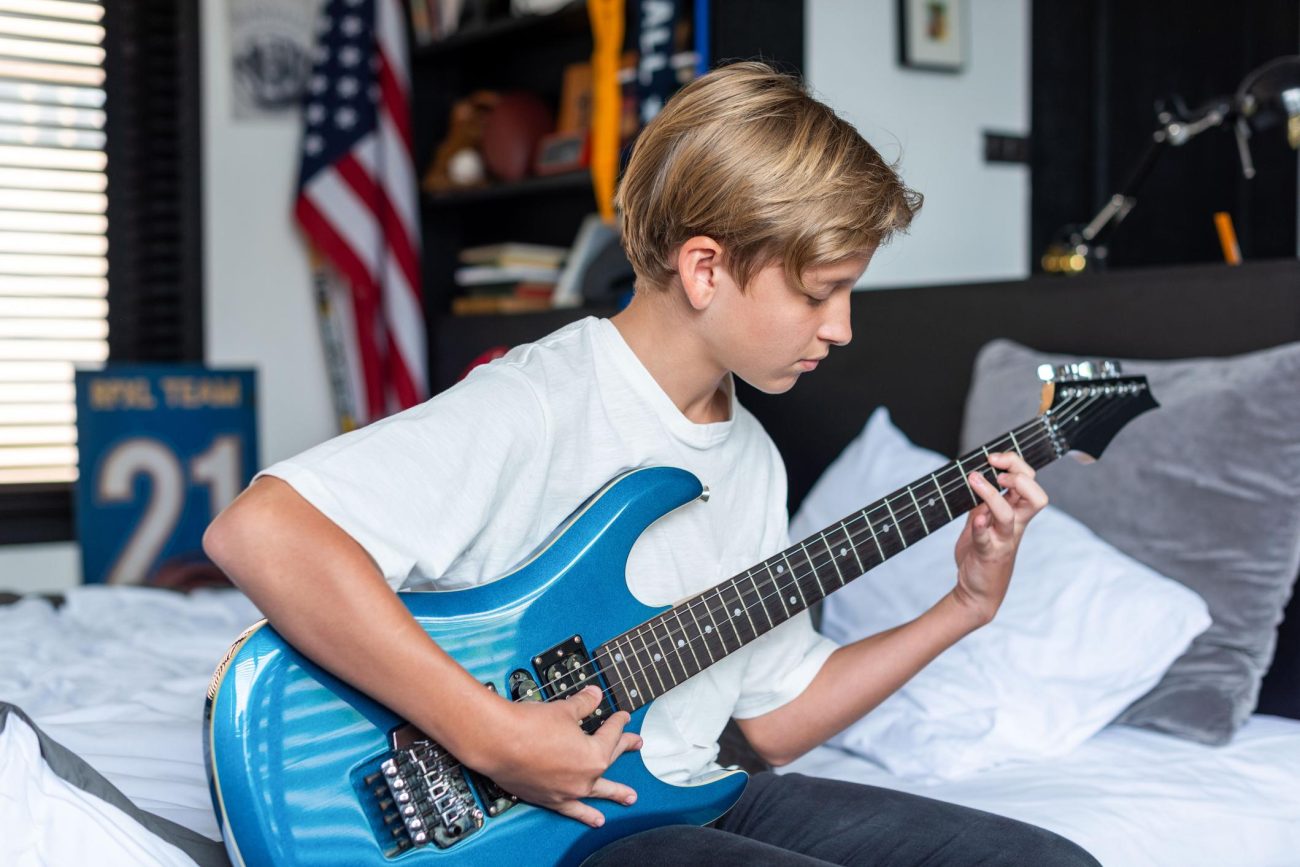
The guitar stand is no longer empty.
Sometimes I hear him repeating the same difficult passage for twenty minutes.
Sometimes he plays quietly.
Sometimes he turns the amplifier up just enough for Mark to shout from the living room.
“Julian, the neighbors don’t need a concert!”
Julian laughs.
Then lowers the volume.
But something about his playing feels different to me now.
I don’t think it’s the sound.
It’s what I know about the person holding the guitar.
My son is still thirteen.
He forgets to take out the trash.
He leaves his shoes in the hallway.
He complains about homework.
He’s an ordinary boy in all the ways that matter.
But when he saw someone struggling, he cared.
And he tried to help.
Even though he didn’t yet understand the best way to do it.
What I Learned From My Son
Before all of this happened, I thought kindness was something parents taught children.
We reminded them to share.
To say thank you.
To include classmates.
To help people who needed assistance.
But Julian taught me something too.
He reminded me how easy it is to become accustomed to other people’s difficulties.
We see someone struggling.
We feel sympathy.
Then we return to our own lives.
Julian didn’t.
He noticed that Maya’s wheelchair was making her school day harder.
He listened when she explained her family’s situation.
And he wanted to do something.
His solution wasn’t perfect.
He needed guidance.
He needed adults to help.
But the compassion behind his decision was real.
And it moved other people to act.
The Morning I Almost Misunderstood Everything
Sometimes I think about that Thursday morning.
The loud knock.
The uniforms.
Julian’s frightened expression.
My own fear that something terrible had happened.
I remember Officer Daniels saying there was more to the story.
And I remember wondering whether my son had made a mistake we couldn’t fix.
In a way, he had made a mistake.
He’d tried to handle a complicated situation alone.
But that mistake became an opportunity for us to teach him something important.
Helping others requires both compassion and judgment.
You can care deeply without sacrificing your own well-being.
You can offer support without assuming you know exactly what someone needs.
And sometimes the most useful thing you can do is bring people together.
The Day Maya Came Over
A few months later, Maya came to our house for a school project.
Julian was helping her prepare a presentation about sound waves.
Naturally, he wanted to demonstrate with his guitar.
I brought them lemonade.
They were sitting at the kitchen table, arguing cheerfully about which notes to use.
Maya looked up.
“Mrs. Vance?”
“Yes, sweetheart?”
“Can I tell you something?”
“Of course.”
She smiled.
“Julian’s a really good friend.”
I looked at my son.
He was pretending to be fascinated by the guitar cable.
“I know,” I said.
Maya continued.
“He didn’t make a big deal about my wheelchair before any of this happened. He just talked to me like everybody else.”
I felt something tighten in my chest.
Because suddenly I understood that the most important thing Julian had given Maya wasn’t the wheelchair.
It was friendship.
The kind that notices when something is wrong.
The kind that listens.
The kind that doesn’t make someone feel different simply because they need help.
The One Thing I Hope Julian Remembers
That evening, after Maya went home, Julian put his guitar back on its stand.
I stood in the doorway.
“Hey, buddy?”
He looked up.
“Yeah?”
“I’m proud of you.”
He smiled.
“You already said that.”
“I know.”
He laughed.
