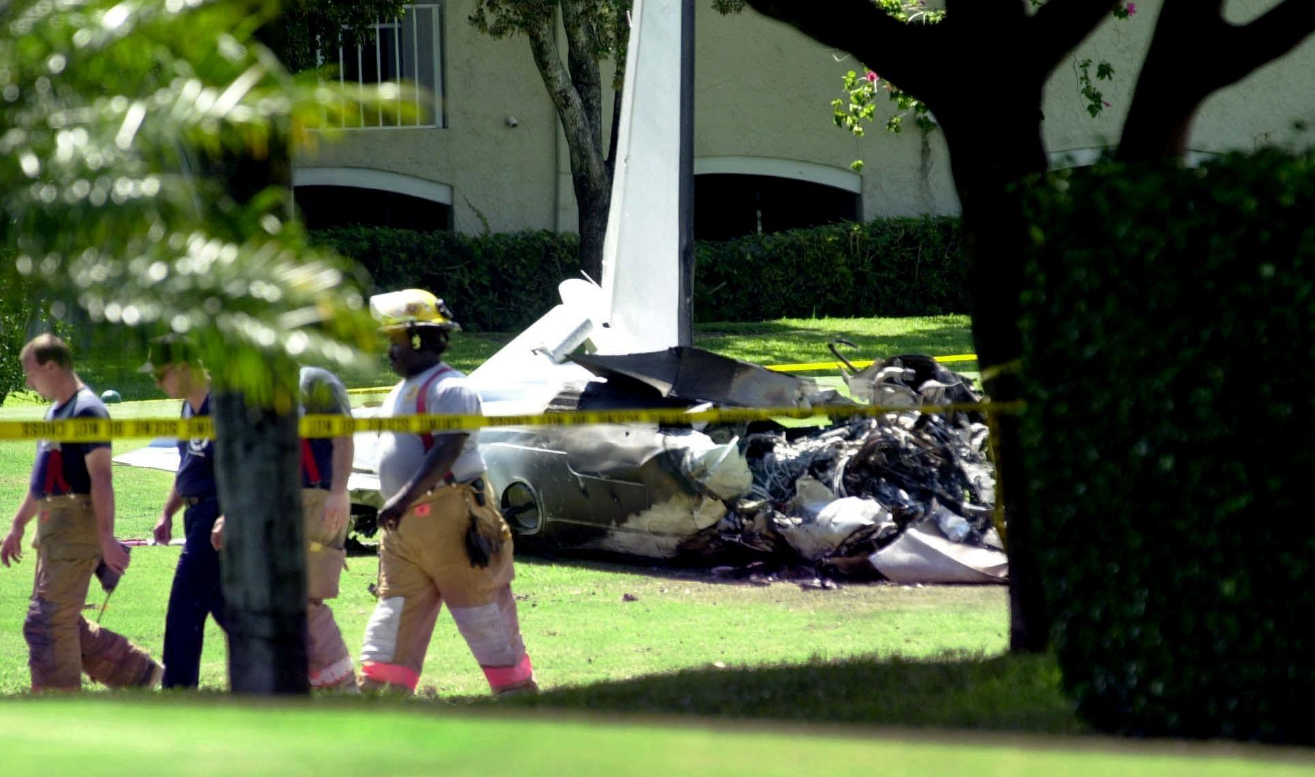
A flight that had been headed toward the Bahamas had ended in tragedy in South Florida.
Residents Witnessed a Terrifying Scene
People near the crash described an enormous impact followed by fire and debris.
Nearby resident Anthony Blackmon said debris struck his home while flames spread across the road.
Emergency crews quickly established a large response area around the wreckage.
Hundreds of residents from a nearby mobile home community were evacuated as authorities worked to secure the site and investigators prepared to examine the debris.
Florida Governor Ron DeSantis said there were no reported injuries on the ground in the immediate aftermath.
Considering that the aircraft crashed in a populated area, the absence of reported ground casualties was significant.
The Crew Had Reported Icing and Turbulence
Attention quickly turned toward the weather conditions the pilots had encountered before the crash.
The crew’s radio communications included reports of icing, precipitation and moderate turbulence.
Those details are important.
However, they do not establish the cause of the accident.
That distinction matters.
Aviation accidents can result from combinations of weather, mechanical conditions, aircraft performance, human factors and other circumstances.
Only investigators can determine which factors actually caused or contributed to this crash.
The Cause Has Not Been Determined
The National Transportation Safety Board is investigating the accident, with assistance from the Federal Aviation Administration.
Investigators will likely examine a wide range of evidence.
That can include the aircraft wreckage, maintenance records, weather information, air traffic control communications, flight-tracking data and the crew’s actions during the emergency.
They will also attempt to reconstruct exactly how the Learjet went from controlled flight to such an extraordinary descent.
Until that investigation progresses, claims that icing, turbulence, mechanical failure or pilot error definitively caused the crash remain premature.
Why the Descent Rate Is So Striking
One of the most disturbing pieces of information from the accident is the speed at which the aircraft lost altitude.
Flightradar24 data showed an extremely rapid descent before the tracking signal disappeared.
At one stage, the descent rate reportedly exceeded 32,000 feet per minute.
That’s far beyond the descent rate passengers would experience during an ordinary approach to an airport.
It also helps explain why the pilots’ radio transmissions became so urgent.
They weren’t dealing with a problem that allowed them unlimited time to work through a checklist.
Altitude was disappearing rapidly.
Every second mattered.
The Controller Refused to Leave Them Alone
The air traffic controller’s words have also attracted attention.
When the pilot warned that the aircraft was going to hit the ground, the controller responded:
“I’m here with you. Talk to me.”
It was a simple response.
But during an emergency in which the controller could do little physically to change what was happening aboard the aircraft, maintaining communication was one of the few forms of assistance available.
The exchange is a reminder that behind aviation accident reports, radar tracks and technical terminology are real people.
There were pilots fighting to save an aircraft.
There was a controller trying to help.
And there were passengers aboard who had begun the day expecting to arrive in the Bahamas.
Investigators Now Face the Hardest Question
Much about the flight’s final moments is already known.
The aircraft departed Texas.
It was traveling toward the Bahamas.
The pilots encountered icing, precipitation and turbulence.
The crew requested a climb.
An emergency developed.
The aircraft entered an extreme descent.
And all nine people aboard died when the Learjet crashed in Florida.
But the most important question remains unanswered:
Why did the aircraft become unrecoverable?
That answer may take time.
The NTSB generally avoids reaching immediate conclusions because aviation investigations require careful examination of evidence.
The final explanation may involve one factor or a combination of several.
Nine Lives Lost in Seconds
For the families of those aboard, however, the technical explanation cannot change what happened.
Nine people boarded a private jet expecting to travel from Texas to the Bahamas.
Instead, their flight ended in a Florida neighborhood.
The final cockpit recordings capture only a few moments of the disaster, but they’re difficult to forget.
A pilot realized the aircraft was descending toward the ground.
A controller tried to keep him talking.
And then came the devastating realization that there was almost nothing left to work with.
“We’re out of time.”
Those words now stand among the final recorded moments of a flight whose cause investigators are still working to understand.
