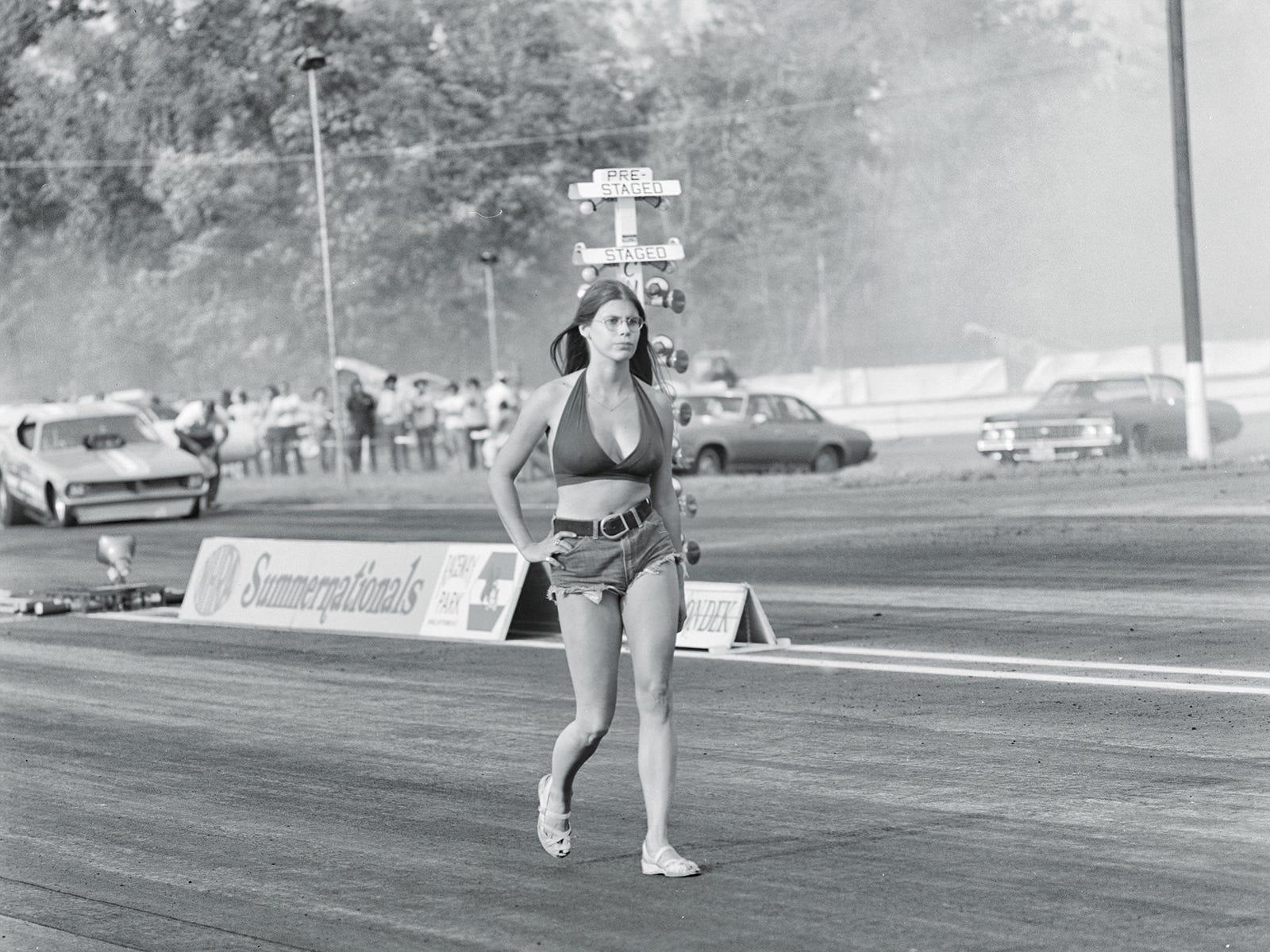
But Jungle Pam occupied a particularly prominent place in the public presentation of a major funny car team.
She became part of what fans remembered about the racing experience.
More Than a Familiar Face at the Track
Jungle Pam’s popularity was closely connected to her appearance and the promotional style of the era.
But her role wasn’t limited to posing for photographs.
She participated in the work surrounding the car and its preparation for racing.
Drag racing required coordination.
The driver depended on the people helping manage the vehicle and the activities around it.
At busy racing events, team members needed to remain attentive and organized.
Hardy’s involvement placed her within that demanding environment.
Her contribution was different from the driver’s, but it was part of the larger operation that fans came to watch.
This combination of participation, personality, and visibility helped make her memorable.
She wasn’t simply someone who appeared in a photograph once.
She became a recognizable presence across the racing circuit.
Life on the Road in the 1970s
Traveling with a racing team offered an unconventional lifestyle.
Events took place in different cities and states.
The schedule required frequent travel.
And life revolved around the demands of the next race.
For Hardy, joining Liberman meant leaving behind the path she had originally imagined.
Instead of a typical college routine, she found herself surrounded by race cars, drivers, mechanics, and crowds of motorsports fans.
The environment was exciting, but it also required commitment.
A racing team couldn’t simply appear at an event and expect everything to happen automatically.
Vehicles needed attention.
Equipment had to be prepared.
Travel plans had to be coordinated.
And the people involved had to adapt to the unpredictable nature of motorsports.
Hardy became part of that world.
Why Fans Remembered Their Partnership
The combination of Jungle Jim and Jungle Pam had a quality that was difficult to reproduce.
Liberman brought his reputation as an exciting driver.
Hardy brought a distinctive energy that complemented the team’s public image.
Together, they represented an era when drag racing personalities could become attractions in their own right.
Fans didn’t necessarily need to know every technical detail of a funny car to enjoy the spectacle.
They could appreciate the excitement of the races.
They could recognize the drivers.
And they could remember the people who made each team stand out.
Jungle Pam became one of those memorable personalities.
Her photographs helped preserve the visual character of the sport during the 1970s.
Even people who weren’t regular racing spectators could recognize the unusual combination of powerful cars, colorful personalities, and trackside glamour.
A Different Era for Women in Motorsports
The 1970s were a period of changing expectations for women in many areas of American life.
Motorsports remained heavily male-dominated, particularly in its most visible competitive roles.
Women who became recognizable figures within the sport often faced different expectations from their male counterparts.
Appearance could attract attention in ways that overshadowed other contributions.
Jungle Pam’s public image reflected some of those attitudes.
She became famous partly because she stood out visually in an environment where few women received comparable attention.
But her continued recognition also shows how strongly she became associated with the history of drag racing.
Her presence was part of the culture surrounding the sport.
And for many fans, remembering Jungle Pam means remembering the atmosphere of racing during that decade.
The Tragedy That Changed Everything
In 1977, Jungle Jim Liberman died in a car accident.
He was only 31 years old.
His death brought a sudden end to one of drag racing’s most recognizable partnerships.
For fans who had followed his career, the news was devastating.
