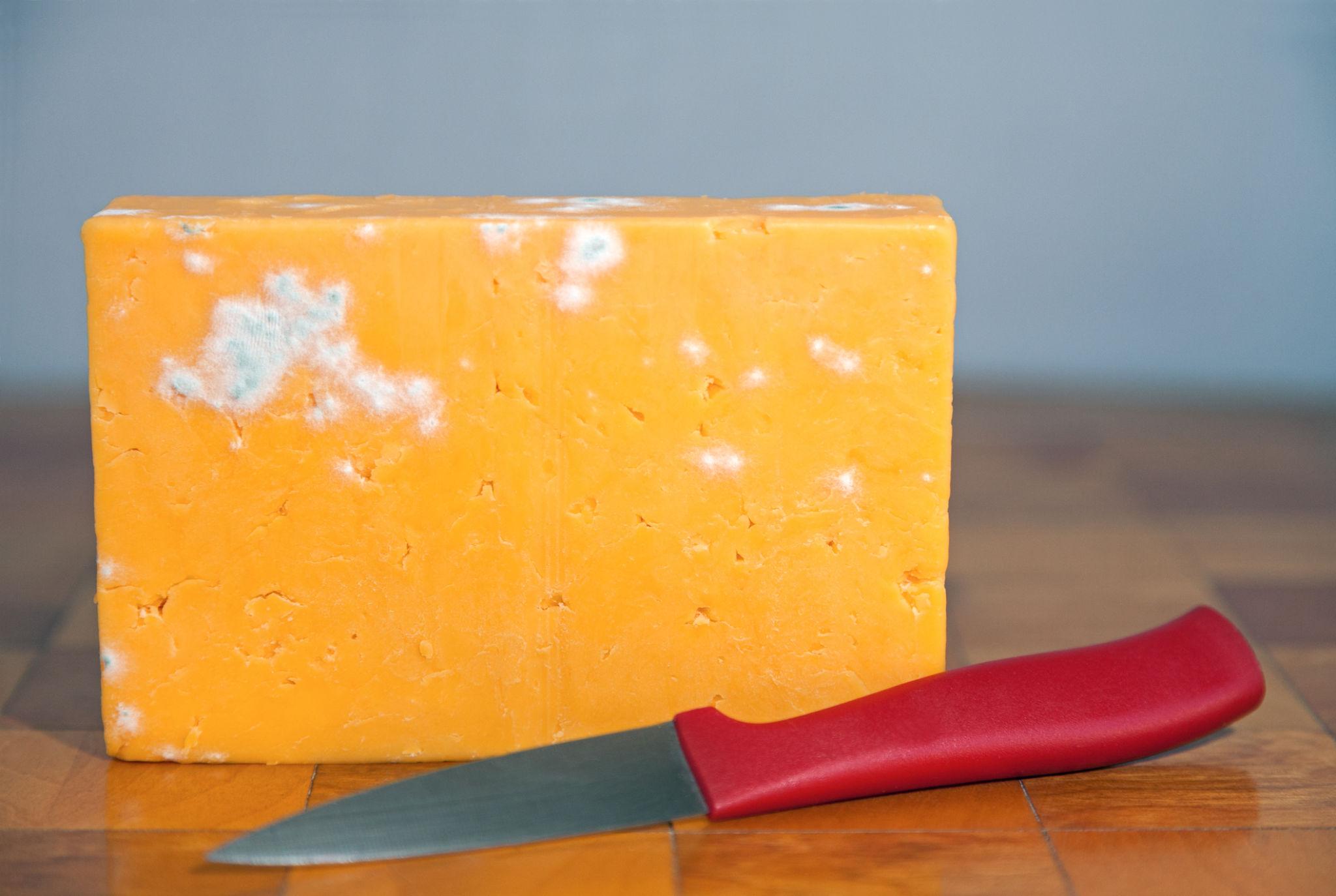
You open the refrigerator, reach for a block of cheddar cheese, and notice something you weren’t expecting.
A small green or blue spot has appeared near the edge.
The rest of the cheese looks perfectly normal.
It still feels firm.
It doesn’t have an unusual smell.
And you may have only purchased it recently.
So what should you do?
Throw away the entire block?
Or simply cut off the moldy section and use the rest?
The answer may surprise you.
According to established food-safety guidance, a small patch of mold on a firm block of cheddar doesn’t always mean the entire piece must be discarded.
But there’s an important catch.
The type of cheese, its texture, and the way it has been prepared can make a major difference.
And using the wrong approach could expose you to contamination that isn’t visible on the surface.
Why Mold Appears on Cheese in the First Place
Mold is a type of fungus that can grow on food under suitable conditions.
Mold spores are common in the environment.
When they reach a food surface with enough moisture and favorable conditions, they may begin growing.
Cheese can provide an environment for certain molds, although different varieties vary significantly in moisture, acidity, salt content, and texture.
That’s why some cheeses develop unwanted mold more easily than others.
Storage conditions also matter.
Exposure to air, moisture, and repeated handling may contribute to spoilage.
For example, opening a package frequently or using an unclean knife can introduce contamination.
But mold doesn’t necessarily mean someone handled the cheese carelessly.
Even properly stored food can eventually spoil.
The important question is what to do once the mold appears.
Not All Mold on Cheese Is the Same
Before deciding whether cheese is safe to eat, it helps to understand that some cheeses are intentionally made using mold.
Blue cheese, Roquefort, Stilton, and Gorgonzola are familiar examples.
Their characteristic blue or greenish veins come from selected mold cultures used during production.
These cultures contribute to the cheeses’ distinctive appearance and flavor.
Other cheeses, including certain varieties of Brie and Camembert, are made with specific surface-ripening cultures.
But that doesn’t mean every mold growing on cheese is safe.
There is a major difference between mold intentionally introduced under controlled production conditions and unexpected mold appearing after purchase.
A random green spot on ordinary cheddar should not be treated as though it were the same as the mold used to make blue cheese.
Can You Cut Mold Off a Block of Cheddar?
For a firm block of cheddar with a small, localized patch of surface mold, established USDA guidance generally allows the affected portion to be removed.
The reason has to do with the cheese’s structure.
Firm, dense cheeses make it more difficult for mold to penetrate deeply than high-moisture, soft cheeses.
However, the visible spot may not represent the full extent of the mold.
The USDA recommends cutting away at least one inch around and below the affected area.
That means removing a generous section, not simply scraping off the colored surface.
The goal is to avoid retaining cheese that may contain mold growth beyond what is visible.
This guidance applies to appropriate hard and firm cheeses, not every product labeled as cheddar.
The One-Inch Rule Explained
If you have a firm block of cheddar with a small moldy spot, the commonly recommended approach is to remove at least one inch, or approximately 2.5 centimeters, around and beneath the mold.
A few precautions matter:
- Use a clean knife.
- Avoid touching the mold with the blade before cutting into the unaffected cheese.
- Remove a generous portion surrounding and beneath the visible growth.
- Keep the removed moldy section separate from the cheese you intend to retain.
- Rewrap the remaining cheese in fresh, suitable packaging and refrigerate it promptly.
This approach is intended for a small, localized area on an otherwise normal firm cheese.
