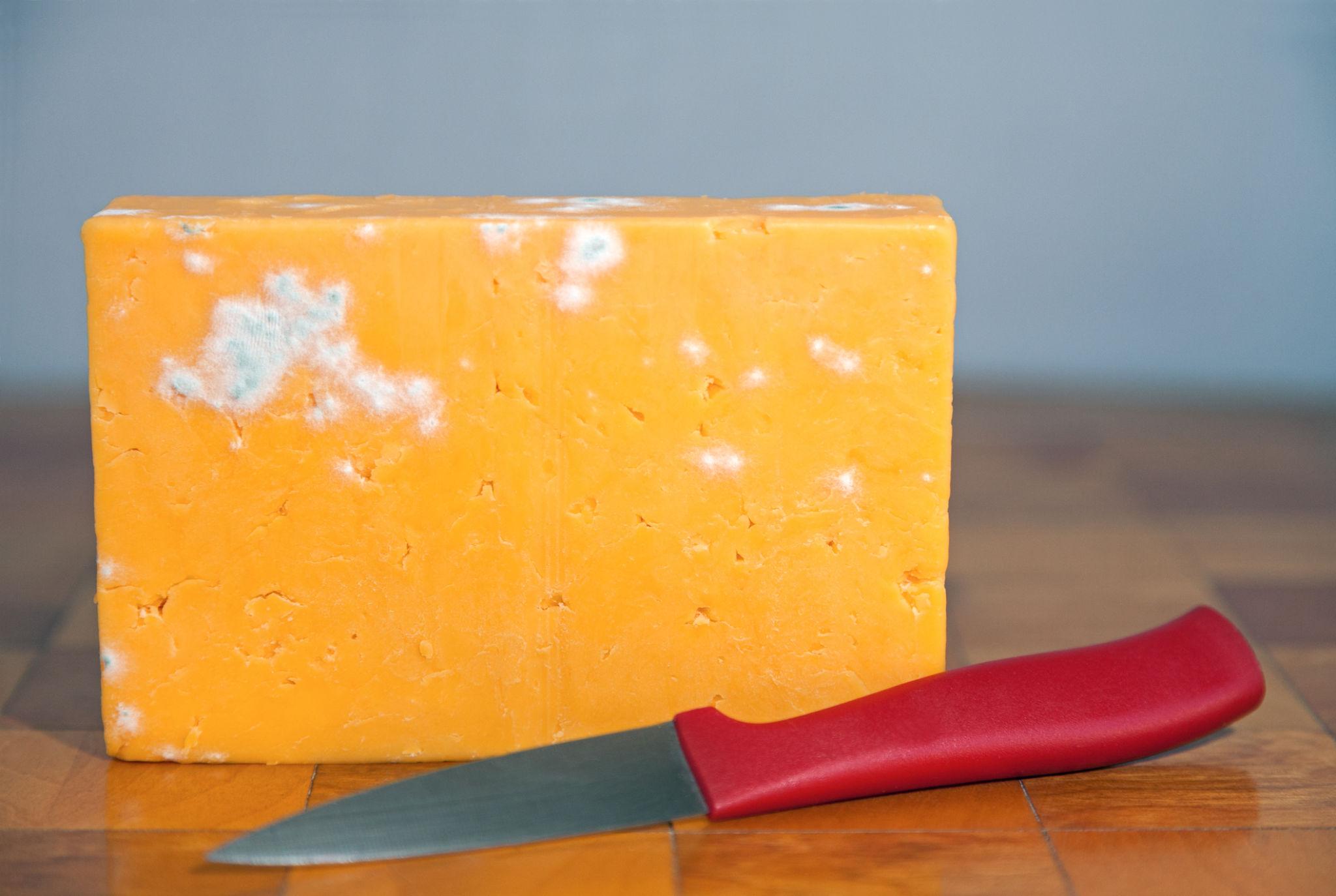
It isn’t a guarantee that every moldy block can be saved.
If mold is widespread, the cheese has become unusually slimy, or there are other signs of deterioration, discarding it is the more cautious choice.
And if you cannot confidently identify the cheese or its condition, don’t take unnecessary risks.
What About Shredded Cheddar?
This is where many people make a mistake.
A solid block of cheddar and a package of shredded cheddar are not treated the same way.
Even though both products may be made from the same type of cheese, their physical forms are different.
Shredded cheese has much more exposed surface area.
Small pieces are also in close contact with one another.
That makes it difficult to remove a moldy section while confidently separating it from the rest of the product.
For this reason, USDA guidance recommends discarding shredded, sliced, or crumbled cheese when unexpected mold appears.
Do not simply remove a few visibly moldy shreds and assume the rest of the bag is safe.
The same caution applies to packaged sliced cheese that has developed unexpected mold.
Why Soft Cheese Is Different
Soft cheeses generally contain more moisture than hard or firm varieties.
Their texture can allow mold and other microorganisms to spread beyond the visible area more readily.
Examples include:
- Cream cheese
- Cottage cheese
- Ricotta
- Fresh mozzarella
- Other high-moisture, soft cheeses
If unexpected mold develops on these products, the safer recommendation is to discard the entire item.
Removing the visible spot is not considered a reliable way to eliminate potential contamination.
This can feel wasteful, especially when the package is nearly full.
But food safety matters more than saving a small amount of cheese.
What About Brie and Camembert?
Brie and Camembert deserve special attention because they are often made with an edible white mold rind.
That rind is an intentional part of the product.
It does not mean the cheese is spoiled.
However, if unexpected mold appears that is not characteristic of the cheese, it should not automatically be considered safe.
The appearance of an intended ripening culture is different from accidental contamination.
If you are unsure whether a particular growth belongs on the cheese, consult the manufacturer’s guidance or discard the product.
Don’t assume that because a cheese normally contains mold, any new mold is harmless.
Can Mold on Cheese Make You Sick?
Some molds are harmless under their intended food-production conditions.
Others can cause spoilage or produce substances that may be harmful.
Certain molds can produce mycotoxins, which are toxic compounds associated with potential health risks.
However, not every mold produces mycotoxins.
And a visible mold spot does not establish whether a particular toxin is present.
There may also be other microorganisms associated with spoiled food.
The problem is that you cannot reliably determine the safety of unexpected mold simply by looking at it.
That is why established food-safety recommendations focus on the type of food and how contamination may spread through it.
Does the Color of Mold Tell You Whether It’s Dangerous?
You might assume that white mold is harmless while green or black mold is dangerous.
But color alone is not a dependable way to judge food safety.
Different molds can produce similar colors.
And the same type of mold may appear different depending on its growth conditions.
Green, blue, white, or dark spots are not enough to identify a mold species.
Without laboratory analysis, it is generally not possible to determine exactly what is growing on the cheese.
That doesn’t mean every colored spot represents a serious health threat.
It means visual appearance alone cannot confirm that the cheese is safe.
What If the Cheese Smells Fine?
One of the most common mistakes people make with questionable food is relying entirely on smell.
