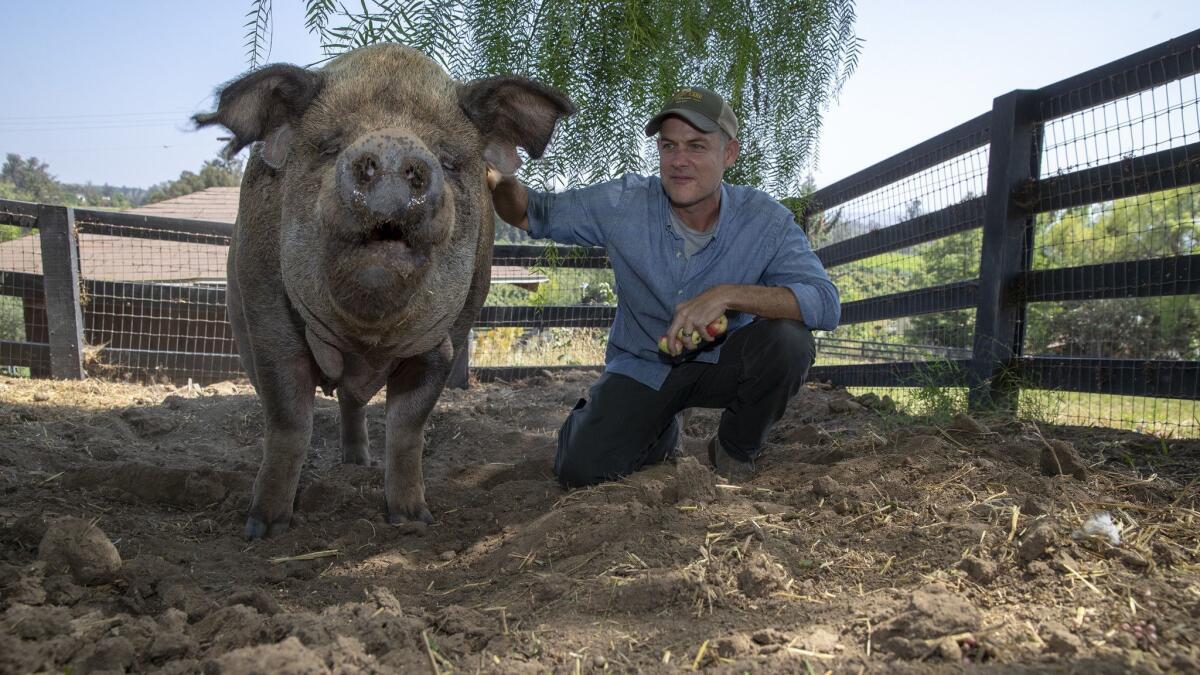
When Emma arrived at a California farm, she was already in poor condition.
She was thin, weak, pregnant, and facing an uncertain future.
The farmers hoped she could recover in her new surroundings. But they had no idea how difficult the coming weeks would become.
Then Emma went into labor.
The farmers had expected a relatively small litter.
Instead, one piglet arrived, followed by another.
And another.
By the time the birth was over, Emma had delivered an astonishing 17 piglets.
What should have been a joyful beginning quickly became a frightening struggle.
Emma developed a dangerously high fever. She was exhausted, unable to care properly for her babies, and growing weaker.
The farmers faced a difficult decision.
They separated the piglets from their mother, hoping the break would give Emma a chance to recover.
But her condition didn’t improve as they had hoped.
Eventually, they decided to bring the babies back.
And what happened next became one of the most memorable stories from Apricot Lane Farms.
A New Beginning at Apricot Lane Farms
Emma’s story unfolded at Apricot Lane Farms in California, where filmmaker John Chester and his wife, Molly, were working to create a farm based on regenerative agricultural practices.
Their journey had begun with a dream of living closer to nature.
They wanted to build a farm where plants, animals, and the surrounding ecosystem could work together.
But turning that dream into reality wasn’t simple.
Farming brought challenges they couldn’t always predict.
There were problems with the soil, water, crops, wildlife, and animal health.
Each difficulty forced the couple to learn something new.
Among the animals that eventually became part of their lives was Emma.
She wasn’t a healthy young animal arriving under ideal circumstances.
She needed care.
And before long, she would test everything the farmers were learning about responsibility and compassion.
A Mother Already Facing Difficult Odds
Emma arrived pregnant and in fragile health.
According to accounts of her story, she had been expected to deliver only around six piglets.
That estimate made what happened next even more surprising.
Her labor resulted in 17 babies.
For a healthy mother, caring for a large litter would already be demanding.
For Emma, whose physical condition was poor before giving birth, the challenge was especially serious.
Her body had to recover from labor while also meeting the needs of her newborns.
And almost immediately, the farmers realized something was wrong.
Seventeen Piglets — and a Dangerous Fever
After delivering her enormous litter, Emma became seriously ill.
Her temperature rose dangerously high.
The situation alarmed John Chester and the people helping care for her.
Emma was struggling, and her newborn piglets depended on her.
The farmers had to think about both the mother’s health and the babies’ survival.
They worked to reduce her fever and provide care.
But the problem extended beyond her temperature.
Emma also needed to regain her strength and begin eating.
Without adequate nourishment and recovery, her condition could become fatal.
The birth of 17 piglets had turned into an emergency.
The Decision to Separate Mother and Babies
With Emma so weak, the farmers made a difficult choice.
They removed her piglets temporarily.
The hope was that Emma would be able to rest without the additional physical demands of nursing.
At the same time, the newborns needed to be protected and fed.
It was a practical decision made during a crisis.
But separating a mother from her newborns also changed the situation inside the barn.
Emma no longer had her babies beside her.
And the improvement the farmers hoped for did not come.
Despite their efforts, she continued to struggle.
When Every Attempt Seemed to Fail
The people caring for Emma faced growing uncertainty.
