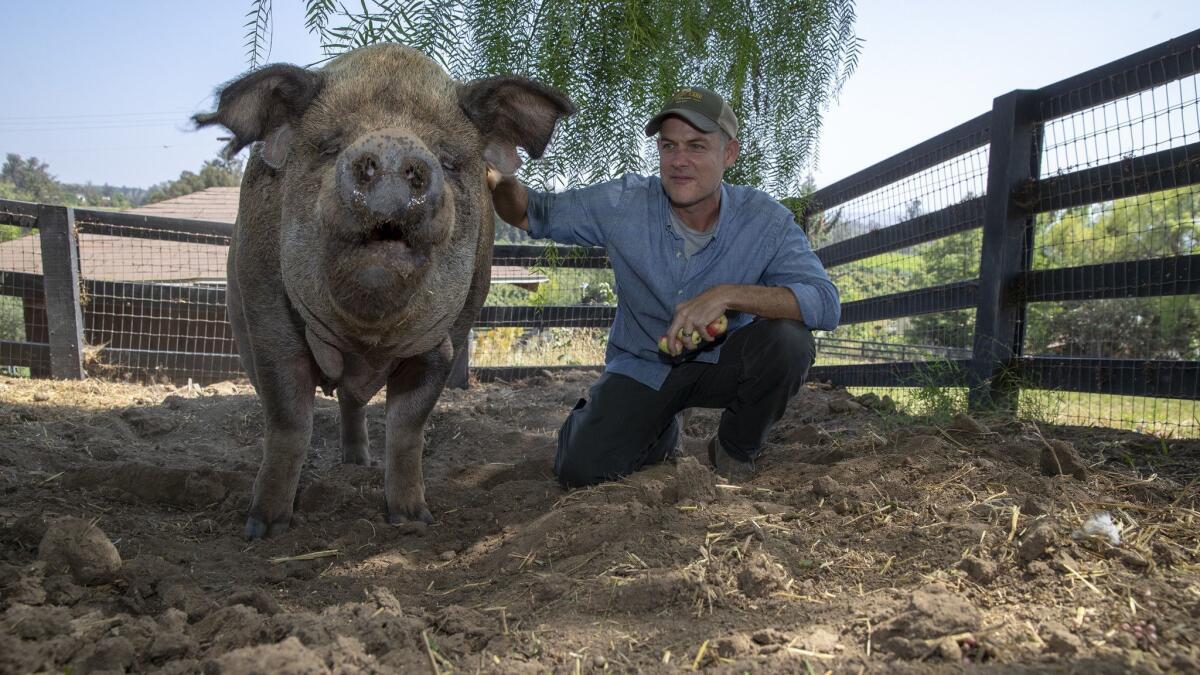
Her fever was a serious concern.
Her lack of appetite made the situation more alarming.
And the longer she remained weak, the more difficult her recovery seemed.
John Chester later described the experience as one of the emotionally demanding moments of life on the farm.
The team was trying to do what was best for Emma.
But the results were discouraging.
They had taken away the piglets to reduce the strain on her body.
Now they began considering whether the separation itself might be affecting her.
They couldn’t know exactly what would happen if they reversed their decision.
But they decided to try.
The Moment Her Piglets Came Back
The farmers returned the piglets to Emma.
The tiny animals were reunited with their mother after a frightening separation.
For John Chester, what followed was extraordinary.
Emma began showing signs of improvement.
Her condition, which had seemed increasingly hopeless, started to change.
Over time, she regained enough strength to eat and care for her babies.
The recovery was remarkable to the people who had watched her struggle.
It also left Chester thinking deeply about the bond between a mother and her young.
He believed that being reunited with her piglets had played an important part in Emma’s renewed determination.
The experience became one of the most powerful stories he would tell about the farm.
Did Her Babies Really Save Her?
Emma’s recovery raises a fascinating question.
Did the presence of her piglets help her survive?
John Chester believed their reunion was important.
He saw a connection between Emma’s return to her babies and her improvement.
But it’s important to distinguish that observation from a proven medical explanation.
Emma had also received care during her illness.
Her recovery cannot be scientifically attributed to maternal instinct alone based on the story.
What is documented is that the farmers returned the piglets and subsequently observed a significant improvement.
For Chester, the experience demonstrated how meaningful relationships between animals can be.
For viewers, it became a moving example of the connection between a mother and her young.
Emma Became More Than Just Another Farm Animal
As Emma recovered, her story took on special significance.
She was no longer simply one of the animals living at Apricot Lane Farms.
She had become an unforgettable part of the farm’s history.
The farmers had watched her survive a difficult birth and a dangerous illness.
They had worried about losing her.
And they had experienced the relief of seeing her recover.
Those moments helped shape their understanding of animal care.
Emma’s story also challenged the idea that farming is only about production and efficiency.
For John and Molly Chester, the animals became individuals whose behavior, health, and relationships mattered.
The Story Reached Audiences Around the World
Emma’s experience eventually became part of the larger story of Apricot Lane Farms.
John Chester directed the documentary The Biggest Little Farm, which followed the couple’s efforts to establish their farm.
The film introduced audiences to the challenges of regenerative farming and the many animals that became part of the property.
Emma was among its most memorable characters.
Her story also inspired Chester’s children’s picture book, Saving Emma the Pig, illustrated by Jennifer L. Meyer.
Published in 2019, the book retold the experience for younger readers.
It presented Emma’s struggle and recovery as a story about compassion, care, and connection.
The book helped bring her experience to families who might never have visited a farm.
What Emma’s Story Says About Caring for Animals
Emma’s experience is emotional, but it also offers a practical reminder.
Animals depend on attentive care, especially during pregnancy, birth, and illness.
