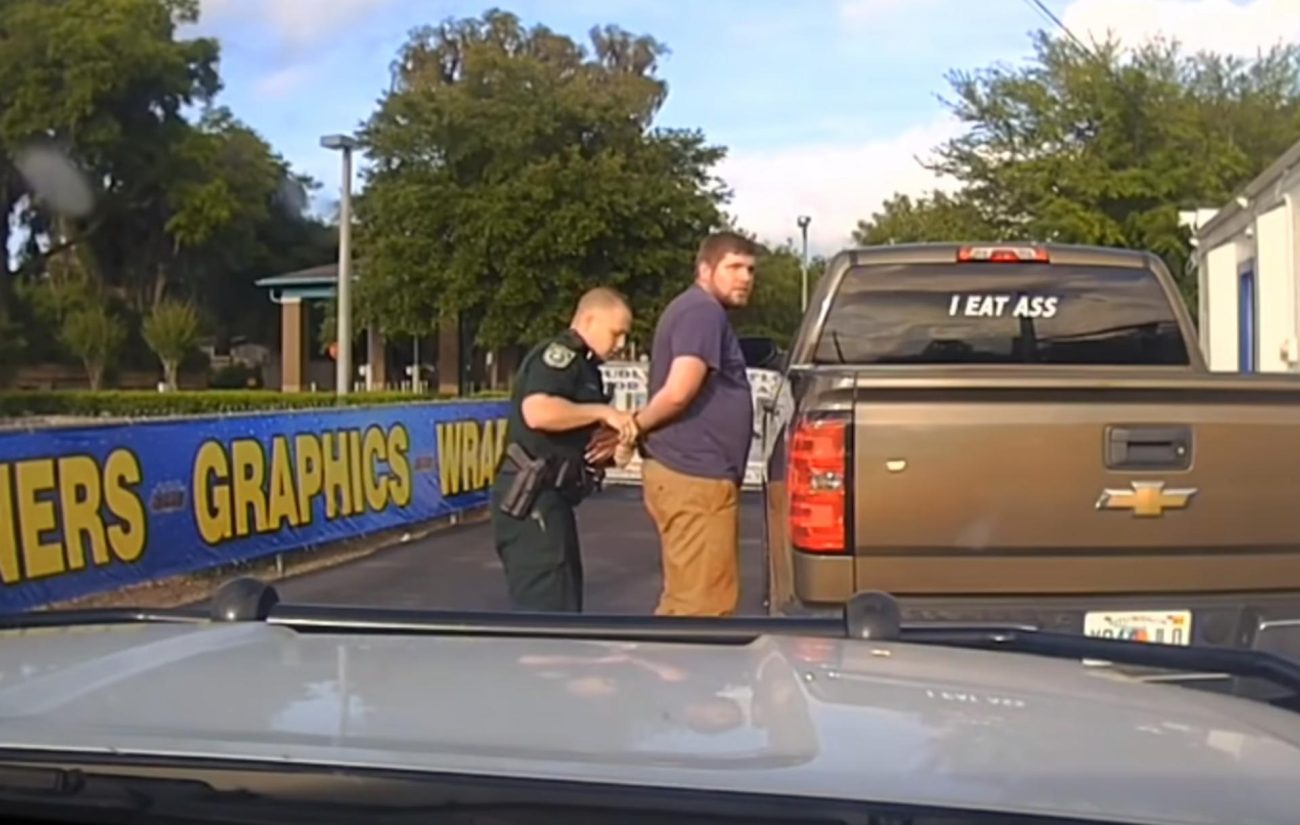
It was an ordinary Sunday afternoon in Florida when a 23-year-old man found himself in a situation that would eventually attract national attention.
Dillon Shane Webb was driving his Chevrolet pickup truck through Columbia County on May 5, 2019, when a sheriff’s deputy noticed something written across the vehicle’s rear window.
The decal contained just three words.
“I EAT ASS.”
The message was crude, provocative, and clearly intended to get attention.
But was it illegal?
That question turned a routine traffic stop into an arrest, a constitutional debate, and eventually a federal lawsuit.
The deputy believed the sticker violated Florida’s obscenity law.
Webb disagreed.
When the officer asked him to alter the decal, Webb refused, arguing that the First Amendment protected his right to display it.
Minutes later, he was in handcuffs.
Four days afterward, prosecutors dropped the charges.
But the dispute didn’t end there.
What began with three words on a truck window became a legal battle over the limits of free speech and the authority of police officers to enforce obscenity laws.
The Sticker That Started Everything
On May 5, 2019, Webb was driving near Lake City, Florida.
He was 23 years old and had a large white-lettered decal displayed on the rear window of his Chevrolet pickup.
The message was impossible to miss.
Deputy Travis English of the Columbia County Sheriff’s Office spotted the decal while stopped behind Webb at a traffic light.
English believed the words were obscene under Florida law.
He initiated a traffic stop.
According to reports and the later federal court record, the deputy told Webb that the sticker was the reason he’d been pulled over.
Webb didn’t agree that displaying the words was a crime.
He viewed the decal as a joke and maintained that he had a constitutional right to display it.
The two men soon found themselves arguing about the difference between offensive language and unlawful obscenity.
That distinction would become central to everything that followed.
The Deputy Asked About Children Seeing the Message
During the stop, Deputy English raised a concern about children who might see the sticker.
What would happen, he asked, if a young child sitting in another vehicle read the words and asked a parent what they meant?
Webb didn’t believe that possibility justified removing the decal.
According to the arrest report, he responded that explaining the message would be the parent’s responsibility.
The disagreement reflected two competing views.
The deputy considered the words inappropriate for public display.
Webb considered them protected expression, even if some people found them offensive.
Neither disputed that the sticker was vulgar.
The disagreement concerned whether its vulgarity was enough to justify government action.
Under American constitutional law, that is an important distinction.
Speech can be offensive without necessarily being legally obscene.
What Florida’s Obscenity Law Actually Says
Florida Statute 847.011 addresses certain obscene materials, including stickers and decals attached to motor vehicles.
But the legal definition of obscenity is narrower than simply using language that people find unpleasant.
Under the standards reflected in Florida law and established Supreme Court precedent, the legal analysis considers whether material appeals to a prurient interest, depicts or describes sexual conduct in a patently offensive manner, and lacks serious literary, artistic, political, or scientific value when considered as a whole.
The distinction matters because the First Amendment protects a wide range of expression that may offend others.
A crude joke is not automatically a criminal offense.
At the same time, not every sexually explicit expression is necessarily protected in every context.
The law requires a more specific analysis than simply asking whether someone dislikes the words.
