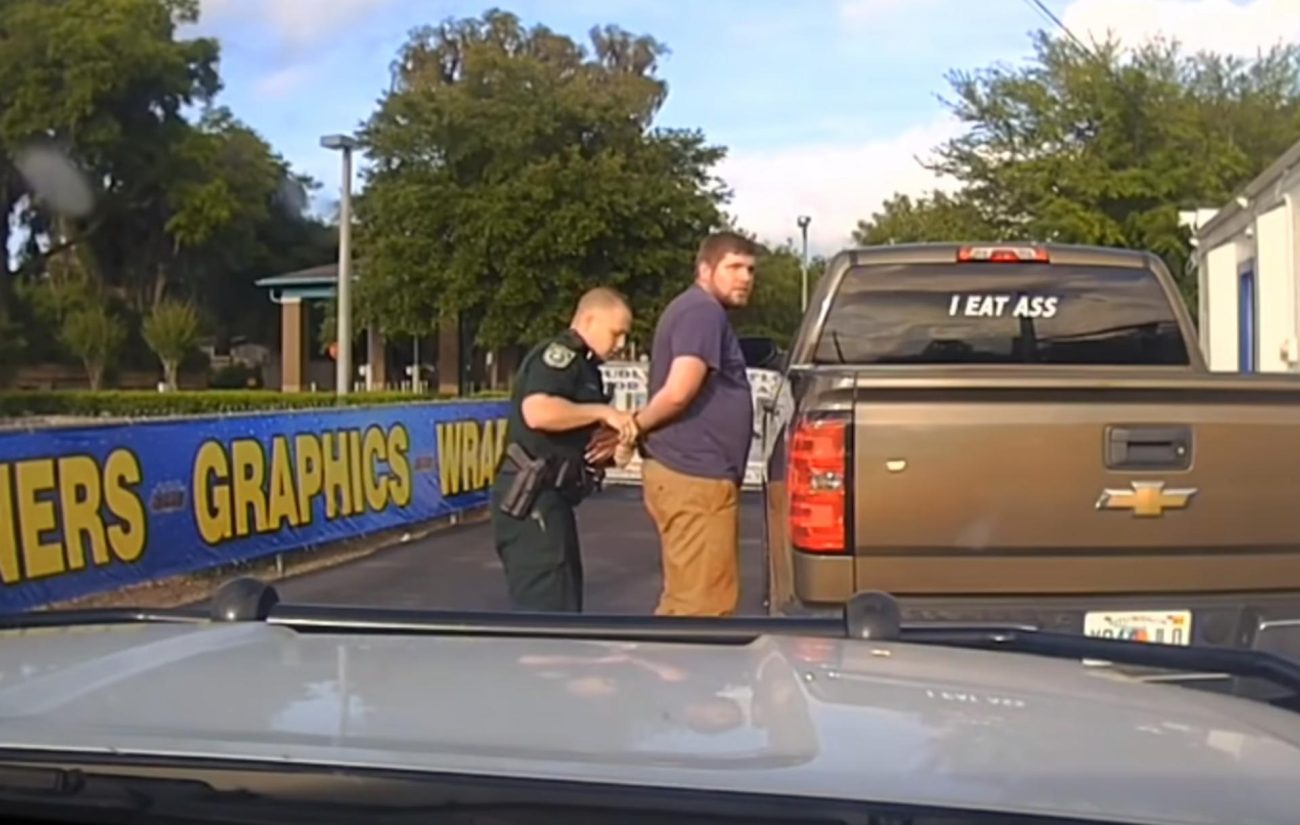
In Webb’s case, the deputy believed the decal crossed the legal line.
Webb believed the officer was treating personal offense as a reason for arrest.
The Moment Webb Refused to Change the Sticker
The deputy initially issued Webb a notice to appear in court on an obscenity allegation.
He then asked Webb to alter the decal by removing one of its letters.
That change would have modified the message.
Webb refused.
He argued that he was exercising his First Amendment rights and should not be required to change the sticker simply because an officer objected to it.
The deputy subsequently arrested him.
Webb faced misdemeanor allegations involving obscene material and resisting an officer without violence.
The resisting allegation was connected to his refusal to comply with the demand to alter the sticker.
Webb was handcuffed and taken into custody.
His truck was removed from the scene.
The disagreement over a few words on a rear window had become a criminal matter.
A Trip to Jail Over Three Words
After the arrest, Webb was taken to the Columbia County jail.
He was booked and later released after posting a $2,500 bond.
The incident quickly attracted attention.
Photographs of the decal circulated online.
News organizations reported on the arrest.
Some people found the situation absurd.
Others considered the message unnecessarily vulgar and sympathized with the deputy’s concerns.
But a central question kept returning.
Should someone be arrested for displaying words that are offensive but may be constitutionally protected?
For Webb, the issue was about more than the sticker.
He believed police officers shouldn’t be able to punish people merely for refusing to change speech they disliked.
That argument would become the foundation of his legal challenge.
The Charges Were Dropped Four Days Later
On May 9, 2019, the State Attorney’s Office decided not to prosecute Webb.
The decision came just four days after the traffic stop.
Prosecutors concluded that Webb had a viable First Amendment defense and that a jury would not convict him under the circumstances.
Both the obscenity allegation and the resisting allegation were dropped.
The decision was significant.
It meant Webb would not face a criminal trial over the sticker.
It also showed that prosecutors did not believe the case could be successfully pursued.
But the dismissal of criminal charges did not automatically establish that every action taken by the officers was unconstitutional.
That issue would become part of a separate federal civil lawsuit.
Why the First Amendment Became Central to the Case
The First Amendment protects freedom of speech from many forms of government interference.
Its protections are not limited to polite, popular, or widely accepted opinions.
Some of the most important free speech disputes involve expression that people find offensive.
In 1971, the United States Supreme Court decided Cohen v. California, a case involving a jacket bearing a profane political message.
The ruling became an important example of the principle that offensive language can receive constitutional protection.
But the legal rules surrounding obscenity are different from the rules governing ordinary profanity.
Courts have long recognized that certain legally obscene material can fall outside First Amendment protection.
Determining whether material qualifies as obscene requires applying established legal standards.
That was one of the difficult questions raised by Webb’s sticker.
Was it merely a vulgar joke?
Or could officers reasonably believe that it violated the state’s obscenity statute?
The criminal prosecutors declined to pursue the case.
The later civil litigation examined additional questions about the officers’ conduct and legal protections.
Webb Decided to Sue
After the charges were dismissed, Webb pursued a federal lawsuit.
He alleged that his constitutional rights had been violated during the traffic stop and arrest.
