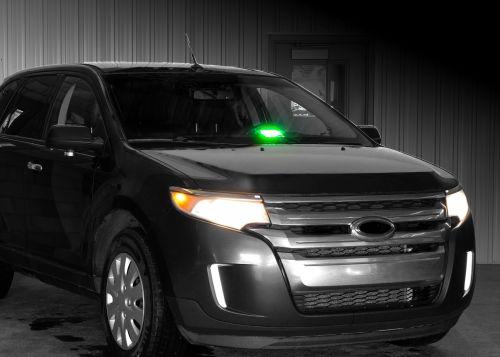
Their permitted use and the obligations of surrounding drivers depend on state law and sometimes additional local rules.
That made me wonder whether I had actually broken a traffic rule.
I Asked Other Drivers What They Knew
I decided to post about the experience in a local community group.
I explained that a dark SUV with green flashing lights had approached from behind.
I said I hadn’t recognized the lights.
And I described the warning I received from the officer.
Within minutes, people began commenting.
One person wrote:
“That’s probably a volunteer firefighter. You should let them through when it’s safe.”
Another disagreed.
“In some states, those are courtesy lights. They don’t automatically give the driver the right-of-way.”
Someone else explained that a volunteer firefighter in their neighborhood used green lights on a personal vehicle when responding to emergencies.
I kept reading.
Then one comment caught my attention.
“What state did this happen in? The laws aren’t the same everywhere.”
That was the first response that made me realize how important the location was.
One Question Changed the Discussion
I explained where the stop had occurred.
Then another commenter asked:
“Did the SUV have any markings? A fire department decal? A volunteer responder sign?”
I thought about it.
I remembered seeing something small on the rear window.
But I hadn’t been close enough to identify it.
Then I remembered something.
My dashcam.
I had recorded the entire drive.
I went outside, retrieved the footage, and watched it on my computer.
And that’s when I noticed the detail I’d missed.
The Dashcam Revealed Something Important
The footage showed the dark SUV approaching from behind.
Two green lights were visible near its windshield.
The vehicle followed me for a short distance.
There was no audible siren in the recording.
It didn’t appear to be a marked ambulance or police cruiser.
Then I paused the video.
On the rear window was a small decal.
I zoomed in.
It appeared to identify the driver as a volunteer emergency responder.
Possibly a volunteer firefighter.
Suddenly, the lights made more sense.
But the footage also raised another question.
If the SUV was a volunteer firefighter’s personal vehicle, was I legally required to yield?
Or were the green lights simply asking other drivers to make room when it was safe?
Those are two different things.
And I wanted to understand the distinction.
What Green Flashing Lights Can Mean
In parts of the United States, volunteer firefighters and certain other emergency responders may be authorized to display special warning lights on their personal vehicles.
The permitted colors vary by jurisdiction.
Depending on the state, authorized lights may include green, blue, red, white, or combinations of colors.
Some laws treat particular lights as a request for courtesy from surrounding drivers.
Other laws establish specific privileges or obligations under defined circumstances.
And in some places, green lights may be reserved for entirely different authorized uses.
That’s why it’s risky to assume that green lights always mean the same thing.
The legal status of the vehicle matters.
The applicable state law matters.
And the circumstances of the encounter matter.
A flashing light alone doesn’t necessarily tell another driver everything they need to know about right-of-way.
Courtesy Lights and Legal Right-of-Way Aren’t Always the Same
This was the most important distinction I discovered.
A courtesy light may be intended to alert surrounding drivers that someone is responding to an emergency.
It can encourage motorists to make room when doing so is safe.
But depending on the jurisdiction, it may not grant the driver the same traffic privileges as an authorized emergency vehicle operating under the conditions specified by law.
