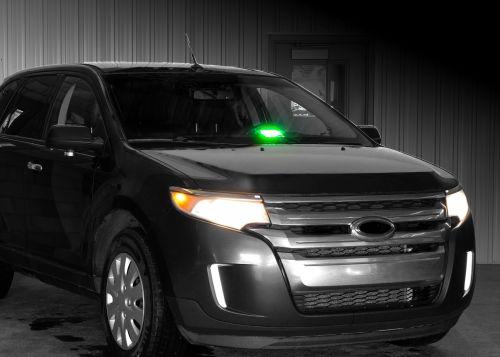
She explained that the purpose was to alert surrounding drivers.
Not frighten them.
I thought about that for a long time.
Emergency responders perform important work.
And volunteer firefighters often give up their own time to help people in dangerous situations.
I respected that.
But I also believed that road safety depended on clear rules and predictable behavior.
Nobody benefits when a driver panics.
What I Wish the Officer Had Explained
The part that frustrated me most wasn’t being stopped.
Police officers can stop drivers for legitimate traffic concerns.
And if I had violated a law, I wanted to understand it.
What bothered me was that I left the encounter without knowing what the green lights meant.
The officer had told me to move over.
But he hadn’t explained the type of vehicle involved.
He hadn’t identified the specific rule.
And he hadn’t clarified whether the lights created a legal obligation or simply signaled a request for courtesy.
That information would have made the stop far more useful.
Instead, I went home confused.
And I had to research the issue myself.
What the Records Told Me
A few days later, I received information relating to the traffic stop.
I compared it with the applicable traffic regulations.
I still couldn’t establish with certainty whether the original officer had made a mistake.
The circumstances and precise legal requirements were not clear enough for me to reach that conclusion.
But I had learned something important.
Not every flashing light has the same legal meaning.
And a vehicle’s right-of-way cannot always be determined by color alone.
That was information I wished I’d known before the incident.
What Drivers Should Do When They See Unfamiliar Warning Lights
After everything that happened, I began thinking about how I would respond if I encountered a similar situation again.
I wouldn’t ignore the vehicle.
But I also wouldn’t make a sudden movement simply because I felt pressured.
The safer approach is to stay calm, observe the traffic around you, and follow the applicable laws.
A few general principles are worth remembering:
- Stay alert. Unusual warning lights may indicate an authorized responder or another situation requiring attention.
- Avoid sudden maneuvers. Don’t swerve, brake unpredictably, or enter an intersection unsafely.
- Check your surroundings. Look for pedestrians, cyclists, other vehicles, and a safe place to move if necessary.
- Follow state law. The meaning of warning lights and the obligation to yield vary by jurisdiction.
- Make room safely when appropriate. If a responder needs to pass, cooperate when it is safe and lawful to do so.
If you’re unsure what a particular light color means where you live, your state’s official driver handbook and motor vehicle laws are better sources than social media comments.
I Shared One Final Update
A few days later, I returned to the community group one last time.
I thanked everyone who had explained the possible meaning of the green lights.
Then I wrote:
“I understand now that some volunteer emergency responders use green warning lights, but the rules depend on where you live. I have no problem making room when it’s safe. I just wish the officer had explained what I was supposed to do.”
The response was mostly supportive.
One person summarized the issue in a way that made sense to me.
“People can’t follow a rule they don’t understand if nobody explains what it is.”
I agreed.
I wasn’t intentionally refusing to help anyone.
I simply hadn’t recognized the vehicle.
And now I knew enough to respond more thoughtfully if I encountered something similar again.
The Lesson I Took From That Traffic Stop
I’ve driven for years.
I’ve seen police cruisers, ambulances, fire trucks, and roadside assistance vehicles.
But until that day, I’d never knowingly encountered a personal vehicle displaying green warning lights.
I didn’t understand what they meant.
And the police stop left me with more questions than answers.
After reviewing my dashcam footage, reading official regulations, and contacting the department, I learned that green lights can have different meanings in different jurisdictions.
They may be associated with volunteer emergency responders in some places.
But they do not automatically establish the same right-of-way rules everywhere.
The experience changed how I think about unfamiliar warning lights.
I’ll pay attention.
I’ll make room when it’s safe and required or appropriate.
And I won’t assume that every unusual light means exactly the same thing.
Because safe driving isn’t just about reacting to flashing lights. It’s about understanding the rules, staying calm, and making decisions that protect everyone on the road.
And I still believe that a clear explanation from the officer would have made the entire experience much more useful.
