His show aired during a period of significant social change in the United States.
Debates over women’s employment, marriage, divorce, reproductive freedom, and equality were reshaping American life.
Donahue gave these subjects substantial attention.
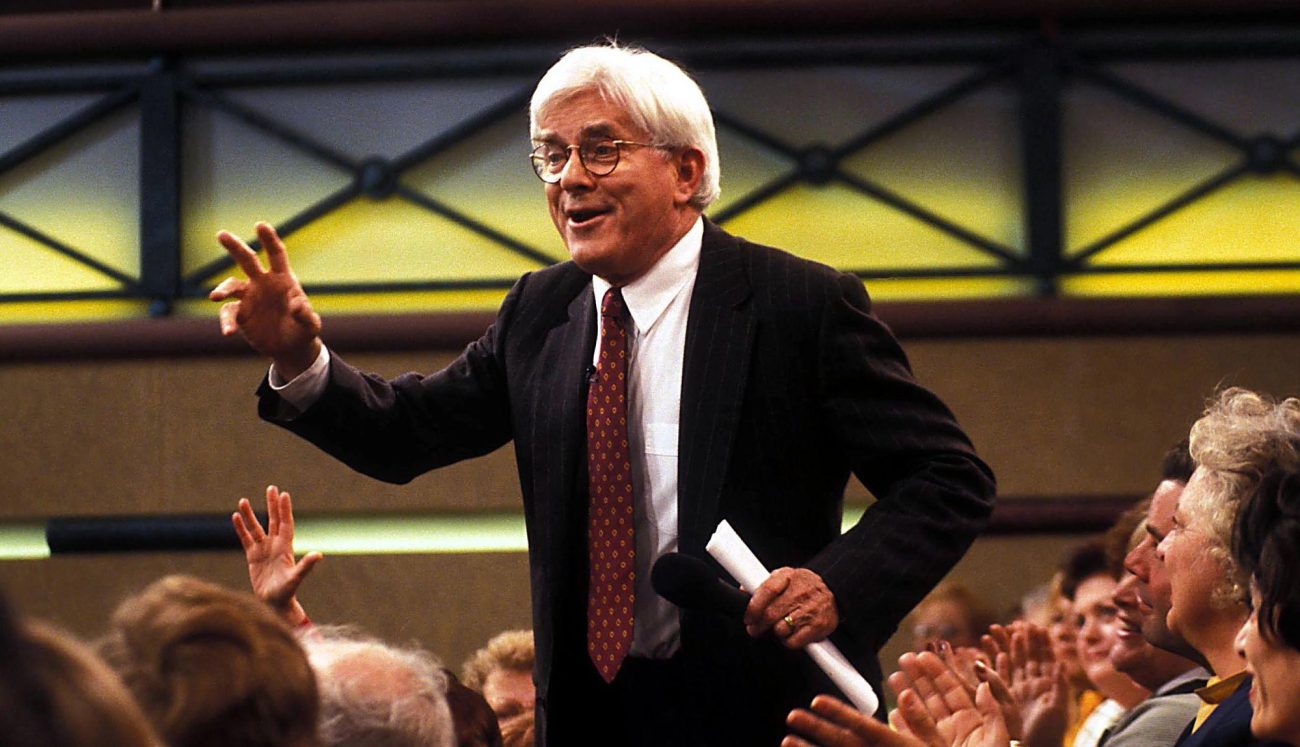
Women in the studio audience were encouraged to ask questions and express opinions.
Their experiences weren’t treated merely as background to discussions led by public officials or celebrities.
They became part of the conversation itself.
For viewers who spent much of their day at home, the show could provide exposure to debates taking place far beyond their immediate communities.
It offered an opportunity to hear women challenge traditional expectations and describe experiences that had often been overlooked.
Donahue’s approach helped demonstrate that daytime television could address serious social issues without abandoning its audience.
Ordinary People Became Part of the Story
Celebrity interviews were never the only attraction of Donahue’s program.
One of its defining qualities was the attention given to ordinary people.
A guest didn’t need to be famous to have something important to say.
A person dealing with discrimination, illness, family conflict, or social pressure could become the center of a national discussion.
That was a meaningful shift.
Television had long been dominated by recognizable personalities and established authorities.
Donahue helped make room for people whose stories might otherwise remain private.
Their experiences could challenge stereotypes.
They could reveal problems that viewers had never considered.
And they could remind audiences that public debates were not merely abstract arguments.
They affected real families and real lives.
The show’s format made those consequences difficult to ignore.
The Art of Asking an Uncomfortable Question
Donahue’s interviewing style was direct.
He was curious, energetic, and often willing to ask questions that created tension.
But asking a difficult question was only part of his method.
The other part was allowing the answer to unfold.
He understood that a revealing conversation sometimes required patience.
A guest might hesitate.
An audience member might struggle to explain a personal experience.
A disagreement might become more complicated after someone introduced a new perspective.
Donahue was not a neutral presence in every discussion, and critics sometimes challenged his approach.
But he helped popularize a form of television in which the host’s job involved more than delivering prepared questions.
It involved responding to what people actually said.
That distinction remains important.
A conversation cannot become meaningful if every answer is treated merely as an opportunity to deliver the next argument.
His Show Wasn’t Always Comfortable — and That Was Its Strength
There is a temptation to remember earlier television as calmer and more respectful than modern media.
The reality was more complicated.
Donahue’s program could be confrontational.
Audience members sometimes expressed anger.
Guests could face sharp criticism.
Sensitive topics produced emotional reactions.
Not every exchange was productive.
Not every participant felt understood.
And not every episode achieved the thoughtful dialogue Donahue hoped to create.
But the program’s willingness to make disagreement visible was part of its significance.
It treated public conversation as something worth attempting, even when the outcome was uncertain.
That required accepting a degree of unpredictability.
In an industry built around schedules, ratings, and commercial expectations, unpredictability carried risks.
Donahue helped demonstrate that audiences would watch anyway.
A Format That Influenced Generations of Television Hosts
Donahue’s success helped establish the audience-participation talk show as a major television format.
Later hosts developed their own versions.
Some emphasized personal storytelling.
Others focused on celebrity interviews, emotional revelations, or confrontational entertainment.
The genre eventually expanded into programs that differed substantially from Donahue’s original approach.
But his influence was unmistakable.
He showed that a host could build an entire program around conversation.
