Before social media gave everyone a platform, before viral arguments became a daily spectacle, and before television conversations were carefully packaged into short, attention-grabbing clips, there was Phil Donahue.
He walked into a television studio, handed ordinary people a microphone, and asked them what they thought.
Sometimes the answers were uncomfortable.
Sometimes the audience disagreed.
Sometimes the conversation became emotional, unpredictable, or deeply personal.
But that was the point.
Donahue believed television could do more than entertain people. It could challenge assumptions, confront difficult subjects, and allow Americans from different backgrounds to hear one another.
For nearly three decades, his groundbreaking daytime talk show changed the relationship between television hosts, studio audiences, and the people watching at home.
When Donahue died on August 18, 2024, at the age of 88, the television industry lost one of its most influential pioneers.
But his absence represents something larger than the loss of a familiar television personality.
It raises a question that feels increasingly relevant today:
Have we forgotten how to listen to people we disagree with?
Before Phil Donahue, Daytime Television Looked Very Different
To understand Donahue’s influence, it’s important to remember what American daytime television was like when his program began.
In the 1960s, much of daytime programming focused on entertainment, household interests, celebrity interviews, and familiar formats.
Audiences were generally expected to watch rather than participate.
The television host controlled the conversation.
Guests answered questions.
Viewers listened.
Donahue helped challenge that arrangement.
His show began in Dayton, Ohio, in 1967, initially under the title The Phil Donahue Show.
Rather than treating the studio audience as decoration, he made its members essential participants.
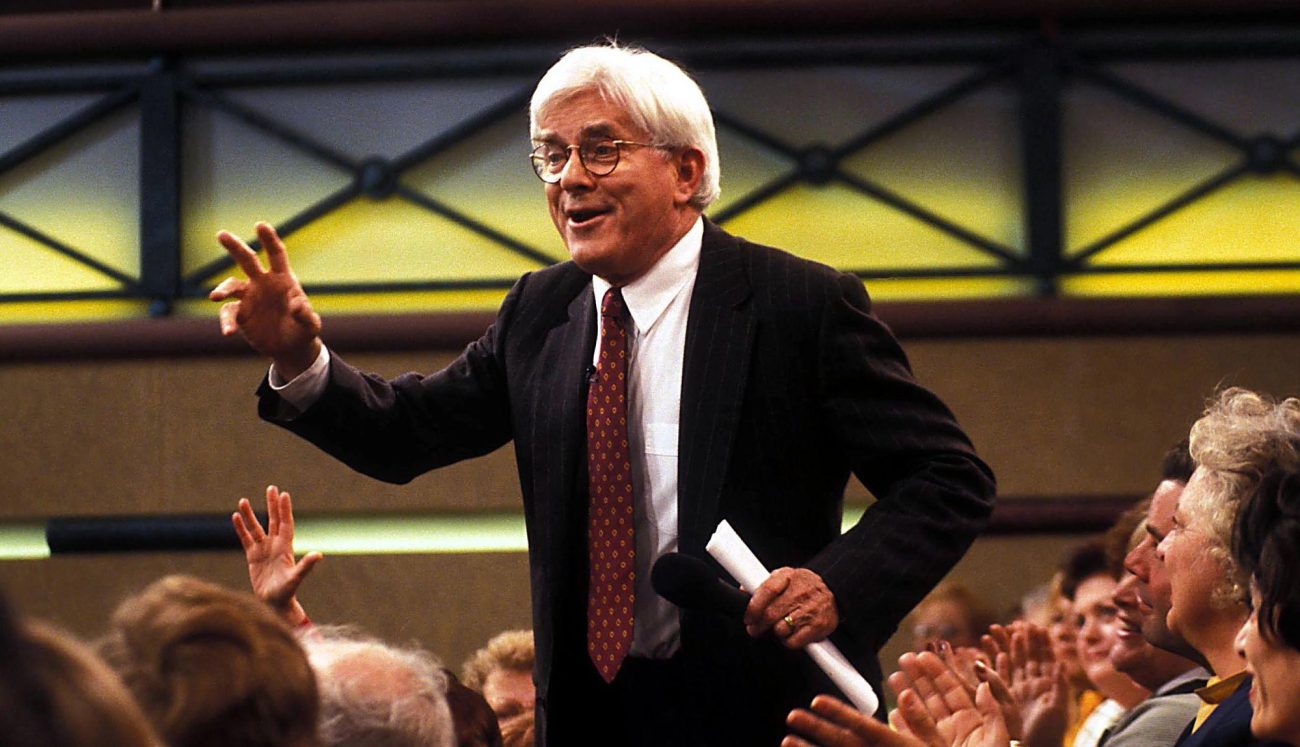
He walked among them with a microphone.
He invited questions.
He encouraged disagreement.
And he allowed conversations to move in directions that conventional television often avoided.
The result was a format that felt unusually immediate.
People weren’t simply watching a host interview a guest.
They were witnessing a public conversation unfold.
The Microphone That Changed Daytime Television
One of Donahue’s most recognizable habits was walking through the audience with his microphone.
It seems ordinary now.
At the time, it helped transform the genre.
Instead of keeping the conversation confined to a stage, Donahue brought the audience directly into it.
A woman sitting several rows back could challenge a guest.
A father could describe his family’s experience.
Someone who had never appeared on television could ask a question that shifted the entire discussion.
Donahue wasn’t always the most important voice in the room.
Often, his greatest contribution was recognizing which voice needed to be heard next.
That approach made his show feel less like a traditional interview and more like a town meeting.
The audience wasn’t guaranteed to agree.
It wasn’t always polite.
But participation mattered.
And for millions of viewers, that was a powerful change.
He Was Willing to Discuss Subjects Others Avoided
Donahue became known for tackling subjects that many television programs considered too controversial or uncomfortable.
His show explored women’s rights, religion, racism, politics, sexuality, reproductive rights, family relationships, and social inequality.
He interviewed activists, public figures, experts, and people whose personal experiences challenged prevailing attitudes.
Some discussions provoked strong reactions.
Others offered viewers perspectives they had rarely encountered.
The program did not eliminate disagreement.
In many cases, it made disagreement more visible.
But Donahue understood that avoiding difficult subjects didn’t make those subjects disappear.
Television could either pretend that complicated social questions didn’t exist or provide a place where people could confront them.
He chose the latter.
Why Women Played Such an Important Role in His Success
Women were central to Donahue’s audience and to the program’s cultural impact.
