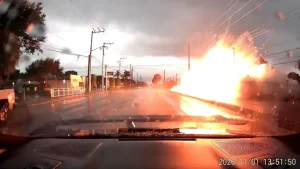
An aviation commentator has raised new questions about the final moments of a private jet that crashed in Florida, killing all nine people aboard, including two young children.
The Learjet 60 was traveling from Austin, Texas, to North Eleuthera in the Bahamas on November 1, 2026, when it entered a rapid descent and crashed near Greenacres in Palm Beach County.
In the minutes before the disaster, the flight crew reported icing, turbulence, and precipitation while communicating with air traffic controllers.
Aviation commentator Captain Steeeve has since offered his interpretation of the available radar imagery and air traffic control recordings, examining whether weather conditions and communication issues may have contributed to the developing emergency.
His observations have attracted attention, but they remain independent analysis rather than official findings.
The National Transportation Safety Board is investigating the crash, and no probable cause has been established.
A Routine Flight That Ended in Tragedy
The Learjet 60 departed Austin-Bergstrom International Airport on the morning of November 1.
The aircraft was carrying seven passengers and two crew members.
Among the passengers were a family of four, including two young children.
The flight was headed toward the Bahamas when the crew began reporting challenging conditions over Florida.
According to information released by federal investigators, the aircraft was flying at approximately 35,000 feet when the crew described encountering light clear icing and moderate turbulence.
The pilots also reported altitude variations of approximately 700 feet.
They subsequently requested permission to climb to 37,000 feet.
Air traffic control approved the request.
Less than 30 seconds later, the situation deteriorated dramatically.
The crew reported a rapid descent and issued an emergency call.
The aircraft eventually struck the ground, killing everyone aboard.
Captain Steeeve Examines the Final Communications
Captain Steeeve, an aviation commentator who discusses flight operations and aircraft incidents on YouTube, examined the available information surrounding the crash.
His commentary focused on several questions about the flight’s final minutes.
One concerned the aircraft’s proximity to severe weather.
Another involved communication with air traffic control following a frequency change.
He also discussed the altitude fluctuations reported by the crew and the possible aerodynamic effects of ice accumulation.
These observations represent his interpretation of the available material.
They do not establish that the pilots made a particular error or that any single factor caused the crash.
Did the Aircraft Encounter a Dangerous Storm?
One of the central questions concerns the weather along the Learjet’s route.
Thunderstorms can create hazardous conditions for aircraft, including turbulence, heavy precipitation, and rapidly changing atmospheric conditions.
Aviation weather radar helps flight crews identify areas of precipitation that may be associated with severe weather.
However, interpreting weather information requires consideration of the aircraft’s position, altitude, and surrounding conditions.
Captain Steeeve questioned whether the flight had approached a thunderstorm that presented a significant risk.
The NTSB has separately confirmed that weather conditions are a major focus of its investigation.
Investigators will examine the weather information available to the crew and the aircraft’s actual flight path.
The fact that a storm was nearby does not establish whether the pilots could reasonably have avoided the conditions they encountered.
Questions About Air Traffic Control
Captain Steeeve also discussed a possible communication issue involving a change in radio frequency.
During a flight, pilots may be transferred between air traffic control sectors as they move through different areas of controlled airspace.
These transfers are routine.
However, clear communication becomes especially important when an aircraft is experiencing challenging conditions.
The commentator questioned whether radar contact had been properly established following a frequency change.
That question should not be interpreted as proof of a controller error.
