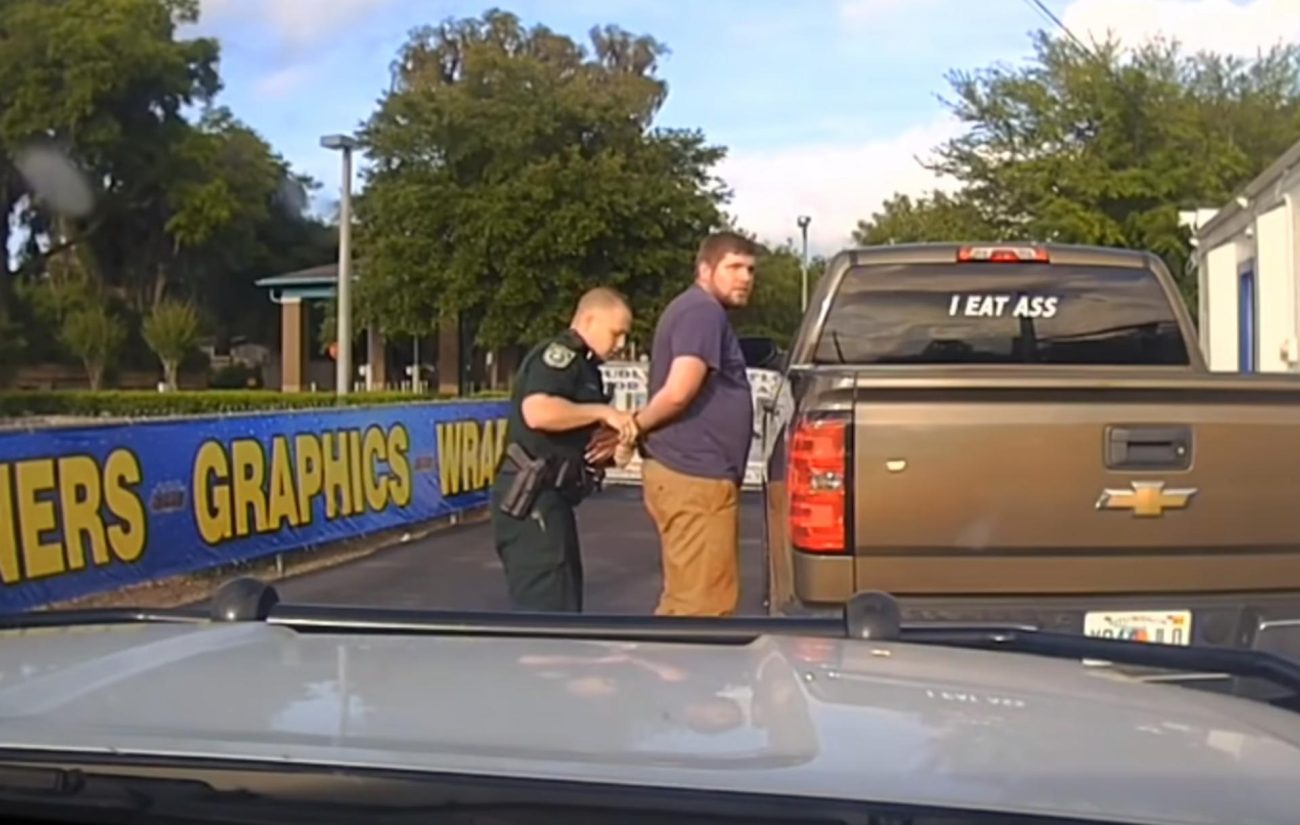
Those are two different judgments.
A person can dislike the sticker while still questioning the arrest.
Likewise, someone can support free speech protections without approving of every message displayed in public.
That separation between personal taste and government authority lies at the center of many First Amendment debates.
Can a Police Officer Make Someone Remove an Offensive Sticker?
The answer depends on the circumstances and the applicable law.
Police officers may enforce valid laws governing vehicle equipment, visibility, and certain prohibited materials.
But they cannot simply treat every offensive message as a crime.
When a sticker’s content is the reason for enforcement, constitutional protections become especially important.
An officer’s personal dislike of a message is not, by itself, enough to establish that the speech is unlawful.
At the same time, a driver cannot assume that every possible display is protected in every situation.
The legal analysis may depend on the wording, context, relevant statute, and established court decisions.
Webb’s case illustrates why these distinctions matter.
A few words on a vehicle led to an arrest, dropped criminal charges, and years of civil litigation.
The Cost of a Controversial Arrest
Even when criminal charges are dismissed, an arrest can have consequences.
A person may spend time in custody.
They may need to post bond or obtain legal representation.
Their name and photograph may appear in news reports.
And they may face public attention long after the original incident.
Webb’s arrest became a national story.
The sticker attracted attention partly because of its provocative wording.
But the lasting interest came from the legal dispute it created.
For many observers, the case raised concerns about how quickly an encounter with law enforcement can escalate when an individual refuses a demand they believe violates their rights.
For others, it highlighted the difficulty officers face when applying obscenity laws to unusual situations.
Both questions are worth examining carefully.
The Difference Between Being Offensive and Being Illegal
Americans encounter offensive messages in many places.
They appear on clothing, bumper stickers, protest signs, billboards, and social media.
Some are political.
Some are intended as jokes.
Others are deliberately confrontational.
The fact that speech causes discomfort doesn’t automatically remove its constitutional protection.
That principle can be frustrating when the message is something a person strongly dislikes.
But freedom of speech has significance precisely because people disagree about which expressions are acceptable.
If protection applied only to words everyone approved of, many difficult constitutional questions would never arise.
Webb’s sticker was not a sophisticated political statement.
It was a crude decal on a pickup truck.
Yet the response to it raised serious legal questions.
A Case That Still Sparks Debate
More than seven years after the 2019 arrest, the incident remains an unusual example of a dispute over public expression.
It began when a deputy noticed a sticker at a traffic light.
It escalated when Webb refused to alter the wording.
It resulted in an arrest, a brief period in jail, and criminal allegations that prosecutors later dismissed.
Then it became a federal lawsuit that ended in 2021.
The incident demonstrates how quickly a disagreement over speech can become a legal controversy.
It also shows why the details of a case matter.
The dismissal of charges is not the same as a final civil verdict.
A lawsuit’s conclusion does not necessarily establish a publicly confirmed settlement amount.
And the legal definition of obscenity is not identical to an individual’s opinion about what is offensive.
What Do You Think?
The words on Webb’s truck were intentionally provocative.
Many people would never display such a message on their own vehicles.
Others might laugh at it.
Some would find it offensive.
But the bigger question is whether that reaction should determine what the government can prohibit.
Should police be able to order a driver to remove a vulgar sticker?
Or should offensive language remain protected unless it meets the legal standard for an actual violation?
The Florida case offers a reminder that constitutional rights are often tested through situations that are uncomfortable, unpopular, or even ridiculous.
A three-word decal became a national story because it forced people to confront the difference between disapproving of someone’s speech and believing the government should punish it.
And that debate is far bigger than one sticker on the back of a truck.
