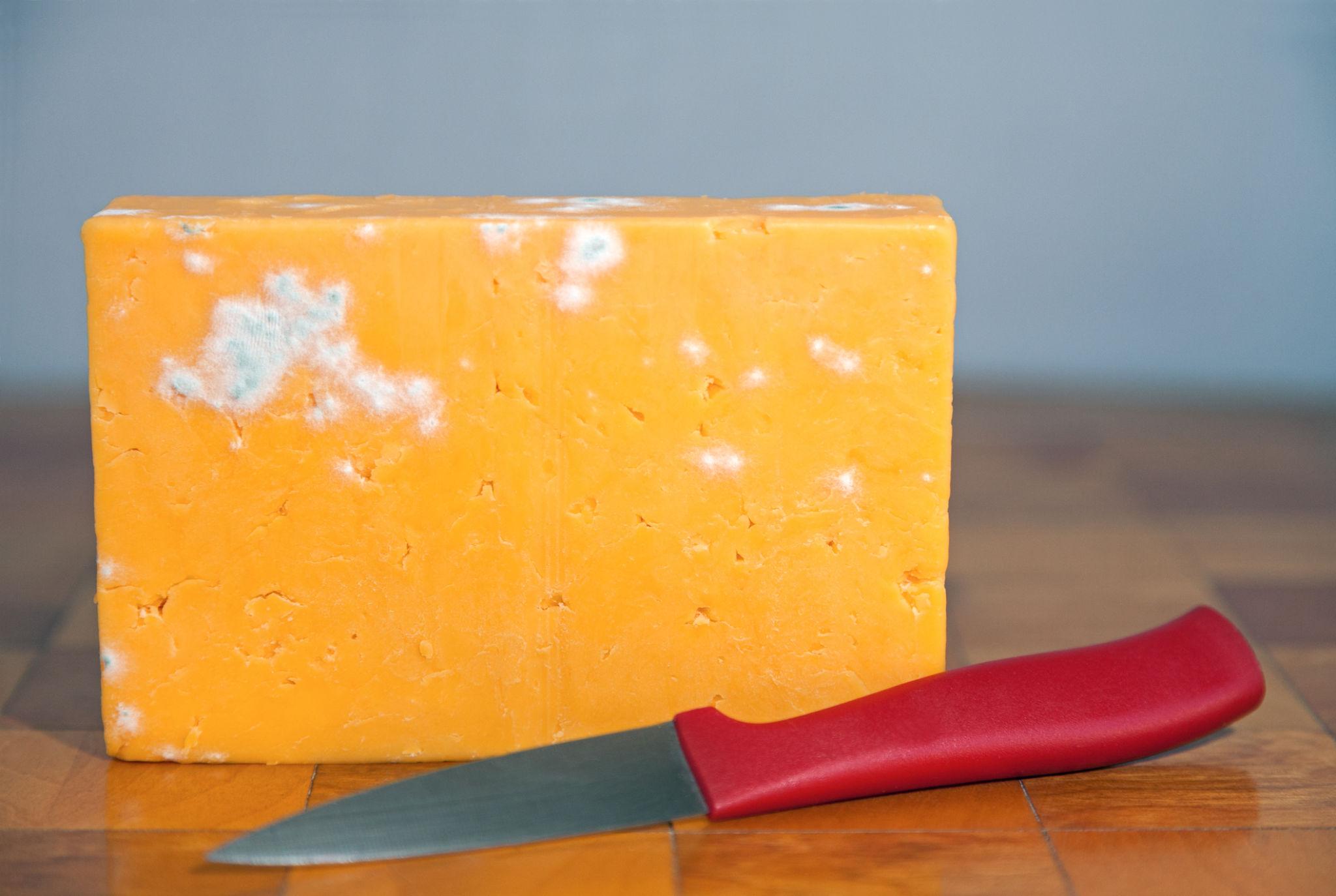
When in doubt, the safest decision is to discard the cheese.
A Quick Guide: Keep It or Toss It?
| Type of cheese | If unexpected mold appears |
|---|---|
| Firm block of cheddar | A small affected area may be removed, cutting at least one inch around and below |
| Parmesan or other appropriate hard cheese | Similar guidance may apply to a small localized mold spot |
| Shredded cheddar | Discard the entire package |
| Sliced or crumbled cheese | Discard the affected product |
| Cream cheese or ricotta | Discard the entire product |
| Cottage cheese | Discard the entire product |
| Brie or Camembert | Intended ripening mold is normal; discard if unexpected mold develops |
The key is to identify the actual product rather than assuming every cheese follows the same rule.
Final Thoughts
Finding a small patch of mold on cheddar cheese doesn’t always mean you need to throw away the entire block.
For a firm block with a small, localized mold spot, USDA guidance generally permits removing at least one inch around and beneath the affected area.
But that advice should not be applied to shredded, sliced, crumbled, or soft cheeses.
Those products should generally be discarded when unexpected mold appears.
It’s also important to remember that smell, color, and taste are not reliable ways to determine whether an unfamiliar mold is safe.
Proper refrigeration, clean utensils, and appropriate storage can help reduce spoilage.
And when you aren’t sure what you’re dealing with, throwing the cheese away is the more cautious option.
The simple rule to remember: A small mold spot on a firm block of cheddar may be removable — but mold on shredded or soft cheese usually means it’s time to toss it.
