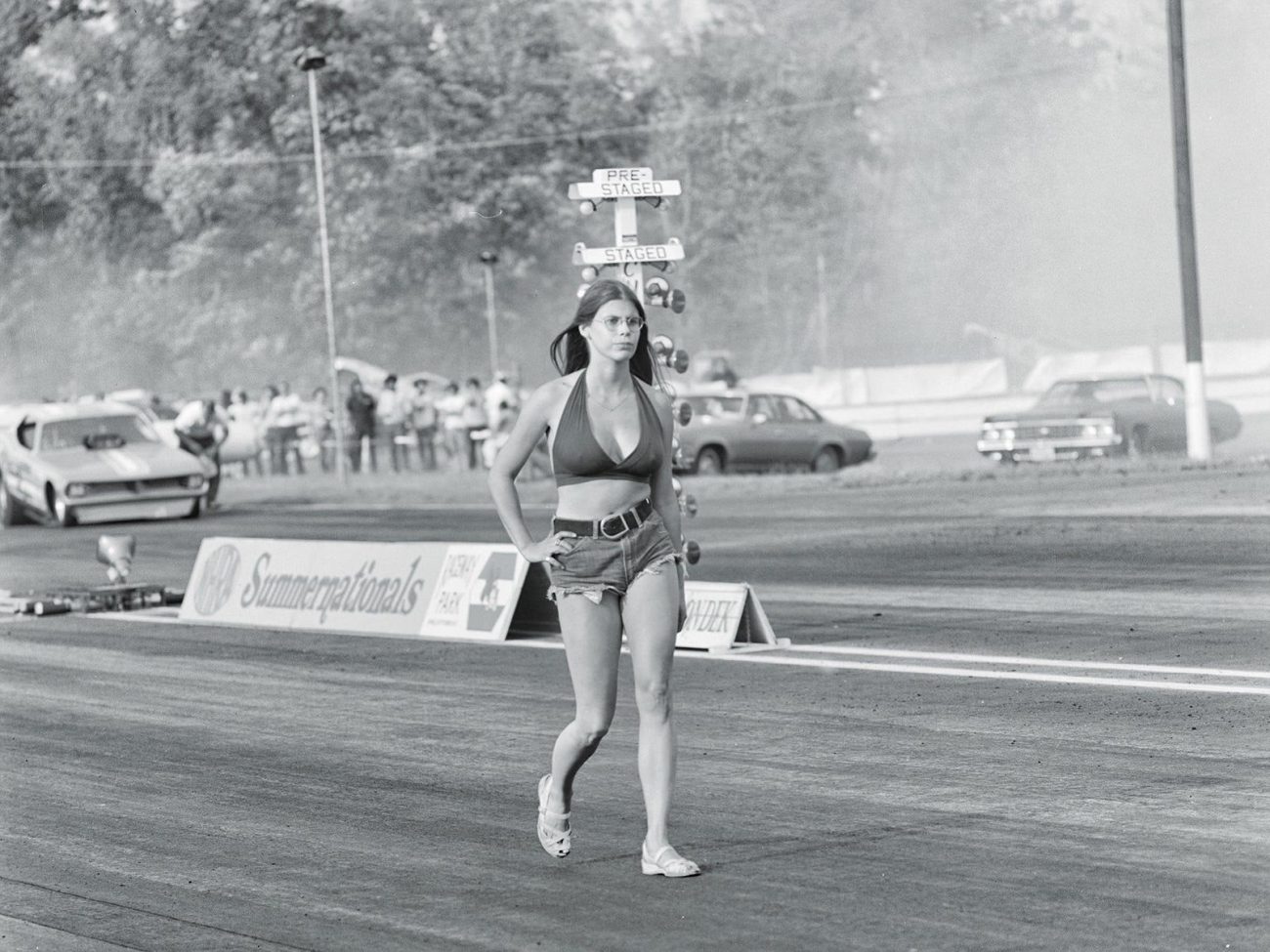
In the early 1970s, a young woman from Pennsylvania made a decision that would change her life. Instead of heading to college as planned, she joined one of the most colorful personalities in American drag racing and began traveling across the country.
Her name was Pamela Hardy.
But racing fans would come to know her by another name: Jungle Pam.
With her long hair, unmistakable 1970s fashion, and confident presence beside some of the fastest cars in America, she became one of the most recognizable figures in drag racing.
She wasn’t the driver. That role belonged to Russell James “Jungle Jim” Liberman, a fearless Funny Car racer whose spectacular performances made him a favorite among spectators.
Together, they created a combination of speed, showmanship, and personality that fans still remember more than fifty years later.
Yet their partnership lasted only a few years. Their personal relationship ended, and in 1977, Liberman died in a devastating road accident at just 31.
Pam stepped away from the racing spotlight, but her story didn’t disappear.
The Chance Meeting That Changed Everything
Pam Hardy was an 18-year-old high school student living in West Chester, Pennsylvania, when she met Jungle Jim in May 1972.
She was approaching graduation and had been accepted to college, where she intended to study business.
At the time, drag racing wasn’t part of her plans.
In a later interview with Hot Rod magazine, Pam recalled walking into town when she noticed a Corvette pass her on the street.
The car came by again. Its driver pulled over, got out, and introduced himself as Jim.
He was already an established drag racer with a reputation for daring performances and an unconventional personality.
What began as an unexpected meeting soon became a relationship.
Pam graduated from high school but decided against attending college. Instead, she joined Jim as he traveled to racetracks across America.
It was a dramatic change for someone who had expected a more conventional future.
She was entering a world of roaring engines, crowded grandstands, long highway journeys, and cars capable of astonishing acceleration.
Before long, she would become an essential part of the spectacle.
Who Was Jungle Jim Liberman?
Russell James Liberman was born in Pennsylvania in 1945 and became one of the best-known Funny Car racers of his generation.
Funny Cars were highly modified drag racing vehicles with powerful engines and lightweight bodies resembling production automobiles.
By the 1970s, they were among the biggest attractions at American drag strips.
But Liberman was not interested in winning races quietly.
He believed spectators deserved a show.
His performances included enormous smoky burnouts, dramatic wheelstands, and unusually fast reverse maneuvers after warming his tires.
He traveled extensively, appearing at major venues and smaller tracks where fans eagerly awaited his arrival.
Unlike competitors who focused primarily on national championship standings, Liberman placed enormous value on match racing.
These events allowed track promoters to arrange appearances between popular drivers, often guaranteeing payment for a series of runs.
The arrangement suited his personality.
He could race frequently, entertain large crowds, and build a reputation that extended beyond official championship results.
In 1975, he won the NHRA Summernationals at Englishtown, New Jersey, his only NHRA national event victory.
Yet his influence was much greater than that single win suggested.
In 2001, the NHRA ranked him 17th among its 50 greatest drivers.
And whenever Jungle Jim appeared, fans increasingly expected to see Jungle Pam beside him.
How Pam Became Part of the Show
Pam’s most recognizable responsibility involved guiding Jim’s Funny Car backward after a burnout.
Before a drag racing run, a driver performs a burnout to heat the tires and prepare them for traction.

Great story.
❤️❤️