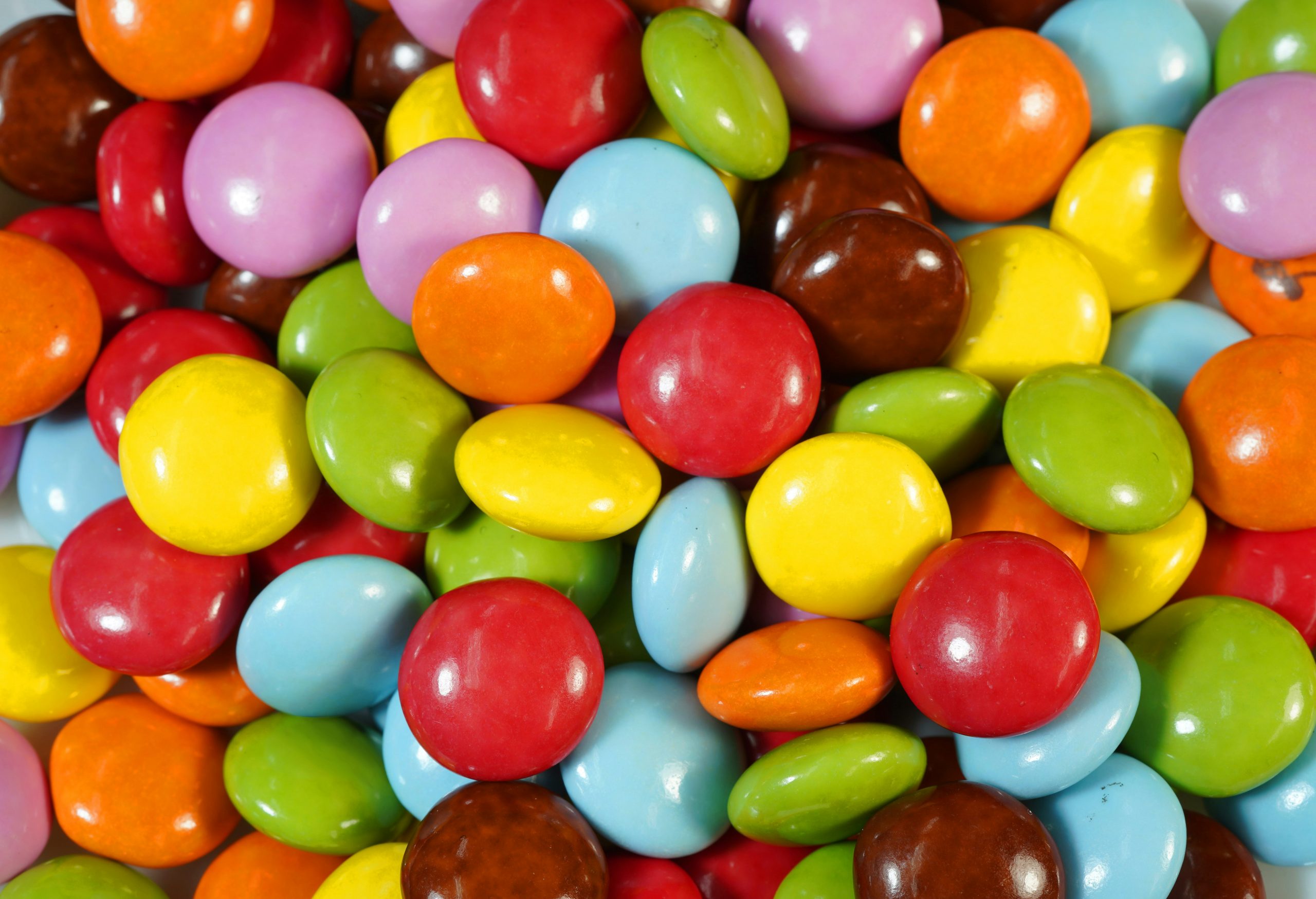
But the earliest candies didn’t have that familiar mark.
The printed M didn’t appear until 1950, nearly a decade after production began.
And initially, it wasn’t white.
It was black.
The Smithsonian says the black M first appeared in 1950 as a way of distinguishing genuine M&M’s from competing candies.
In 1954, the printed letter was changed from black to white.
Mars’ own history also dates the introduction of the printed M to 1950, when consumers were encouraged to look for the M on every piece.
So if you could open a package of the earliest wartime M&M’s, they wouldn’t look exactly like the pieces sitting in a candy bowl today.
The Original Candies Were Already Colorful
Another misconception is that early M&M’s were simply brown.
Historical accounts describe the original candy shells as appearing in several colors.
HISTORY reports that the early lineup included brown, red, orange, yellow, green and violet.
The colors have changed over the decades, but using multiple brightly colored shells was part of the product’s identity remarkably early in its history.
The familiar M came later.
What Happened to Bruce Murrie?
The Mars-Murrie partnership didn’t last forever.
After the wartime period, Forrest Mars eventually bought out Murrie’s interest in the business and gained control of the brand.
But Murrie’s name never disappeared.
It’s still there every time someone says:
M&M’s.
That’s an unusual legacy.
Millions of people around the world routinely say two men’s surnames without realizing they’re doing it.
Then Came Peanut M&M’s
The original chocolate candy was only the beginning.
Over time, Mars expanded M&M’s into numerous varieties.
One of the most famous was Peanut M&M’s.
Today the broader M&M’s lineup includes varieties such as Milk Chocolate, Peanut, Dark Chocolate, Almond and Peanut Butter, among others marketed in different places and periods.
Packaging changed.
Advertising changed.
Colors changed.
New flavors appeared.
But the basic concept remained recognizable:
Chocolate—or another center—surrounded by a colorful candy shell.
The Candy Even Went to Space
M&M’s eventually traveled much farther than Forrest Mars or Bruce Murrie probably imagined.
In 1981, the candy went aboard the first NASA space shuttle mission after being requested by the crew of Columbia, according to HISTORY.
A candy whose early success was closely connected to military portability had now become useful in an entirely different environment.
From soldiers during World War II to astronauts in space, the little candy had developed an unusual place in American culture.
The Name Has Survived for More Than Eight Decades
Perhaps the most interesting part of the story is how little most consumers know about a name they recognize instantly.
Ask someone what M&M’s are and they’ll almost certainly know.
Ask what the letters mean, and many people won’t.
The answer is surprisingly simple:
Mars and Murrie.
But behind those two words is a story involving family candy businesses, wartime shortages, military rations, an unusual partnership and an idea for making chocolate easier to handle.
M&M’s began production in 1941.
The famous printed M didn’t appear until 1950.
And more than eight decades after the candy’s introduction, the names of Forrest Mars and Bruce Murrie remain hidden in plain sight on packages sold around the world.
So the next time you open a bag and see those tiny white letters, you’ll know what you’re actually looking at.
One M represents Mars.
The other represents Murrie.
And together, they tell the origin story of one of the most recognizable candies ever created.
Before reading this, did you know what the two M’s in M&M’s actually stood for?
