My Mother Left Dad With Six Daughters—15 Years Later, She Returned for My Wedding and Blamed Him for Everything

My mother left when there were six little girls in our house.
The youngest, Maya, was only nine months old.
Dad suddenly had six daughters to raise and a household that no longer had two parents sharing the responsibility.
Mom’s name was Elena.
She had chosen a different life with her boss, Julian—a life she apparently believed could offer her more than the family she was leaving behind.
Dad was the one who remained.
He worked double shifts.
He attended school events.
He dealt with all the ordinary responsibilities that don’t disappear simply because one parent does.
And despite everything that had happened between them, he tried to keep a connection open between us and our mother.
For 15 years, we grew up with Dad.
Then, as my wedding approached, Elena announced that she wanted to attend.
My name is Chloe.
And I said yes.
I wanted my mother at my wedding.
But there was one thing I wasn’t willing to allow.
She could come back into our lives.
She could sit among our relatives.
She could watch me get married.
But if she tried to rewrite the previous 15 years and blame the man who had stayed, I was ready.
Because Dad had spent years protecting us from the ugliest parts of the truth.
I had no intention of letting that kindness be used against him.
Mom Had Left Dad With Six Children
There was no convenient time for a mother to walk away from six young daughters.
But Maya was still a baby.
Nine months old.
The rest of us were children too.
We needed meals, clothes, school supplies, transportation, supervision, comfort and stability.
Dad suddenly had to figure out how to provide all of it.
There was no dramatic transformation that magically made the situation easy.
He simply did what had to be done.
He worked.
Then he came home and remained a father.
When school events happened, Dad tried to be there.
When everyday problems appeared, they became his problems too.
The responsibility didn’t stop when he was exhausted.
There were six of us.
He couldn’t afford for it to.
But Dad Didn’t Teach Us to Hate Our Mother
That may have been the most important part.
Dad could have spent our childhood telling us exactly what he thought of Elena.
He could have made every missed birthday another opportunity to remind us that she had chosen to leave.
He could have turned our disappointment into anger.
Instead, according to the family account, he repeatedly softened her absence.
He made excuses.
He tried to preserve some possibility that his daughters might still have a relationship with their mother.
At the time, we couldn’t fully understand what that cost him.
Children usually see only the immediate disappointment.
Someone isn’t there.
Someone didn’t call.
Someone didn’t answer.
Someone didn’t come.
Dad saw more.
And he often carried that knowledge himself.
He Kept Trying to Maintain a Connection
This wasn’t a situation in which Dad simply closed the door and decided Elena no longer existed.
He tried to maintain communication.
That fact would become extremely important years later.
There was correspondence.
There were attempts at contact.
There were pieces of our childhood that documented what had actually happened.
And Dad kept records.
At the time, those things didn’t look important.
A returned piece of correspondence is just paper.
A child’s drawing is just a drawing.
A private journal is just a collection of thoughts.
Until somebody tries to change the past.
Then ordinary pieces of paper can become extraordinarily important.
Fifteen Years Passed
We grew up.
Six little girls became six young women.
Maya, who had been only nine months old when Mom left, grew up with almost no meaningful memory of having her in the home.
Dad remained the constant.
Life moved forward because it had to.
Eventually, it was my turn to begin another chapter.
I was getting married.
Weddings have a strange way of pulling family history into the present.
People who haven’t spoken suddenly call.
Old relationships become relevant again.
Questions about who should attend become emotionally complicated.
And that’s when Elena returned.
Mom Said She Wanted to Attend My Wedding
After 15 years, my mother wanted to be there.
I could have refused.
Part of me had every reason to.
But I allowed her to come.
I wasn’t trying to punish her forever.
I also didn’t want my wedding to become a battlefield before it had even begun.
If she wanted to witness her daughter’s marriage, I was prepared to let her.
But I knew something else.
A person can return to an event without truly confronting why they were absent from everything that came before it.
So I prepared myself.
Not for revenge.
For the possibility that history might suddenly be rewritten.
I Had Evidence of What Dad Had Actually Done
Over the years, pieces of our childhood had survived.
Returned correspondence.
Drawings we’d made as children.
Dad’s journal.
The journal was particularly painful because it revealed something we hadn’t fully appreciated when we were young.
Dad had documented some of the explanations he’d given us for Mom’s absence.
He hadn’t always told us the harshest version of what was happening.
He had tried to protect us.
That meant Elena’s absence had hurt him twice.
First, he had to raise six daughters after she left.
Then he had to find ways to explain her absence without destroying our image of her.
Years later, those private efforts became part of the record.
I hoped I wouldn’t need any of it.
For a While, It Was Simply My Wedding
Mom arrived.
Julian was with her.
This was the man with whom she had pursued the new life she’d chosen years earlier.
Dad was there too.
And so were my sisters.
For one day, people who represented completely different parts of my life occupied the same celebration.
I wanted to focus on getting married.
I wanted to remember the people who had shown up because they loved me.
I wanted the reception to be about a beginning rather than a 15-year-old wound.
But old stories have a way of resurfacing when people refuse to accept their role in them.
And eventually, Mom said something I couldn’t ignore.
She Blamed Dad
According to the supplied story, Elena claimed that Dad had kept us away from her.
The implication was devastating.
Suddenly, the history we’d lived was being presented differently.
Mom wasn’t the parent who had simply remained distant.
Dad was supposedly responsible.
The man who had stayed.
The man who had worked double shifts.
The man who had attended our school events.
The man who had spent years trying to preserve some connection between his daughters and their mother.
Now he was being cast as the obstacle.
I knew what I had with me.
And I knew I couldn’t stay silent.
I Brought Out the Returned Correspondence
I had prepared for exactly this possibility.
The evidence wasn’t dramatic.
There was no secret recording.
No surprise witness waiting behind a door.
There were records from our actual lives.
Correspondence that had come back.
Evidence of attempts to reach her.
Pieces of a history that didn’t fit the version she was presenting at the reception.
Then there were the childhood drawings.
For someone else, they might have looked insignificant.
For us, they represented children still reaching toward an absent parent.
And then there was Dad’s journal.
Dad’s Journal Revealed What He Had Been Doing All Along
The journal wasn’t evidence that Dad had spent years trying to turn us against our mother.
It showed almost the opposite.
It documented the excuses he had made.
The explanations he had given his daughters when reality was too painful or complicated to place on children.
That changed the emotional meaning of everything.
As girls, we had heard explanations.
As adults, we could finally see the person who had been creating them.
Dad had been absorbing part of the hurt for us.
He had been trying to make Mom’s absence easier to understand.
Now the woman whose image he had tried to soften was suggesting that he had caused the separation.
I couldn’t accept that.
Julian Was Hearing Another Version of the Story Too
The confrontation wasn’t happening only between Mom, Dad and six daughters.
Julian was there.
And as the evidence came out, the account he’d apparently been given was colliding with the history we remembered.
His reaction changed.
The details didn’t fit neatly together anymore.
I didn’t need to decide exactly what Elena had told him over the previous 15 years.
The material in front of us was enough.
There had been attempts at contact.
Dad had not simply erased her from our lives.
And there was one very basic fact that made the accusation even harder to sustain.
Dad Had Never Changed His Address or Phone Number
Dad confirmed it himself.
His address hadn’t changed.
His phone number hadn’t changed.
For all those years, the basic routes back to us had remained available.
That didn’t explain every detail of the past.
It didn’t tell us every private conversation that had happened between our parents.
But it mattered.
Because Mom’s claim depended on the idea that Dad had prevented her from reaching us.
The history in front of us told a different story.
And for once, Dad didn’t need to defend himself alone.
His daughters were old enough to understand.
The Man Who Stayed Didn’t Need a Speech
There are some people whose love is easiest to recognize through what they repeatedly do.
Dad didn’t need to describe himself as devoted.
We had watched him.
For 15 years.
We knew who attended the events.
We knew who worked the extra hours.
We knew who came home.
We knew who handled the responsibilities that couldn’t be postponed.
We also now understood that he had protected us from some of his own anger and disappointment.
That mattered more than any speech he could have delivered at my wedding.
Then It Was Time to Dance
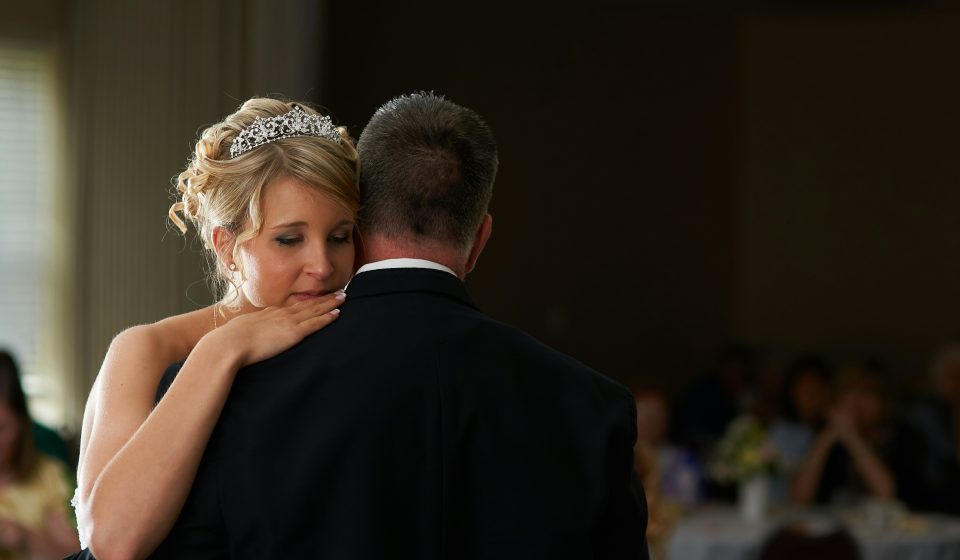
After everything that had happened, I turned toward Dad.
My wedding had already become far more emotionally complicated than I’d wanted.
But there was one moment I still wanted to belong to us.
I led him onto the dance floor.
This was the man who had raised me.
The man who had raised all six of us.
And then my sisters joined us.
One after another, the family Dad had spent years holding together gathered around him.
There were six daughters standing beside their father.
Nothing about that moment required an argument.
The picture itself said enough.
Fifteen Years Could Not Be Rewritten in One Evening
That’s ultimately what Mom’s return forced us to understand.
A person can tell a different version of history.
But the people who lived through it have memories too.
And sometimes they have records.
Letters.
Drawings.
Journals.
Addresses.
Phone numbers.
Years of ordinary actions.
The truth about a family rarely exists in one dramatic moment.
It accumulates.
Who called.
Who answered.
Who showed up.
Who remembered.
Who worked.
Who comforted.
Who stayed.
Over 15 years, those small actions become a history of their own.
Children Don’t Always Understand the Parent Who Stays
When you’re young, you rarely see everything your parent sacrifices.
You see that dinner exists.
You don’t necessarily see the exhaustion behind it.
You see someone sitting at a school event.
You don’t see how their work schedule had to be rearranged.
You hear an explanation for why the other parent isn’t there.
You don’t know that the person giving you that explanation may be choosing gentler words specifically to protect you.
Adulthood can reveal an entirely different version of childhood.
For me, Dad’s journal did that.
It allowed me to see not just what he’d done, but what he’d deliberately kept from us.
Protecting Children Doesn’t Mean Lying About History Forever
There is also a difficult balance here.
Parents often want to protect children from adult conflict.
That’s understandable.
Children shouldn’t be turned into weapons during a separation.
They shouldn’t be forced to choose sides.
They shouldn’t become messengers carrying hostility between parents.
But as children become adults, they may eventually ask harder questions.
And they deserve answers that respect both the facts and their ability to understand complexity.
In this story, the daughters eventually had access to information they couldn’t have fully processed when they were little.
That didn’t erase their childhood.
It helped explain it.
Forgiveness and Accountability Are Different Things
Allowing Mom to attend my wedding didn’t mean pretending the previous 15 years hadn’t happened.
Those are two different things.
You can open a door without surrendering your memory.
You can allow someone back into a room without allowing them to rewrite why they left it.
You can want peace while still insisting on accountability.
That was the boundary I discovered at my wedding.
Mom was welcome to attend.
Her version of events was not automatically entitled to replace ours.
Family Loyalty Shouldn’t Require Denying Facts
It would have been easy to remain silent because it was my wedding.
Nobody wants confrontation at a reception.
Nobody wants relatives arguing while guests watch.
But silence would have carried its own cost.
Dad had protected us for years.
When Mom’s accusation placed the responsibility for her absence on him, staying quiet would have allowed that claim to stand unchallenged.
Sometimes supporting someone isn’t about attacking the other person.
It’s simply refusing to let an unfair version of events become the accepted one.
Six Daughters Were His Answer
Dad’s strongest response wasn’t contained in the journal.
It wasn’t his unchanged phone number.
It wasn’t his address.
It wasn’t even the returned correspondence.
It was us.
Six daughters.
We had grown from babies and little girls into women.
He had been there for the years in between.
No document could capture every breakfast.
Every school morning.
Every worry.
Every ordinary conversation.
Every responsibility.
Every moment when a parent was needed and Dad was the one available.
The paperwork could challenge a claim.
Our lives told the larger story.
My Wedding Revealed More Than I Expected
I had imagined my wedding as the beginning of a new family chapter.
I hadn’t expected it to force such a direct confrontation with the old one.
But perhaps that was unavoidable.
Marriage makes you think differently about commitment.
About showing up.
About what promises mean after the celebration ends.
Watching Dad that day, I understood something I’d been living with for years.
Love isn’t proven by the dramatic moment when everyone is watching.
It’s proven by what happens after.
On ordinary Tuesdays.
During difficult years.
When nobody is applauding.
When you’re exhausted.
When leaving would be easier.
Dad had spent 15 years answering that question through his actions.
Mom Returned, but Dad Had Never Left
That was the difference I couldn’t ignore.
Elena’s appearance at my wedding mattered.
But one appearance couldn’t outweigh 15 years of presence.
It couldn’t change who had raised us.
And it couldn’t transform the parent who stayed into the reason the other parent remained absent.
Whatever happened after that day would require its own choices.
Relationships aren’t repaired in a single confrontation.
Trust doesn’t return because evidence settles an argument.
But at least one thing had become clear.
The past couldn’t be rewritten simply because enough time had passed.
The Dance Floor Became the Moment I Remember
There were six of us around Dad.
The daughters he had raised.
The girls who had once depended on him for everything were now adults standing beside him by choice.
It wasn’t about humiliating Mom.
It wasn’t about choosing revenge.
It was about recognition.
Dad had spent years quietly doing the work.
For once, he didn’t need to minimize it.
He didn’t need to invent an excuse for someone else.
He didn’t need to protect us from what had happened.
We were old enough to see it ourselves.
And when my sisters joined us on that dance floor, the story of our family became very simple.
One parent had left.
One parent had stayed.
Fifteen years later, we knew exactly who had been there while we grew up.
Sometimes the person who loves you most isn’t the one with the best explanation. It’s the one whose presence became so constant that you once mistook it for ordinary.
Editor’s note: This story is presented as a fictionalized or unverified family narrative based on the supplied account. The names, correspondence, journal, wedding confrontation, family history, and other events described here have not been independently verified and should not be interpreted as reporting about identifiable real people.