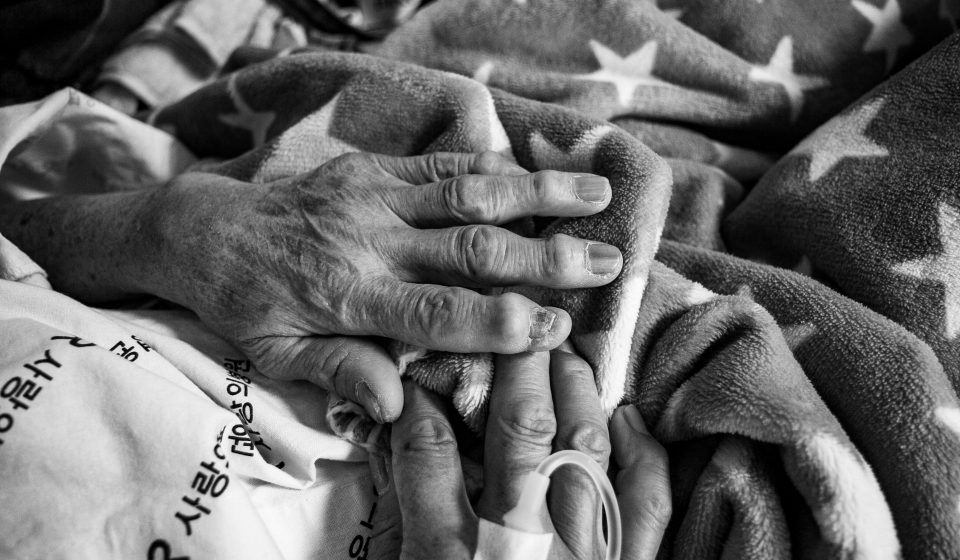
Police Found My Pregnant Daughter Bleeding at a Freezing Bus Stop—What She Revealed From Her Hospital Bed Changed Everything

The phone rang at five in the morning.
No parent expects anything good from a call at that hour.
I remember staring at the screen for a second before answering, still caught somewhere between sleep and consciousness.
Then I heard the words that changed everything.
My daughter Chloe had been found injured at a bus stop.
She was five months pregnant.
And she was in the hospital.
Everything after that seemed to happen too quickly and too slowly at the same time.
I got dressed without thinking.
I don’t remember deciding what to wear.
I don’t remember locking the door.
I barely remember the drive.
There was only one thought repeating in my head:
Please let my daughter be alive.
The Hospital Felt Like Another World
Hospitals have their own atmosphere in the early morning.
Bright lights.
Quiet hallways.
Closed doors.
People speaking in lowered voices.
I arrived desperate for information but terrified of what someone might tell me.
Chloe had suffered serious injuries.
Doctors were also monitoring her pregnancy closely.
I wanted certainty.
No one could give it to me.
That may have been the hardest part.
I could deal with anger.
I could deal with action.
Waiting was different.
Waiting meant standing there while other people worked to keep my daughter safe and knowing there was almost nothing I could do.
Then came the information that transformed my fear into something darker.
According to the account Chloe later gave, the people responsible weren’t strangers.
They were members of her own family by marriage.
Her husband, Garrett.
And his mother, Evelyn.
Anger Took Over
There are moments when rage feels almost physical.
My daughter had been hurt.
She was pregnant.
She had somehow ended up alone at a bus stop before dawn.
Every protective instinct I had seemed to collapse into one thought:
Someone needs to pay.
Not tomorrow.
Not after an investigation.
Not after court.
Now.
That kind of anger can convince you that retaliation is justice.
It can make destruction feel like loyalty.
For a brief period, that was where my mind went.
I wasn’t thinking about consequences.
I wasn’t thinking about what Chloe would need if she survived.
I wasn’t thinking about the baby.
I was thinking only about the people I believed had done this to her.
And I came dangerously close to making a decision that could have destroyed another life—mine.
Then the Hospital Called Again
Dr. Miller’s voice brought me back.
Chloe was awake.
Her condition had shown signs of improvement.
The baby’s heartbeat was stronger.
And Chloe was asking for me.
Those words changed the direction of everything.
She wanted her mother.
Suddenly I understood what revenge would actually cost.
If I crossed that line, I might not be beside Chloe when she woke up.
I might not be there during her recovery.
I might not be there when the baby arrived.
Instead of supporting my daughter through what came next, I could spend years dealing with the consequences of my own actions.
The people I was furious with would have taken something else from Chloe.
Her mother.
I stopped.
Then I went back to the hospital.
Chloe Didn’t Need Revenge
She needed me.
That distinction became painfully clear when I saw her again.
She was injured and exhausted.
Communication wasn’t easy.
But she was conscious.
She knew I was there.
That mattered more than anything I could have accomplished through violence.
I stayed beside her.
And as soon as she was able, Chloe began helping investigators understand what she said had happened.
At one stage, a whiteboard helped her communicate.
Two names emerged clearly from her account:
Garrett.
Evelyn.
Her husband and his mother.
From That Point Forward, Evidence Had to Matter
This is where stories about violence sometimes move unrealistically fast.
A victim names an attacker.
Police immediately know everything.
The accused are arrested.
A courtroom scene follows.
Justice is delivered.
Real criminal cases are generally more complicated.
An allegation must be investigated.
Police may document injuries, gather statements, review physical or digital evidence, speak with witnesses and consult prosecutors.
Whether someone is arrested or charged depends on the available evidence and the law where the incident occurred.
And an arrest isn’t a conviction.
That distinction matters.
In Chloe’s story, however, her account became part of a broader investigation.
Garrett and Evelyn were eventually arrested.
The criminal process began.
I Wanted to Fix Everything for Her
But there are some things a parent can’t fix.
I couldn’t erase what had happened.
I couldn’t make Chloe forget.
I couldn’t make her body recover instantly.
And I couldn’t guarantee what would happen in court.
What I could do was remain present.
Sometimes that meant listening.
Sometimes it meant sitting quietly.
Sometimes it meant dealing with practical problems so she didn’t have to.
And sometimes it meant reminding myself that this was Chloe’s life.
Not mine.
Supporting someone after abuse doesn’t mean taking control of every decision.
It means helping them regain the control that violence attempted to take away.
The Baby Became a Source of Hope
Throughout everything, there was another life being monitored.
Chloe’s unborn child.
The pregnancy made the situation even more frightening.
Trauma during pregnancy can require careful medical evaluation, and the appropriate treatment depends on the injuries, stage of pregnancy and condition of both patient and fetus.
There was no meaningful way for me to predict the outcome.
So we waited.
One day at a time.
One medical update at a time.
Eventually, the future stopped feeling completely impossible.
Then Came the Legal Fight
According to this account, attorney Patricia Vance later helped Chloe pursue a civil claim while prosecutors handled the criminal case.
Those are separate legal processes.
A criminal prosecution focuses on whether the government can prove criminal charges under the applicable standard of proof.
A civil case can involve claims for damages arising from injuries and other losses.
One doesn’t automatically guarantee the outcome of the other.
Legal procedures and available claims also vary significantly by jurisdiction.
For Chloe, the legal process became part of trying to rebuild a life after violence.
But it wasn’t quick.
Justice rarely arrives with the speed people imagine when they’re angry.
Garrett and Evelyn Faced the Consequences
Ultimately, according to the story, both Garrett and Evelyn were convicted.
Garrett received a 30-year prison sentence.
Evelyn received 20 years.
Those sentences represented the legal consequences described in Chloe’s account.
But by then I had learned something I hadn’t understood during those first furious hours.
Their punishment wasn’t the same thing as Chloe’s recovery.
A judge could impose a sentence.
A court could resolve a case.
None of that could automatically restore what violence had taken from her.
Recovery was going to require something else.
Time.
Support.
Safety.
And the opportunity to make decisions about her own future again.
A Year Later, I Saw Her Coming Up the Porch
That image remains more powerful to me than any courtroom.
Chloe was walking toward me.
She still needed a cane.
The injuries had left lasting effects.
But she was walking.
And in her arms was Oliver.
Her son.
The baby we had once been terrified she might lose was now resting against his mother.
For a moment, I could only look at them.
Then I noticed Chloe was carrying something else.
An acceptance letter.
She Had Been Accepted to Nursing School
That piece of paper represented more than education.
It represented a future.
A year earlier, Chloe’s world had narrowed to a hospital room and questions nobody could answer.
Now she was making plans again.
She wanted to study nursing.
She wanted independence.
She wanted to build something from what remained rather than allow the worst thing that had happened to her to define everything that came afterward.
That didn’t mean the past had disappeared.
Her scars were real.
Her physical limitations were real.
Healing didn’t require pretending otherwise.
But trauma and future plans were able to exist in the same life.
Then She Told Me About Hope Haven
Chloe had another idea.
According to the story, the civil case resulted in financial compensation.
She wanted to use part of those resources to establish something she called Hope Haven.
Her vision was a shelter for women and children escaping abuse.
I thought about that for a long time.
After experiencing violence herself, Chloe wanted to create safety for someone else.
There was something powerful about that.
But I also understood that survivors shouldn’t be expected to transform trauma into charity or activism.
Chloe didn’t owe the world an inspirational ending.
Surviving was enough.
Whatever she chose to build afterward had to belong to her.
Hope Haven was her choice.
I Kept Thinking About That Morning
Watching Chloe hold Oliver brought me back to the moment when I had nearly made the worst decision of my life.
At the time, revenge had felt like action.
It felt as though doing nothing violent meant failing my daughter.
I eventually understood the opposite.
Walking away from retaliation was one of the most important things I could have done for her.
Because Chloe needed a mother.
Oliver needed a grandmother.
They needed someone who wasn’t dead, injured or incarcerated because of a moment of rage.
Staying wasn’t passive.
Staying was the harder choice.
Violence Creates More Than One Moment of Damage
When people discuss domestic abuse, attention often centers on the violent incident itself.
But the consequences can extend much further.
There can be physical injuries.
Fear.
Housing instability.
Financial problems.
Legal proceedings.
Medical appointments.
Changes in relationships.
Lost work.
Long-term recovery.
And when children are involved, the effects can spread across generations.
That’s why helping someone escape an abusive situation isn’t as simple as saying, “Just leave.”
Leaving can require planning, resources, transportation, documents, money, medical care, legal assistance and somewhere safe to go.
In some circumstances, separation itself can be a particularly dangerous period.
What Should You Do If Someone You Love Says They’re Being Abused?
Start by taking them seriously.
Listen.
Avoid turning the conversation into an interrogation.
If there’s immediate danger or serious injury, contact the appropriate emergency services in your location.
Professional domestic-violence organizations can also help survivors think through safety planning, shelter, legal resources and other options.
If the survivor is an adult and capable of making decisions, support should generally focus on restoring their agency rather than replacing one form of control with another.
Ask what they need.
Help where you can.
And understand that leaving an abusive relationship can be complicated.
Documenting Injuries Can Matter
When it’s safe and appropriate, medical records and other documentation may later become relevant.
Healthcare professionals can treat injuries and record clinical findings.
Law enforcement may collect evidence.
Attorneys can explain which records are relevant under local law.
But medical treatment should come first when someone is injured.
Evidence is important.
A person’s immediate health and safety are more important.
Pregnancy Makes Physical Violence Especially Concerning
Violence against a pregnant person requires particular attention because there may be risks to both the pregnant patient and the pregnancy.
After significant physical trauma, medical evaluation can be important even when the person initially believes they’re okay.
Symptoms and appropriate monitoring depend on the circumstances.
Anyone experiencing severe bleeding, significant abdominal trauma, loss of consciousness, severe pain, breathing difficulty or another medical emergency should seek urgent medical care.
The purpose isn’t to frighten survivors.
It’s to recognize that serious trauma deserves serious evaluation.
Revenge Wouldn’t Have Given Chloe Her Life Back
This was the lesson I struggled with most.
When someone hurts a person you love, revenge can masquerade as protection.
But retaliation after the fact doesn’t undo the original harm.
Sometimes it simply creates another victim, another criminal case and another devastated family.
Accountability matters.
But accountability and revenge aren’t identical.
One relies on evidence and legal processes.
The other can destroy the person seeking it.
I almost learned that distinction too late.
Chloe’s Victory Wasn’t the Prison Sentences
For a long time, I thought justice would be the moment Garrett and Evelyn were punished.
Eventually, I realized I was looking in the wrong place.
The greater victory was on my porch.
Chloe standing there.
Oliver in her arms.
A cane helping her walk.
A nursing-school acceptance letter in her hand.
Plans for Hope Haven forming in her mind.
She was still here.
She still had choices.
She still had ambitions.
That mattered more than watching anyone else lose their freedom.
Survival Doesn’t Have to Look Perfect
People sometimes expect recovery stories to follow a clean path.
Victim.
Rescue.
Justice.
Healing.
Happy ending.
Real recovery rarely works like that.
Scars can remain.
Fear can return unexpectedly.
Physical limitations may continue.
Court proceedings can reopen painful memories.
Parenthood, work and education can create new pressures.
Moving forward doesn’t mean the past has disappeared.
It means the past no longer gets to make every decision.
I Was Grateful I Answered the Phone
There are mornings that divide life into before and after.
That 5 a.m. call became one of mine.
Before it, I thought protecting my daughter meant I would destroy anyone who hurt her.
Afterward, I learned something different.
Sometimes protecting someone means controlling your own rage.
It means staying available.
It means letting doctors do their work.
Letting investigators gather evidence.
Letting attorneys handle the legal fight.
And letting the survivor decide what she wants the next part of her life to become.
A year after I thought I might lose my daughter and grandson, they were standing on my porch together.
Chloe was injured but moving forward.
Oliver was alive.
There were plans for nursing school.
There was a vision for Hope Haven.
And I was there to see it.
That was when I finally understood what would have happened if I’d chosen revenge that morning.
I would have missed all of this.
They didn’t need me to destroy someone for them.
They needed me to come back.
Editor’s note: This story is presented as a fictionalized or unverified human-interest narrative. The names, alleged assault, criminal proceedings, sentences, civil case and Hope Haven project have not been independently verified. Legal outcomes and procedures vary by jurisdiction. Anyone facing immediate danger or a medical emergency should contact local emergency services; domestic-violence services can also provide confidential safety-planning and support.