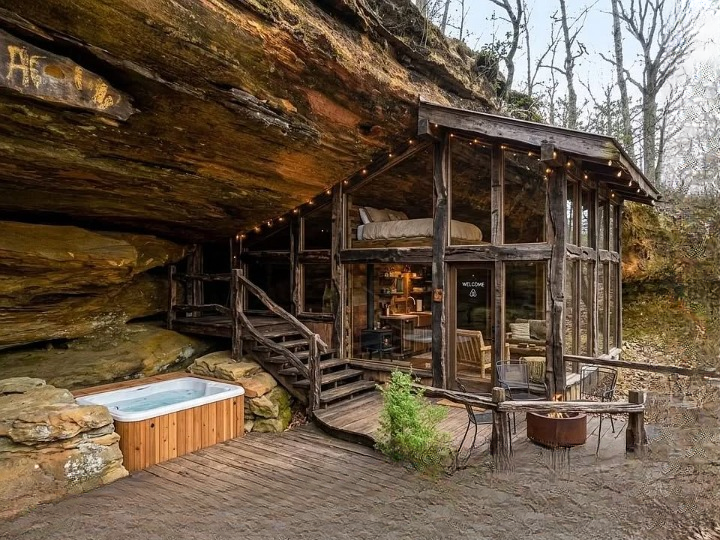

For buyers who think ordinary vacant land is a little too ordinary, one Kentucky property currently on the market comes with a feature you don’t encounter every day.
A roughly 8.8-acre wooded parcel near Ravenna, Kentucky, is listed for $50,000—and the property listing highlights a natural cave formation as its defining feature.
Located on Lot 2 of Mountain Springs Cem Road, the undeveloped property is being marketed as a potential site for an unconventional private retreat or short-term rental project.
But there’s an important distinction.
There isn’t a finished cave house waiting for a buyer.
There isn’t an existing luxury Airbnb hidden inside the mountain.
This is unimproved land with an unusual natural feature and ideas for what a future owner might potentially create, subject to surveys, site conditions, utilities, permits and other development requirements.
And according to the listing, some of the eye-catching structures shown in the property’s marketing images are AI-generated concepts—not existing buildings.
Here’s what prospective buyers are actually getting for $50,000.
The Property Covers 8.8 Acres
The listing identifies the parcel as approximately 8.8 acres of unimproved land in the Ravenna area of Kentucky.
That’s about 383,328 square feet.
At the current $50,000 asking price, the simple asking-price calculation works out to roughly $5,682 per acre.
The property is described as wooded, hilly, rolling and gently sloping.
Those characteristics are important because this isn’t a cleared suburban building lot.
It’s rural Kentucky land with substantial natural terrain.
The Natural Cave Is the Main Attraction
The feature that separates this listing from countless other wooded parcels is the natural cave formation.
The seller’s marketing suggests that a future owner could explore integrating a dwelling into or around the formation.
Ideas mentioned in the listing include a cave dwelling, an earth-integrated retreat or a distinctive short-term rental.
Those ideas are certainly attention-grabbing.
But they’re concepts.
The listing does not establish that a cave residence has already been engineered, permitted or approved.
A buyer interested in actually constructing something around the cave would need to determine whether that concept is technically, legally and financially feasible.
Even the Cave’s Property-Boundary Position Needs Verification
This is perhaps the most important sentence in the listing.
Prospective buyers are advised to obtain a survey to ensure the cave is actually within the property’s boundaries.
That may sound like a small technical detail.
It isn’t.
If the cave is the primary reason someone wants to buy the property, confirming its precise location relative to the legal parcel boundaries should be a fundamental part of due diligence.
A photograph or real-estate description isn’t a substitute for a professional boundary survey.
There’s Also a Ridge-Top Building Area
The cave isn’t the only feature being marketed.
The listing also describes a ridge area where a more conventional structure could potentially be built.
The seller promotes the ridge for its panoramic views on both sides.
That creates two very different conceptual directions for the land.
One would involve exploring construction around the cave or rock formation.
The other would focus on a more traditional structure positioned higher on the property.
A buyer could potentially investigate one or both possibilities.
Again, however, a marketed “homesite” shouldn’t be interpreted as a guarantee that a particular house design can be built there without further evaluation.
The Land Is Wooded and Hilly
According to the current listing information, the parcel includes:
- wooded terrain
- rolling slopes
- gentle slopes
- hilly sections
That variety could be appealing to someone looking for privacy and a more natural setting.
It could also affect development costs.
Road access, grading, drainage, foundation design, septic suitability and utility installation can all become more complicated on undeveloped rural terrain.
The same topography that makes a property visually distinctive can make construction more challenging.
That’s why the $50,000 land price shouldn’t be confused with the cost of creating a finished retreat.
It’s Being Marketed at $50,000
As of October 2026, the property is being advertised for $50,000.
The listing has appeared under Lot 2 Mountain Springs Cem Road in the Ravenna area.
Real-estate portals identify it as unimproved or residential land rather than an existing residence.
That’s worth emphasizing because conceptual imagery can make unusual land listings look much further along than they really are.
A buyer is purchasing land.
Not the fantasy rendering.
Some of the Marketing Images Are AI-Generated
This disclosure deserves prominent placement.
The listing states that all structures shown in the photos are AI-generated for illustration purposes.
In other words, if an image shows an incredible glass-fronted cave house, luxury cabin or similar completed structure, buyers shouldn’t assume that building exists.
Those images represent possibilities envisioned for marketing.
The actual property is undeveloped land.
This is increasingly important in real-estate advertising as AI-generated architectural concepts become easier to produce.
They can be useful for visualizing possibilities.
But they can also create unrealistic expectations if the disclosure is overlooked.
An AI Rendering Is Not a Building Plan
There’s an enormous gap between generating an attractive image and constructing a safe, legal building.
An AI image doesn’t determine:
Whether the rock is structurally suitable.
Whether the site can support the proposed foundation.
Whether water infiltration can be controlled.
Whether the cave is appropriate for habitation.
Whether septic approval is possible.
Whether emergency access requirements can be satisfied.
Whether utilities can economically reach the site.
Whether local authorities will approve the proposed use.
Or what construction will actually cost.
Those questions require real professionals and real site investigation.
Nearby Utilities Are Mentioned—but That Doesn’t Mean They’re Installed
The listing promotes nearby utility access and notes that neighboring properties have utility connections.
That’s encouraging compared with land located far from existing infrastructure.
But “utilities nearby” isn’t the same as:
“All utilities are installed at the future building site.”
A buyer should determine exactly what services are available, where they are located and what extending them onto the parcel would cost.
Electricity is only one consideration.
Water and wastewater arrangements can be equally important on rural land.
The current listing information doesn’t provide enough detail to assume those systems are ready for a future residence.
Zoning Information Needs Verification
Zillow’s current property information describes the zoning as “Other” and the zoning description as “Unknown.”
That should immediately tell a serious buyer not to make development assumptions based on an online advertisement.
Before buying with plans for a house, rental cabin or cave accommodation, the buyer should confirm requirements directly with the relevant local authorities.
Questions could include:
What uses are permitted?
What building permits are required?
Are there restrictions on short-term rentals?
Are there minimum setbacks?
What septic requirements apply?
Are there restrictions related to caves, slopes, waterways or other natural features?
What access requirements apply?
The answers can materially affect what the property is worth to a particular buyer.
The Red River Gorge Connection Is a Major Part of the Marketing
The listing says the property is near High Rock and roughly 30 minutes from Red River Gorge.
That’s significant because the Red River Gorge region is known for its dramatic sandstone cliffs, natural arches, hiking and climbing opportunities.
Tourism is therefore part of the property’s marketing story.
The seller specifically presents the land as a possible short-term rental investment.
A cave-themed accommodation near an outdoor recreation destination certainly has an intuitive marketing appeal.
But investment potential shouldn’t be confused with guaranteed investment performance.
A “Premium Airbnb” Is an Idea, Not a Proven Return
The listing suggests that a distinctive cave stay could potentially command stronger rates than an ordinary cabin.
That’s a marketing proposition.
The listing does not provide verified occupancy data, comparable-property revenue, operating expenses or a professional investment analysis demonstrating what this specific property would earn.
Anyone purchasing it primarily for short-term rental income would need to conduct a separate business analysis.
That could include:
Comparable nightly rates.
Seasonal occupancy.
Cleaning expenses.
Property management.
Insurance.
Maintenance.
Financing.
Utilities.
Platform fees.
Local taxes.
Construction cost.
Permitting.
And the cost of creating safe access to the property.
A spectacular idea can still be a poor investment if the development cost is too high.
Unique Doesn’t Automatically Mean Profitable
This principle applies to unusual properties everywhere.
Rarity can be valuable.
Travelers may indeed pay more for memorable accommodations.
Treehouses, converted barns, tiny homes and other unconventional stays have developed substantial audiences.
But uniqueness also creates challenges.
Custom construction can cost more.
Maintenance may require specialized work.
Insurance can be complicated.
Financing can be different from financing a conventional house.
Resale markets can be narrower.
The feature that makes a property exciting can simultaneously make it harder to develop.
The Cave Could Require Specialized Evaluation
Anyone seriously considering construction in or around a natural cave or rock formation should expect more investigation than would be required for an ordinary flat lot.
A qualified professional may need to evaluate rock stability, drainage, moisture, structural conditions and other geological or engineering considerations.
Caves and rock shelters are natural environments.
They weren’t designed as buildings.
Turning one into habitable space isn’t simply a matter of adding windows, electricity and furniture.
Water Could Be a Major Design Consideration
Natural rock formations interact with groundwater and rainfall.
Water may travel through cracks.
Moisture levels may change seasonally.
Heavy rain can reveal drainage conditions that aren’t obvious during a dry property showing.
Before designing an enclosed structure around a cave, a buyer would want to understand how water behaves on the site.
That information can affect everything from foundation design to waterproofing and long-term maintenance.
Septic Feasibility Could Matter Too
Rural properties often depend on private wastewater systems rather than municipal sewer service.
Whether a conventional septic system can be installed—and where—depends on site-specific conditions and local requirements.
A beautiful building location isn’t necessarily the same place that works for wastewater infrastructure.
That’s another reason a buyer should avoid designing the dream house before completing basic site due diligence.
Access Deserves Attention
The listing directions describe access involving a gravel road and an unkept dirt driveway where visitors can pull off.
That may fit perfectly with someone seeking a secluded mountain retreat.
But prospective buyers should evaluate access practically.
Can construction vehicles reach the proposed building site?
What happens during heavy rain?
Who maintains the road?
What legal access rights come with the parcel?
Would guests comfortably reach a future rental?
What would road improvements cost?
Those questions become particularly important if the property is intended to generate rental income.
The Ridge Could Be the More Conventional Option
For someone fascinated by the property but uncertain about building directly around the cave, the ridge could provide another path.
A cabin or home on elevated terrain might preserve the cave as a natural feature rather than attempting to transform it into living space.
That could potentially allow the cave to become part of the property’s recreational experience.
A future owner might envision trails or viewing areas connecting different parts of the acreage.
But these remain conceptual possibilities until site conditions and applicable regulations are confirmed.
It Could Also Remain Mostly Undeveloped
Not every unusual parcel needs to become a commercial project.
A buyer could potentially value the land simply for privacy, recreation or long-term ownership.
The wooded acreage and natural formation could appeal to someone who wants a rural retreat without immediately pursuing an elaborate construction project.
In fact, maintaining much of the land in its natural condition may be part of what attracts certain buyers.
Buyers Should Consider Environmental and Wildlife Factors
Natural caves can provide habitat for wildlife, including bats and other species.
That means a buyer contemplating major alterations shouldn’t assume the cave is merely an empty construction shell.
A site-specific environmental review may be appropriate depending on what is present and what development is proposed.
This is another area where professional evaluation matters more than conceptual renderings.
A Cave Is a Feature—Not a Guarantee of a Cave House
That’s probably the most useful way to understand this listing.
The property has a natural cave formation.
The seller suggests creative possibilities involving it.
Those facts don’t automatically establish that a finished cave dwelling can be constructed exactly as imagined.
The distinction protects buyers from confusing potential with permission.
And it makes the property more interesting, not less.
The real question becomes:
What can actually be created here after the necessary investigation?
What Should a Serious Buyer Verify?
Before purchasing this parcel specifically for development, a buyer would reasonably want answers in several areas.
First, obtain a boundary survey and confirm the cave’s location.
Second, verify legal access and road arrangements.
Third, confirm zoning, land-use and building requirements with the appropriate authorities.
Fourth, determine water and wastewater options.
Fifth, obtain accurate information about electricity and other utilities.
Sixth, evaluate the proposed building areas with appropriate construction, engineering or geological professionals.
Seventh, if short-term rental income is central to the purchase, verify that use and build a realistic financial model.
And finally, don’t base a development budget on an AI rendering.
The $50,000 Price Is Only the Starting Point
The asking price is attention-grabbing.
$50,000 for 8.8 acres with a natural cave near a major outdoor recreation region certainly sounds compelling.
But the eventual cost of developing the land could be far greater than the acquisition price.
Site preparation alone can add substantial expense to rural construction.
Then come utilities.
Driveway work.
Engineering.
Permits.
Foundation work.
Water.
Wastewater.
The structure itself.
Interior finishing.
Insurance.
And potentially specialized work associated with building near or within rock formations.
Until those costs are estimated, the land price alone doesn’t tell you whether the overall project is inexpensive.
For the Right Buyer, That’s Part of the Appeal
Not everyone wants a finished suburban house.
Some buyers specifically seek land that requires imagination.
They want to decide where the structure goes.
What it looks like.
How it interacts with the landscape.
How much of the natural environment remains untouched.
This property clearly belongs in that category.
The buyer isn’t paying for someone else’s finished vision.
They’re paying for the land and the possibility of creating their own.
The Current Listing Is Still Active
As of October 2026, major real-estate portals continue to show the 8.8-acre parcel for sale at $50,000.
The listing identifies Keller Williams Legacy Group as the brokerage and markets the property around its cave, wooded privacy, ridge and proximity to Red River Gorge.
It has also moved through different listing statuses during 2026, including a period when it was shown as pending before returning to the market.
That means anyone encountering older social-media posts or property articles should check the current listing rather than assuming the status or price hasn’t changed.
What Makes This Kentucky Property Stand Out
Strip away the AI concepts and marketing language, and the basic offering remains unusual.
Approximately 8.8 acres.
$50,000 asking price.
Wooded and hilly terrain.
A natural cave formation.
A ridge area promoted for potential building.
Nearby utilities according to the listing.
Roughly 30 minutes from Red River Gorge.
And a warning from the listing itself that buyers should survey the property to verify the cave’s location.
That’s enough to make the property interesting without promising a luxury cave Airbnb that doesn’t yet exist.
Final Thoughts
Lot 2 Mountain Springs Cem Road is the kind of listing that encourages imagination immediately.
It’s easy to look at the cave and picture glass walls tucked beneath rock.
A secluded vacation rental.
A private woodland retreat.
A cabin overlooking the surrounding terrain.
Maybe one of those ideas is feasible.
Maybe several are.
But the responsible way to present the property is to separate what exists today from what someone might build tomorrow.
Today, this is approximately 8.8 acres of undeveloped Kentucky land listed for $50,000, with wooded terrain, a ridge and a natural cave formation.
The dramatic structures shown in marketing materials are conceptual.
The cave boundary needs verification.
Zoning and development requirements need confirmation.
Utilities need investigation.
And any ambitious cave-building project would require considerably more professional evaluation.
For a buyer willing to do that work, however, it’s certainly not an ordinary piece of vacant land.
Would you rather preserve the cave as a natural feature and build on the ridge—or investigate whether an actual cave retreat could safely be created around it?
Editor’s note: Property prices, availability and listing details can change at any time. Development concepts discussed here are possibilities, not representations that construction has been approved or is technically feasible. Prospective buyers should independently verify boundaries, access, utilities, zoning, permits, geological conditions and construction feasibility before purchasing.
Listed on Zillow