
At first glance, this looks like an ordinary afternoon at home.
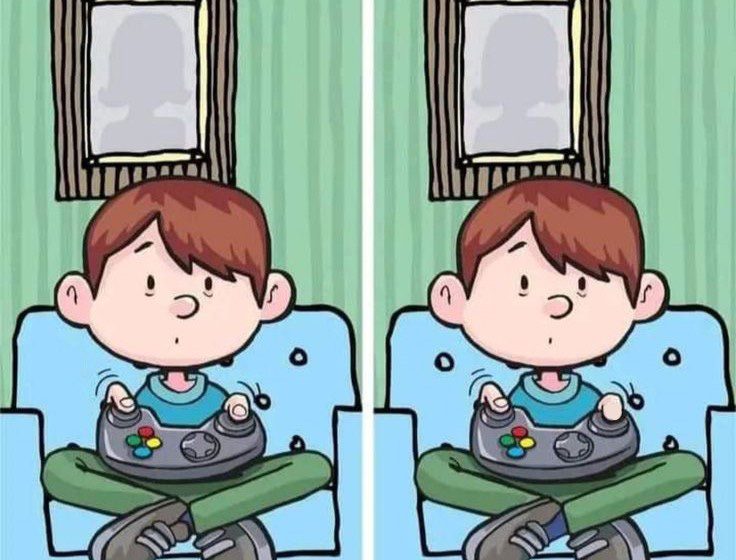
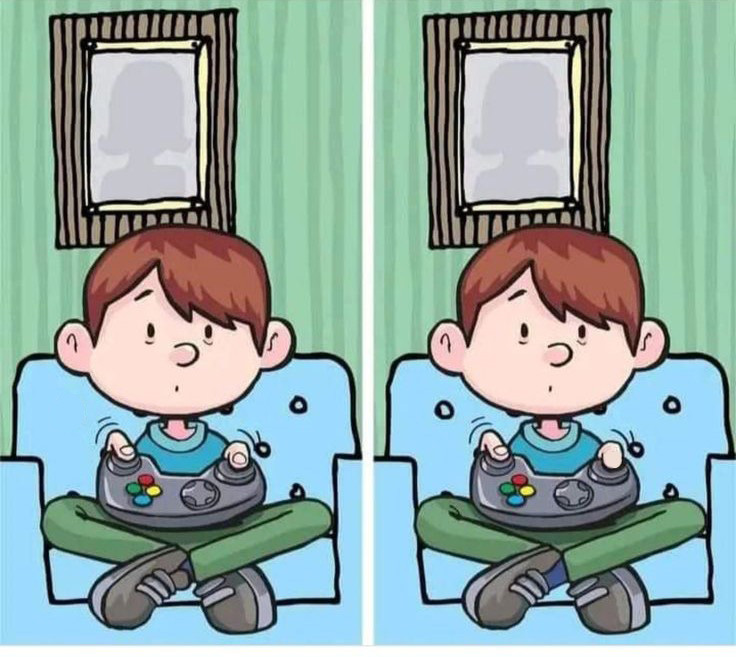
A young boy sits cross-legged on a bright blue sofa, holding a game controller in both hands.
His attention is completely fixed on the game.
Behind him is green striped wallpaper, a framed picture hangs on the wall, and everything seems perfectly normal.
But there’s a challenge hidden inside this seemingly simple scene.
The two pictures are not identical.
There are three differences hiding between them.
Can you find all three?
Take a good look before scrolling any farther.
Don’t Let the Simple Picture Fool You
Spot-the-difference puzzles often seem easy when you first see them.
Your brain immediately recognizes the overall scene:
Boy.
Sofa.
Controller.
Picture frame.
Shoes.
Wallpaper.
Once your brain decides that both images show the same thing, however, it can begin overlooking tiny changes.
That’s what makes these puzzles surprisingly tricky.
The differences don’t necessarily jump out immediately.
You have to stop looking at the picture as one complete scene and begin comparing individual details.
Give Yourself 30 Seconds
Before using any hints, try this:
Set a mental timer for about 30 seconds.
Look carefully at both images.
Your goal is to find:
Difference #1
Difference #2
Difference #3
If you find one quickly, don’t stop.
There are three in total.
The first discovery is only the beginning.
A Better Way to Search
If your eyes keep jumping randomly around the pictures, change your strategy.
Start at the top-left corner.
Then move slowly across the image.
After reaching the opposite side, move slightly downward and scan back.
Continue until you’ve covered the entire scene.
This prevents you from repeatedly examining the same obvious areas while accidentally ignoring others.
Start With the Picture Frame
Need your first hint?
Look near the upper portion of the scene.
Pay attention to the framed silhouette hanging behind the boy.
Don’t simply ask whether the frame exists in both pictures.
Compare the smaller details.
Shape.
Position.
Outline.
Orientation.
Anything that appears slightly different deserves another look.
Remember, this is only an area to inspect—not the answer itself.
Now Look at the Gamer
Move down from the wall and study the boy.
Our brains are particularly good at recognizing faces, but that can sometimes work against us in puzzles.
We see “the same boy” and stop examining individual features.
Instead, compare one detail at a time.
Hair.
Eyes.
Eyebrows.
Nose.
Mouth.
Ears.
Then look at his clothing.
Don’t rush.
A tiny alteration can disappear when you’re looking at the whole person instead of individual features.
Don’t Ignore the Controller
The controller naturally attracts attention because it’s positioned near the center of the image.
But have you actually examined it?
Look closely at:
The buttons.
Their positions.
Their colors.
The controls on either side.
The shape of the controller.
Small colorful objects are common places for puzzle designers to hide differences because your brain remembers the general object without necessarily remembering every detail.
The Blue Sofa Deserves a Second Look
The sofa takes up a large portion of the image.
That can make it surprisingly easy to overlook.
We tend to search complicated objects for differences while assuming large background areas haven’t changed.
Don’t make that assumption.
Compare the cushions.
Edges.
Lines.
Shapes.
And the areas immediately around the boy.
If something feels slightly wrong, compare the same location in the other picture.
Check His Trousers
Still missing one?
Move lower.
Look carefully at the boy’s trousers.
Don’t just compare their overall color.
Examine smaller details and shapes.
A difference doesn’t need to be large to count.
Sometimes the most difficult change is sitting directly in front of you because your brain has already categorized both objects as “the same.”
And Don’t Forget His Shoes
The lower part of an image is easy to neglect.
By the time people have inspected the boy’s face and controller, they often return to the top and start searching again.
Instead, continue downward.
Compare both shoes carefully.
Look at their shape and individual details.
Then inspect the area surrounding them.
Have You Found Three Yet?
Stop here if you’re still searching.
You should have exactly three differences.
If you only have one, keep looking.
If you have two, you’re very close.
And if you’ve identified three, make sure you’re confident before checking the solution.
The temptation to peek is strong.
Resist it for another few seconds.
Why Can Spot-the-Difference Puzzles Feel So Difficult?
The challenge isn’t simply eyesight.
Attention plays an important role.
When two pictures are nearly identical, your brain quickly recognizes the shared scene and stops processing every individual detail with equal intensity.
That’s normally useful.
Imagine having to consciously reexamine every object in a familiar room every time you entered it.
Your brain instead relies heavily on patterns and expectations.
A puzzle takes advantage of that efficiency.
The scene looks familiar enough that small changes can slip past unnoticed.
We Notice Meaning Before Tiny Details
Look at the image for a second and ask what you see.
Most people won’t say:
“A rectangle, several curved shapes, five colored circles and alternating green vertical lines.”
They’ll say:
“A boy playing video games on a sofa.”
Your brain turns hundreds of visual details into meaningful objects almost instantly.
That’s incredibly useful in everyday life.
But in a visual puzzle, the important information may be hidden inside those tiny details your brain normally compresses.
That’s Why Systematic Searching Works
Instead of looking for “something different,” compare matching objects directly.
Picture frame against picture frame.
Face against face.
Controller against controller.
Sofa against sofa.
Trousers against trousers.
Shoes against shoes.
Now the task becomes much easier.
You’re reducing the amount of information your brain has to compare at one time.
Try the Cover-and-Compare Trick
Here’s another simple method.
Cover part of one image with your hand or a piece of paper.
Focus on a small section of the visible picture.
Memorize what you see.
Then reveal the corresponding area in the other image.
This can help when the pictures are positioned in a way that makes direct comparison difficult.
Another Trick: Look Away Briefly
If you’ve been staring at the puzzle for too long, your attention may become stuck.
Look away for several seconds.
Then return.
You may notice a difference almost immediately that you had overlooked for the previous minute.
A fresh look can break the pattern your eyes have settled into.
Challenge Someone Else Before Revealing the Answer
This puzzle becomes more entertaining when two people attempt it independently.
Don’t point at the areas you’ve already discovered.
Give the other person the same challenge:
Find all three differences.
Then compare how long each of you needed.
You may even notice that different people find different changes first.
One person immediately notices something near the boy.
Another sees something in the background.
Someone else focuses on the controller.
That’s part of what makes these simple puzzles fun.
Ready for the Solution?
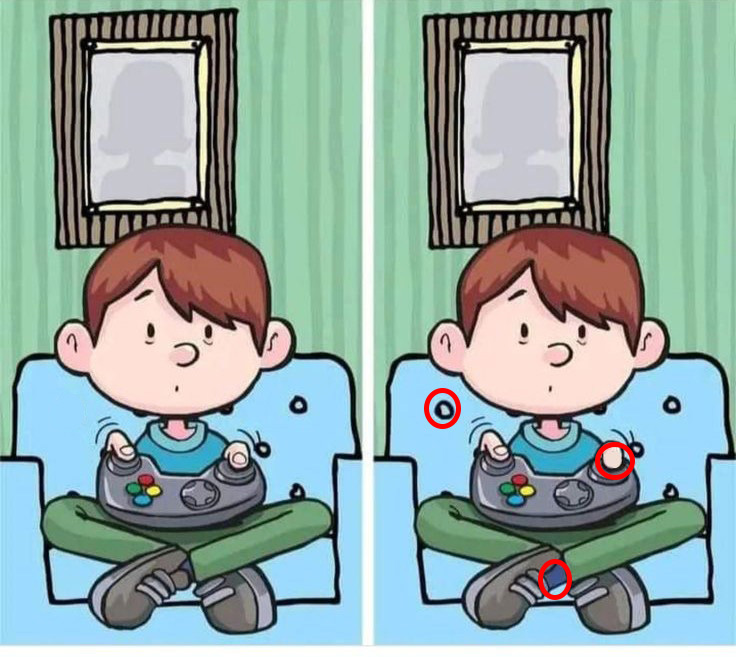
If you’ve found three differences, it’s time to compare your answers with the solution image below.
Look carefully at the highlighted areas and check them against the differences you identified.
Did you find all three without help?
If so, you passed the challenge.
If you missed one, go back to the original image after seeing the solution.
The difference that seemed almost invisible before will probably look obvious now.
That’s one of the strangest things about visual puzzles:
Once you know where a difference is, it becomes difficult not to see it.
Don’t Spoil It for Everyone Else
If you’re sharing this puzzle with friends or family, avoid immediately posting the three answers.
Instead, tell them how many you found.
Then give them a chance to try.
A simple:
“I found all three—can you?”
is enough to start the competition.
Final Challenge
One gamer.
One blue sofa.
Two nearly identical pictures.
Three hidden differences.
The scene may look simple, but the smallest details are doing all the work.
So take one final look before checking the answer image.
Start with the frame.
Move to the boy.
Inspect the controller.
Scan the sofa.
Then finish with his trousers and shoes.
How many did you find without looking at the solution—1, 2, or all 3?
Editor’s note: This is a recreational visual puzzle. The areas mentioned above are search hints based on the supplied puzzle description; they should not be interpreted as confirmed solutions unless they match the accompanying answer image.