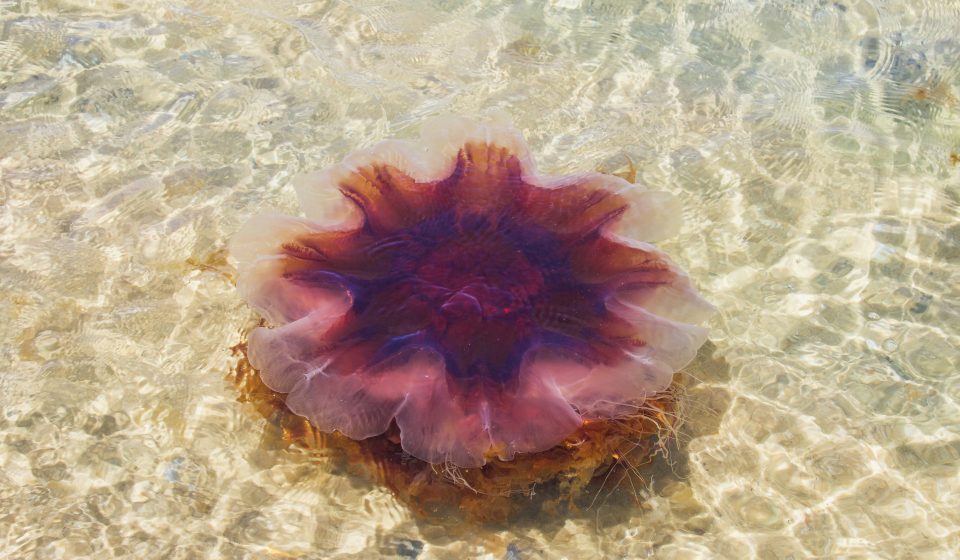
I Found This Giant Creature Washed Up on the Beach—Then I Learned Why I Shouldn’t Touch It

It was supposed to be an ordinary morning beside the Atlantic.
The tide was retreating.
My dog was exploring the beach.
I was enjoying the kind of quiet walk where nothing particularly memorable is supposed to happen.
Then I saw something lying near the waterline.
At first, I couldn’t tell whether it was an animal at all.
It was large, translucent and covered with long strands that shifted every time the water reached it.
My dog immediately became interested.
I immediately became nervous.
I pulled him away before he could investigate.
That simple decision turned out to be the right one.
Because after spending hours trying to identify what had washed onto the beach, I found a convincing possibility:
It appeared to be a lion’s mane jellyfish—one of the most remarkable jellyfish found in colder ocean waters, and a creature that should still be treated cautiously even when stranded on shore.
It Didn’t Look Like Anything I Recognized
Beaches have a way of making familiar things look strange.
Seaweed twists into unusual shapes.
Driftwood can resemble bones.
Foam gathers into unfamiliar patterns.
Marine animals can look completely different outside the water than they do in photographs.
This was different enough that I stopped walking.
The central mass looked gelatinous and translucent.
Long, thin structures extended away from it.
Each time the retreating water moved across the sand, those strands shifted.
For a moment, it almost looked as though the creature was moving deliberately.
I knew enough not to touch it.
But my dog didn’t share my caution.
My First Concern Was Keeping the Dog Away
Dogs investigate the world with their noses and mouths.
That’s normally harmless curiosity.
On a beach, it can become a problem very quickly.
A dead fish may contain something harmful.
A hook can be hidden in discarded fishing line.
An unfamiliar marine animal can sting or contain irritating tissue.
So before trying to solve the mystery, I moved my dog farther away.
That was the first important decision.
Identification could wait.
Safety couldn’t.
I Took Photographs Instead
Once we were at a reasonable distance, I photographed the object.
I expected someone I knew to recognize it immediately.
Nobody did.
One person thought it was some type of seaweed.
Another wondered whether it was part of a larger marine animal.
Someone else simply responded with the digital equivalent of:
What on earth is that?
That didn’t help much.
So I started searching.
The Images Eventually Led Me Toward Jellyfish
I compared photographs.
I looked through marine-life discussions.
I searched for large jellyfish found along Atlantic coastlines.
Gradually, one candidate began appearing again and again.
The lion’s mane jellyfish.
The resemblance was striking enough to provide a plausible identification, although a photograph alone isn’t always sufficient to identify a marine species with certainty.
And once I started reading about lion’s mane jellyfish, my reaction changed.
The strange object on the beach became much more interesting.
But it didn’t become something I wanted to touch.
What Is a Lion’s Mane Jellyfish?
The lion’s mane jellyfish is known scientifically as Cyanea capillata.
Its common name comes from the mass of tentacles beneath its bell, which can resemble a lion’s mane.
It is associated particularly with cooler waters and can occur in northern parts of the Atlantic and Pacific oceans.
The species has become famous partly because of its potential size.
Large specimens can develop impressive bells and exceptionally long tentacles.
That appearance helps explain why a stranded individual can look so bizarre on a beach.
In the water, the tentacles trail behind the animal.
On shore, they may become tangled, stretched across wet sand or mixed with seaweed and debris.
Some Lion’s Mane Jellyfish Can Become Enormous
The species is frequently described among the world’s largest jellyfish.
But that doesn’t mean every lion’s mane jellyfish becomes gigantic.
Size varies considerably.
Smaller individuals are common.
Occasionally, however, very large specimens are recorded.
Their long tentacles make them appear even larger than the bell itself.
And those tentacles are exactly why keeping your distance matters.
A Stranded Jellyfish Can Still Sting
This was the detail that immediately made me think about my dog.
A jellyfish doesn’t necessarily become harmless simply because it has washed ashore.
The stinging structures in its tentacles can remain capable of firing after the animal is stranded or even dead.
That means a person walking barefoot along the beach—or a curious dog sniffing something unfamiliar—could potentially encounter active stinging cells.
The safest rule is simple:
Don’t handle a jellyfish you find on the beach, even if it appears dead.
The Tentacles Are the Main Concern
Jellyfish tentacles contain specialized microscopic structures used to deliver venom.
In nature, they’re part of how jellyfish capture prey and defend themselves.
For humans, contact can produce a painful sting.
The severity varies depending on the species, the amount of contact and the individual’s response.
Lion’s mane jellyfish stings are generally known for causing pain and skin irritation.
That doesn’t mean every encounter becomes a medical emergency.
But it does mean touching an unidentified jellyfish isn’t worth the experiment.
Children and Pets Need Extra Attention
Adults may recognize an unusual jellyfish and decide not to touch it.
Children may see something fascinating.
Dogs may see something worth sniffing.
That’s why adults supervising children or animals on a beach should pay attention to unusual material along the tide line.
If something resembles a jellyfish, giving it plenty of room is much easier than dealing with a sting afterward.
A leash can be particularly useful when jellyfish have been reported or when large numbers are washing ashore.
Even Pieces of Tentacle Can Matter
Another reason to be cautious is that the entire jellyfish doesn’t have to be intact.
Tentacle fragments can become separated.
They may be difficult to see, particularly when mixed with wet sand, seaweed or other debris.
So finding one large stranded jellyfish can be a good reason to pay additional attention to the surrounding area.
There may be more material nearby.
Why Do Jellyfish Wash Ashore?
Seeing a jellyfish on the beach doesn’t necessarily mean something mysterious has happened.
Jellyfish are strongly influenced by currents, tides, waves and wind.
Conditions can push them toward shore.
Once in shallow water, some become stranded as the tide retreats.
At certain times, multiple jellyfish may appear along the same stretch of coastline.
To a person arriving afterward, the scene can look dramatic.
From the ocean’s perspective, however, water movement may provide much of the explanation.
The Retreating Tide Made It Look Alive
That was one of the strangest things about my encounter.
The creature seemed to move.
But I couldn’t tell how much of that apparent movement came from the animal and how much came from the water pulling its long strands across the sand.
That’s another reason beach discoveries can be difficult to interpret.
Water creates motion.
Wind creates motion.
Tentacles and gelatinous tissue move easily.
What looks like deliberate movement from several feet away may simply be the tide rearranging the animal.
Either way, the correct response doesn’t change.
Don’t touch it.
Identification From a Photograph Has Limits
The internet makes wildlife identification easier than it used to be.
Upload a photograph.
Compare images.
Ask a community.
Search by shape and location.
Those tools can narrow the possibilities considerably.
But resemblance isn’t always proof.
Closely related jellyfish can look similar.
A stranded animal may be damaged.
Colors can change after death or exposure.
Tentacles can become tangled.
Scale can also be difficult to judge from a photograph.
So while the animal I encountered appeared consistent with a lion’s mane jellyfish, responsible identification should leave room for uncertainty unless a knowledgeable local expert confirms it.
That’s Particularly Important With Viral Beach Photos
Social media is filled with images of strange creatures supposedly discovered on beaches.
The captions often become more dramatic with every repost.
“Deadly creature discovered.”
“Experts issue warning.”
“Never touch this.”
Sometimes there is a legitimate safety issue.
Sometimes the species is incorrectly identified.
Sometimes the animal isn’t nearly as dangerous as the caption suggests.
The best response lies between panic and carelessness.
Treat unfamiliar wildlife cautiously.
Then verify what you’re looking at through reliable sources.
Don’t Assume “Dead” Means Safe
This is probably the most useful lesson from the entire encounter.
People naturally associate danger with movement.
If an animal is moving, we’re cautious.
If it appears dead, we relax.
Jellyfish don’t fit neatly into that assumption.
Their stinging cells operate differently from a bite delivered intentionally by an animal.
Physical contact can trigger them.
So a motionless jellyfish deserves the same basic rule:
Leave it alone.
What If Someone Is Stung?
First-aid recommendations for jellyfish stings can vary by species and region, so local guidance matters.
In general, the person should get out of the water and avoid rubbing the affected area, because rubbing can worsen exposure to remaining stinging cells.
Visible tentacle material should be handled cautiously rather than grabbed with bare hands.
For severe pain, extensive exposure, breathing difficulty, chest symptoms, loss of consciousness, or signs of a serious allergic reaction, emergency medical help should be sought promptly.
When lifeguards or local authorities are present, they can also provide guidance appropriate to jellyfish species in that area.
Dogs Can Be Stung Too
Pets aren’t protected simply because they have fur.
Exposed areas such as the nose, mouth and paws may come into contact with tentacles.
A dog may also try to bite or eat a stranded jellyfish.
That’s another reason I was relieved I’d stopped mine before curiosity became contact.
If a pet encounters a jellyfish and develops significant pain, swelling, distress, breathing problems or other concerning symptoms, contacting a veterinarian promptly is the safer approach.
There Was No Reason to Kill or Move It
Once I had a likely identification, I didn’t need to do anything to the animal.
I didn’t need to poke it with a stick.
I didn’t need to drag it farther onto the beach.
I certainly didn’t need to pick it up for a photograph.
Wild animals don’t become souvenirs because they wash ashore.
In many situations, the most responsible response is simply to give the animal space.
If a large or potentially hazardous marine animal is creating a public-safety concern on a busy beach, local lifeguards, park staff or wildlife authorities are better positioned to decide whether anything needs to be done.
Fear Gradually Turned Into Fascination
Once I understood what I might be looking at, the experience changed.
The creature was still strange.
But it was no longer alien.
Its translucent body had a purpose.
The trailing structures weren’t random threads.
They were part of an animal adapted to an environment almost completely different from mine.
What had initially looked like a shapeless heap on the sand belonged to a much larger ocean ecosystem.
That realization made the encounter feel less frightening.
But not less deserving of respect.
The Ocean Hides Most of Its Life From Us
A beach gives us only the edge of an enormous environment.
We see seabirds.
Shells.
Fish.
Crabs.
Seaweed.
Occasionally something much stranger appears.
A jellyfish can spend its life moving through water that most of us will never see beneath the surface.
Then wind and tide place it directly in front of someone walking a dog before breakfast.
That’s part of what makes coastlines fascinating.
You never quite know what the ocean will leave behind.
Curiosity and Caution Can Exist Together
My first instinct was caution.
My second was curiosity.
Neither was wrong.
The mistake would have been believing I had to touch the creature in order to understand it.
I didn’t.
I could photograph it.
Research it.
Learn about it.
And leave it exactly where it was.
That’s a useful approach to unfamiliar wildlife in general.
You don’t need to be afraid of every strange animal.
But you also don’t need to handle everything you find.
The Best Wildlife Encounter Often Ends With Distance
There is something deeply satisfying about identifying an animal you’ve never encountered before.
A strange object becomes a species.
The species becomes a story about adaptation.
Suddenly, an ordinary morning has taught you something about an ecosystem you thought you already knew.
But responsible wildlife encounters should leave both sides as undisturbed as possible.
For me, that meant keeping the dog away, taking photographs from a safe distance and continuing down the beach.
Final Thoughts
What began as an unsettling discovery on an ordinary Atlantic morning became a reminder of how much unfamiliar life exists just beyond the shoreline.
The translucent animal with long trailing strands appeared consistent with a lion’s mane jellyfish, an impressive species known for its mass of tentacles and, in larger specimens, remarkable size.
But the most important lesson wasn’t its name.
It was the decision not to touch it.
Stranded jellyfish and their tentacles can remain capable of stinging, which makes distance particularly important for curious children and pets.
There was no need to panic.
There was no need to destroy it.
And there was certainly no need to pick it up.
I only needed to respect it.
A few hours earlier, I’d looked at the creature and wondered what kind of bizarre thing the Atlantic had deposited at my feet.
By the end of the day, the answer felt much simpler.
It wasn’t a monster.
It wasn’t something alien.
It was simply an extraordinary ocean animal that had ended up temporarily in my world.
And sometimes the best thing we can do when nature gives us an encounter like that is look, learn—and leave enough distance between curiosity and danger.
Editor’s note: The animal described in this story appeared consistent with a lion’s mane jellyfish based on visual comparison, but a definitive species identification should not be made from the supplied description alone. Jellyfish stings can vary by species and region. Follow local beach or medical guidance if a sting occurs, and seek urgent medical care for severe symptoms.