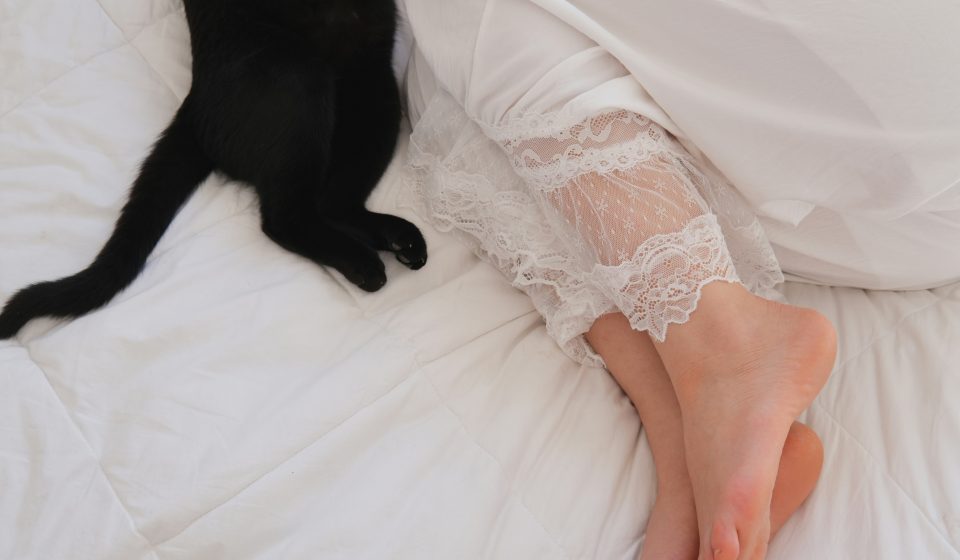

If you have a cat, you’ve probably experienced this at least once.
You turn off the lights, pull up the blankets, and settle in for the night.
A few minutes later, you feel something jump onto the bed.
Your cat walks across the mattress, circles the same spot several times, and finally curls up beside you.
Maybe it sleeps near your feet.
Maybe it presses against your legs.
Or perhaps it ignores every available inch of mattress and settles directly beside your head.
Many cat owners simply consider this another quirky feline habit.
But when a cat repeatedly chooses to sleep beside a person, there can be several perfectly natural explanations.
It doesn’t mean your cat is secretly detecting something supernatural, and there is no reason to believe dramatic online claims that a sleeping cat is somehow “healing” a particular part of your body.
The real explanations are simpler—and arguably more interesting.
Your Cat May Feel Safe Around You
Sleep is a vulnerable time for animals.
When a cat is asleep, it cannot monitor its surroundings as carefully as it can while awake.
That’s one reason cats often choose sleeping locations where they feel protected.
A favorite chair.
A high shelf.
A quiet corner.
A covered bed.
Or sometimes, you.
If your cat regularly curls up beside you and falls deeply asleep, it may simply mean that your presence has become associated with safety.
Your bedroom is familiar.
Your scent is familiar.
Your movements are familiar.
And for a cat that trusts you, being nearby may feel like a comfortable place to let its guard down.
Your Body Is Also a Convenient Source of Warmth
Cats are famous for finding warm places.
A patch of sunlight on the floor.
A blanket fresh from the dryer.
The top of a warm piece of furniture.
And, naturally, a human being under a comforter.
Your body continuously produces heat, making the bed particularly attractive during cooler nights.
This may explain why some cats seem much more interested in sleeping beside their owners during winter than during the hottest part of summer.
Sometimes the explanation really is that simple.
You’re warm.
Your Cat Knows Your Scent
Scent plays an important role in how cats experience their environment.
Your bed is filled with familiar smells.
So are your blankets, pillows and clothing.
For an animal that lives with you every day, those familiar scents can be part of a predictable environment.
That familiarity may contribute to why your cat chooses your bed over an empty room.
It isn’t necessarily making a complicated emotional calculation.
Your bed simply smells, feels and sounds like a familiar part of its territory.
Sleeping Near You Can Be a Social Behavior
Cats sometimes get portrayed as completely independent animals that tolerate humans only because we provide food.
Anyone who has lived with an affectionate cat knows the reality can be more complicated.
Individual cats vary enormously.
Some want constant contact.
Others prefer interaction on their own terms.
Some will follow their owners from room to room but dislike being held.
Others happily spend hours curled up on a person’s lap.
Sleeping near you can be another form of social contact.
Your cat doesn’t need to be actively playing or asking for attention to choose your company.
Sometimes simply being nearby is enough.
Why Does My Cat Sleep at My Feet?
This is a common favorite.
Your feet provide warmth without placing the cat directly beside your moving arms or face.
The end of the bed may also provide an easy escape route.
If something startles the cat, it can jump down quickly.
So a cat sleeping at your feet isn’t necessarily being less affectionate.
It may simply have found a location that combines warmth, proximity and convenience.
What If the Cat Sleeps Beside Your Head?
Other cats do the opposite.
They want the pillow.
Or the space directly beside it.
There are several possible reasons.
Your head and upper body produce warmth.
Your pillow carries your scent.
And compared with your legs, your head may move less dramatically during sleep.
For some cats, that makes the upper part of the bed an attractive location.
Of course, your cat may also have learned that sleeping beside your face is an excellent way to make sure you notice it the moment you wake up.
Breakfast matters.
What About Sleeping on Your Chest?
This can feel particularly affectionate because the cat is physically close to you.
Warmth is likely part of the attraction.
The position also provides direct physical contact.
Some cats appear comfortable with the gentle movement and sounds associated with resting against their owner.
But don’t assume every cat will enjoy this.
Feline personalities differ.
One cat may happily sleep on your chest every night.
Another may consider sitting three feet away an impressive display of affection.
Purring Makes the Experience Feel Even More Special
Few sounds are more closely associated with cats than purring.
When a cat curls up beside you and begins to purr, it’s easy to interpret the moment as pure happiness.
Often, purring does occur when a cat appears comfortable and relaxed.
But purring isn’t exclusively a sign of happiness.
Cats may also purr in other situations, including when stressed or uncomfortable.
Context matters.
If your cat is relaxed, resting comfortably and voluntarily choosing to stay beside you, purring can be part of that calm interaction.
Does a Cat Sleeping Beside You Mean It Loves You?
We can’t ask a cat to define love in human terms.
But we can observe behavior.
A cat that voluntarily approaches you, relaxes nearby, seeks contact and repeatedly chooses to spend time with you is demonstrating a positive social relationship.
Whether you call that love, trust, attachment or companionship is partly a matter of language.
What’s clear is that the cat has options.
It could sleep somewhere else.
Instead, it keeps choosing your bed.
For many owners, that’s meaningful enough.
Does Your Cat Think You’re Another Cat?
Probably not in the simplistic way this claim is sometimes presented online.
Cats can clearly interact differently with humans than they do with other cats.
But some behaviors they use socially with other cats can also appear in their relationships with people.
Rubbing.
Grooming.
Resting nearby.
Seeking physical contact.
That doesn’t mean your cat literally mistakes you for an enormous hairless feline.
It means some feline social behaviors can extend to the humans they live with.
Why Does My Cat Knead the Blanket Before Sleeping?
Another familiar bedtime ritual is kneading.
The cat alternates its front paws against a blanket, pillow—or occasionally your stomach.
Kneading begins early in a cat’s life, when kittens knead around their mother’s mammary area while nursing.
Adult cats may continue the behavior in comfortable situations.
If your cat kneads a blanket before settling down, it can be associated with relaxation and comfort.
Unfortunately, the cat may not understand that its claws make the experience significantly less relaxing for you.
Why Does My Cat Turn in Circles Before Lying Down?
Dogs are famous for this behavior, but cats can do it too.
A cat may inspect a location, turn around and adjust itself several times before finally settling.
This can simply be part of getting comfortable and checking the sleeping area.
To you, the entire bed may look equally soft.
To your cat, apparently, one particular six-inch section is perfect.
Your Routine Can Become Your Cat’s Routine
Cats can become very familiar with household schedules.
They may learn when you wake.
When you leave.
When food usually appears.
And when the lights go out.
If your cat starts walking toward the bedroom at roughly the same time you do, it may have incorporated your bedtime into its own routine.
That’s why some cats seem almost offended when their owners stay awake much later than usual.
The household schedule has changed.
And nobody consulted the cat.
There Are Benefits to Sharing the Bed
For many people, having a pet nearby is comforting.
The warmth.
The purring.
The companionship.
The familiar nighttime routine.
Some owners simply sleep better knowing their pet is close.
A cat curled up at the foot of the bed can make a room feel less empty, particularly for someone who lives alone.
Those emotional benefits don’t require exaggerated medical claims.
Companionship itself can be valuable.
But Sharing a Bed Isn’t Perfect for Everyone
Cats are not always considerate roommates.
They move.
They groom themselves.
They jump on and off the mattress.
They may decide that 4:30 AM is the ideal time to walk across your chest.
Some cats become active during hours when their owners would strongly prefer them to remain asleep.
If your cat repeatedly disrupts your sleep, there’s nothing wrong with establishing a different nighttime routine.
Your health and sleep matter too.
Allergies Can Also Be a Consideration
Someone with significant cat allergies may find that allowing a cat onto pillows and bedding worsens exposure to allergens.
In that situation, keeping the bedroom or bed pet-free may be part of managing symptoms.
Individual medical circumstances differ, so people with significant allergy or asthma concerns should follow advice appropriate to their own health situation.
Loving your cat doesn’t require sharing a pillow with it.
Hygiene Matters
Cats walk through litter boxes.
They explore floors.
Outdoor cats may encounter dirt, parasites and other environmental contaminants.
That doesn’t mean a healthy household cat is automatically dangerous to have near you.
But basic hygiene remains sensible.
Keep litter areas clean.
Maintain appropriate veterinary care.
Use recommended parasite prevention when appropriate.
Wash bedding regularly.
And pay attention to changes in your cat’s health.
Children and People With Certain Health Risks May Need Extra Caution
Not every household has the same circumstances.
Very young children, people with weakened immune systems, or individuals with specific health concerns may need additional precautions around pets.
If there’s a medical reason to limit animal exposure, follow guidance from an appropriate healthcare professional.
General internet claims shouldn’t replace individualized medical advice.
What If Your Cat Suddenly Starts Sleeping With You?
This can be interesting when the behavior is new.
Perhaps the weather has become colder.
Maybe something changed elsewhere in the home.
Your cat may have discovered that your bed is simply more comfortable.
A change in sleeping location alone doesn’t automatically indicate a medical problem.
But sudden behavioral changes can sometimes accompany stress or illness.
If the new behavior occurs alongside changes in appetite, activity, grooming, litter-box habits, breathing, mobility or other concerning symptoms, consider discussing them with a veterinarian.
What If Your Cat Suddenly Stops Sleeping With You?
Don’t take it personally.
Cats change sleeping locations frequently.
Temperature can matter.
So can noise.
Furniture changes.
Another pet.
A new household routine.
Or the discovery of an apparently superior cardboard box.
A cat choosing another sleeping spot doesn’t necessarily mean your bond has changed.
Look at the animal’s overall behavior rather than interpreting one habit in isolation.
The Internet Loves Dramatic Explanations
You may have seen posts claiming that a cat sleeps on a particular part of your body because it can detect disease there.
Or that purring is actively repairing your organs.
Or that the location where your cat sleeps reveals a hidden health problem.
These claims should be treated cautiously.
Cats have impressive senses and fascinating behavior, but a sleeping position isn’t a medical diagnostic test.
If you have a health concern, talk to an appropriate healthcare professional.
Don’t wait for your cat to diagnose you.
What Your Cat’s Choice Probably Says Most Clearly
Your bed offers several things cats value.
Warmth.
Familiarity.
Security.
Comfort.
And access to a person they know.
There doesn’t have to be one single explanation.
Your cat may sleep beside you because the bed is warm and because it feels safe and because it enjoys being close to you.
Animal behavior rarely needs a supernatural explanation to be fascinating.
The Most Meaningful Part Is That Your Cat Has a Choice
Think about all the places available in a home.
The couch.
A chair.
A cat bed.
A rug.
A windowsill.
A box that arrived five minutes ago and has somehow become the most valuable object in the house.
Yet night after night, some cats return to the same person’s bed.
Whatever combination of warmth, safety, habit and social attachment is responsible, the behavior tells you something simple:
Your cat is comfortable being there.
The Bottom Line
If your cat sleeps in your bed, you don’t need a dramatic viral explanation for what it means.
Your cat may be seeking warmth.
It may enjoy your familiar scent.
Your bedroom may feel secure.
Sleeping near you may be part of your cat’s social bond with you.
Or your mattress may simply be the most comfortable sleeping spot in the house.
Often, several of these explanations probably overlap.
So the next time your cat curls up beside you, purrs for a few minutes and falls asleep, you don’t need to wonder whether it’s secretly diagnosing your body or sending you a mysterious message.
The explanation may be much simpler.
Of all the places your cat could sleep, it feels comfortable choosing one close to you.
And for a cat owner, that may be the nicest meaning of all.
Editor’s note: This article discusses general feline behavior and should not be used to diagnose either human or animal health conditions. Sudden or persistent changes in a cat’s behavior accompanied by other concerning symptoms should be discussed with a veterinarian.