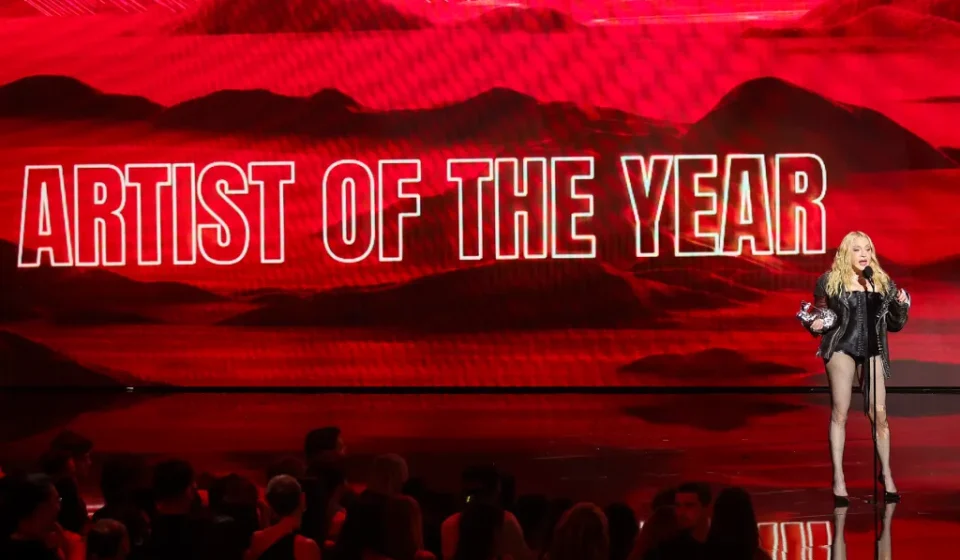
Madonna, 68, Returns to the VMAs Stage After 23 Years—and Fans Can’t Stop Talking About Her Performance

More than four decades after Madonna helped define what an MTV Video Music Awards performance could look like, she returned to the stage where some of her most famous pop-culture moments began.
And at 68, she wasn’t there simply to look back.
Madonna opened the 2026 MTV Video Music Awards in Los Angeles on September 27, marking her first live performance at the ceremony in 23 years.
She didn’t return alone.
Sabrina Carpenter joined her early in the performance, while Charli xcx later made a surprise appearance, creating a three-generation pop spectacle that immediately became one of the night’s most talked-about moments.
For longtime Madonna fans, however, the significance went beyond a single performance.
This was an artist whose relationship with the VMAs stretches all the way back to the ceremony’s beginning.
And once again, she made sure people were paying attention.
Madonna’s VMA History Goes Back to 1984
To understand why her 2026 return mattered, it’s worth going back more than 40 years.
Madonna performed “Like a Virgin” at the inaugural MTV Video Music Awards in 1984.
The performance became one of the defining moments of her early career.
Wearing a bridal-inspired outfit, she delivered the kind of provocative television appearance that would become closely associated with her ability to turn an awards-show performance into a cultural event.
At the time, not everyone was convinced it was a good idea.
Madonna has recalled that her then-manager believed the controversial performance could damage her career.
History went in a very different direction.
Rather than ending her rise, the VMAs became one of the stages most closely associated with Madonna’s willingness to take risks.
She Kept Reinventing the Awards-Show Performance
Madonna’s VMA history didn’t stop with “Like a Virgin.”
Her 1989 performance of “Express Yourself” became another memorable moment.
A year later, she delivered an elaborate performance of “Vogue” inspired by 18th-century European imagery.
In 1993 came “Bye Bye Baby.”
Each performance belonged to a different Madonna era.
That’s part of what made her relationship with the VMAs unusual.
She didn’t simply return to reproduce the same image.
The visual language changed.
The music changed.
The fashion changed.
Madonna changed.
Yet the expectation remained the same:
Something memorable was probably about to happen.
Then Came 2003
For a younger generation, Madonna’s most recognizable VMA moment may be the 2003 opening performance with Britney Spears and Christina Aguilera.
It became an immediate pop-culture story.
The three singers performed together before Madonna kissed both Spears and Aguilera onstage, producing one of the most replayed awards-show moments of the era.
That performance would eventually become particularly significant for another reason.
It was Madonna’s last live VMA performance for 23 years.
Until 2026.
Her Return Was Announced as a Major VMA Moment
Ahead of this year’s ceremony, CBS and MTV confirmed that Madonna would open the show.
The announcement emphasized the history behind the appearance: it would be her first live performance at the VMAs in more than two decades.
She also entered the ceremony as the night’s most-nominated artist, with 11 nominations connected to her latest era, including Confessions II.
The return wasn’t designed as a quiet cameo.
Madonna was opening the show.
Sabrina Carpenter Appeared at the Piano
The performance began with Sabrina Carpenter playing piano as Madonna appeared above her.
Carpenter joined Madonna for “Bring Your Love,” their collaboration from Confessions II.
Visually, the staging mixed references to Madonna’s current work with elements that acknowledged the pop-star mythology surrounding her.
Madonna appeared in a black waistcoat and knee-high boots before revealing a red-and-black corset as the performance expanded into a larger theatrical production.
Dancers, cameras and elaborate staging surrounded the performers.
It wasn’t simply Madonna walking onto the stage to receive applause for her career.
She was performing.
Then Charli xcx Appeared
The next surprise came when Charli xcx joined the performance.
Madonna and Charli performed their collaboration connected to “Danceteria,” extending the opening into a multi-generational celebration of dance-pop.
The appearance was particularly fitting.
Madonna’s influence can be traced through multiple generations of pop artists, especially performers who combine dance music, provocative visuals, fashion and deliberate reinvention.
Putting Madonna alongside Sabrina Carpenter and Charli xcx made that lineage visible on one stage.
Three Generations of Pop Shared One Stage
That’s arguably what made the pairing more interesting than a conventional anniversary performance.
Madonna could easily have built the entire segment around nostalgia.
She has enough famous songs and enough iconic VMA moments to do that.
Instead, the performance connected her to artists currently occupying major positions in pop culture.
Sabrina Carpenter was 27.
Charli xcx was 34.
Madonna was 68.
Their careers emerged in different musical environments, under different expectations and in very different versions of the music industry.
Yet all three were sharing the same VMA stage.
Fans Immediately Focused on Madonna’s Age
Online reaction quickly centered on one detail.
Madonna is 68.
For many viewers, watching her return to a physically demanding, highly produced awards-show performance more than four decades after her first famous VMA appearance was striking.
Social media filled with comments praising her longevity and stage presence.
Some viewers described the appearance as “legendary,” while others expressed amazement that she was still delivering large-scale performances at 68.
The tone was remarkably consistent among many of the enthusiastic reactions:
Madonna’s longevity itself had become part of the spectacle.
But Age Isn’t the Whole Story
Focusing exclusively on Madonna being 68 risks missing what actually makes the moment unusual.
There are plenty of artists with long careers.
Longevity alone doesn’t guarantee cultural relevance.
Madonna’s career has involved something more difficult: repeatedly adapting to changes in popular music while maintaining a recognizable artistic identity.
The music industry she entered in the early 1980s barely resembles the one that exists today.
MTV itself has changed.
How people discover music has changed.
Physical albums gave way to downloads and then streaming.
Music videos moved from television schedules to on-demand platforms.
Social media transformed the relationship between performers and audiences.
Entire generations of stars arrived after Madonna was already famous.
Yet she remained part of the conversation.
Her 1984 and 2026 Performances Belong to Different Worlds
Think about the distance between those two moments.
In 1984, Madonna was a young star appearing at the first VMAs.
MTV was still relatively new.
The internet wasn’t part of ordinary life.
Social media didn’t exist.
Streaming didn’t exist.
A major television performance could become a cultural event precisely because millions of people were watching the same limited number of channels.
By 2026, audiences consume entertainment completely differently.
A performance is immediately clipped.
Shared.
Remixed.
Commented on.
Turned into memes.
Viewed on phones.
Replayed independently of the original broadcast.
Madonna has now performed at the VMAs in both eras.
She Has Always Understood the Power of an Image
That may be one reason she has remained so closely associated with the awards.
The VMAs have always rewarded artists who understand that pop music isn’t purely audio.
Image matters.
Fashion matters.
Movement matters.
Staging matters.
Controversy sometimes matters.
Madonna understood that very early.
Her most famous performances weren’t simply opportunities to sing familiar songs.
They created images people remembered.
A bridal dress.
“Vogue.”
The military-influenced confidence of “Express Yourself.”
Britney Spears and Christina Aguilera in 2003.
The 2026 performance joined that visual history rather than merely referencing it.
Sabrina Carpenter’s Presence Was Significant
Carpenter’s involvement also highlighted how pop stardom reproduces itself across generations.
Every era has artists who are told they’re too provocative.
Too manufactured.
Too sexual.
Too ambitious.
Too interested in fashion.
Too interested in attention.
Madonna heard versions of those criticisms decades ago.
Today’s female pop stars encounter their own versions through a much faster and more unforgiving social-media environment.
Putting Carpenter beside Madonna therefore created more than a celebrity duet.
It visually connected two very different eras of mainstream pop.
Charli xcx Added Another Dimension
Charli’s appearance brought a different kind of pop career into the mix.
Her work has frequently moved between mainstream pop and more experimental electronic spaces.
That made her pairing with Madonna particularly interesting.
Madonna’s career has also repeatedly absorbed influences from club culture and dance music before presenting them to enormous mainstream audiences.
The connection wasn’t based simply on fame.
Dance-floor culture has been central to Madonna’s work for decades.
The VMAs Were Central to Madonna’s Career
Few artists are as intertwined with the history of the MTV Video Music Awards.
The official announcement of her 2026 return specifically highlighted several of her earlier performances, including “Express Yourself,” “Vogue” and “Bye Bye Baby.”
And then there is 2003.
For people who grew up during different decades, “Madonna at the VMAs” can mean completely different things.
Someone remembers 1984.
Another remembers 1990.
Someone else remembers Britney and Christina in 2003.
Now another generation has 2026.
The Night Became Even Bigger for Madonna
The performance wasn’t Madonna’s only major moment at the ceremony.
She entered the 2026 VMAs with 11 nominations.
By the end of the night, she had won seven awards, according to the official results.
Among them was Artist of the Year.
Her collaboration with Sabrina Carpenter, “Bring Your Love,” won Best Collaboration.
Confessions II – The Film also collected awards in multiple categories, while Confessions II won Best Album.
So the evening wasn’t simply a lifetime-achievement-style return for a veteran performer.
Madonna was competing—and winning—alongside current artists.
That’s What Makes the Comeback More Interesting
There is a difference between being honored for what you did decades ago and being recognized for work you’re producing now.
Madonna already has an enormous legacy.
She doesn’t need another VMA performance to establish her historical importance.
What made 2026 notable was that the ceremony treated her simultaneously as part of its history and part of its present.
That is considerably harder to achieve.
She Didn’t Try to Recreate 1984
And that was probably wise.
Trying to reproduce “Like a Virgin” more than four decades later would have turned the performance into pure nostalgia.
Instead, the show acknowledged Madonna’s past while emphasizing the artist she is now.
That’s consistent with the strategy that has sustained her career.
Reinvention doesn’t mean pretending the past never happened.
It means refusing to live entirely inside it.
Pop Stars Are Often Given an Expiration Date
The reaction to Madonna’s age also reveals something about the way audiences think about performers.
Female pop stars in particular have historically faced intense scrutiny as they get older.
Their clothes are analyzed.
Their bodies are analyzed.
Their faces are analyzed.
Their ability to dance is analyzed.
Sometimes simply continuing to perform becomes controversial.
Madonna has spent much of her career refusing to behave according to those expectations.
At 68, she was still doing it.
Not Everyone Has to Love Every Madonna Era
Longevity doesn’t mean universal approval.
Madonna’s career has always produced strong reactions.
Some people love her constant reinvention.
Others prefer particular periods.
Some viewers may have preferred the 1980s.
Others the Ray of Light era.
Others the dance-pop periods that followed.
That’s normal for an artist whose catalog spans more than four decades.
The significance of the 2026 VMAs isn’t that every viewer had the same opinion.
It’s that Madonna could still generate that much attention at all.
More Than 40 Years After ‘Like a Virgin’
The contrast is difficult to ignore.
In 1984, Madonna stepped onto the VMA stage while still establishing who she would become.
In 2026, she returned as one of the artists most closely associated with the entire history of the event.
Between those appearances came decades of albums, tours, controversies, awards, reinventions and performances.
The industry around her changed almost completely.
Madonna remained.
The Manager’s Prediction Didn’t Age Well
The story about her manager fearing the 1984 performance could damage her career has become amusing in retrospect.
The controversial moment certainly attracted attention.
But Madonna’s career didn’t collapse.
Quite the opposite.
Four decades later, the same performer returned to the same awards franchise as its most-nominated artist of the year.
Few career predictions could have been proven more decisively wrong.
And the Audience Was Still Watching
That’s ultimately what the social-media reaction captured.
Yes, people were talking about Madonna’s age.
But underneath those comments was something broader.
People were surprised by the scale of her longevity.
A performer who helped define MTV’s earliest years was standing on the VMA stage with artists born long after her career had already begun.
And she wasn’t simply standing there accepting applause.
She was opening the show.
Final Thoughts
Madonna’s 2026 VMA appearance connected more than four decades of pop history in a single performance.
She first made VMA history in 1984 with “Like a Virgin.”
Her 2003 appearance alongside Britney Spears and Christina Aguilera became another defining pop-culture moment.
Then came a 23-year absence from performing at the ceremony.
On September 27, 2026, that absence ended.
At 68, Madonna opened the VMAs alongside Sabrina Carpenter and Charli xcx, bringing together artists from different generations while adding another performance to her long history with MTV.
And the evening didn’t end there.
Madonna finished the ceremony with seven wins, including Artist of the Year, while “Bring Your Love” with Carpenter won Best Collaboration.
More than 40 years after someone reportedly warned her that a provocative VMA performance could damage her career, Madonna was back on the same stage.
Still performing.
Still changing the presentation.
And, perhaps most importantly for a pop star whose career has always depended on commanding attention, still giving people something to talk about.
What is the Madonna VMA moment you remember most—the 1984 “Like a Virgin” performance, the 2003 appearance with Britney and Christina, or her return in 2026?