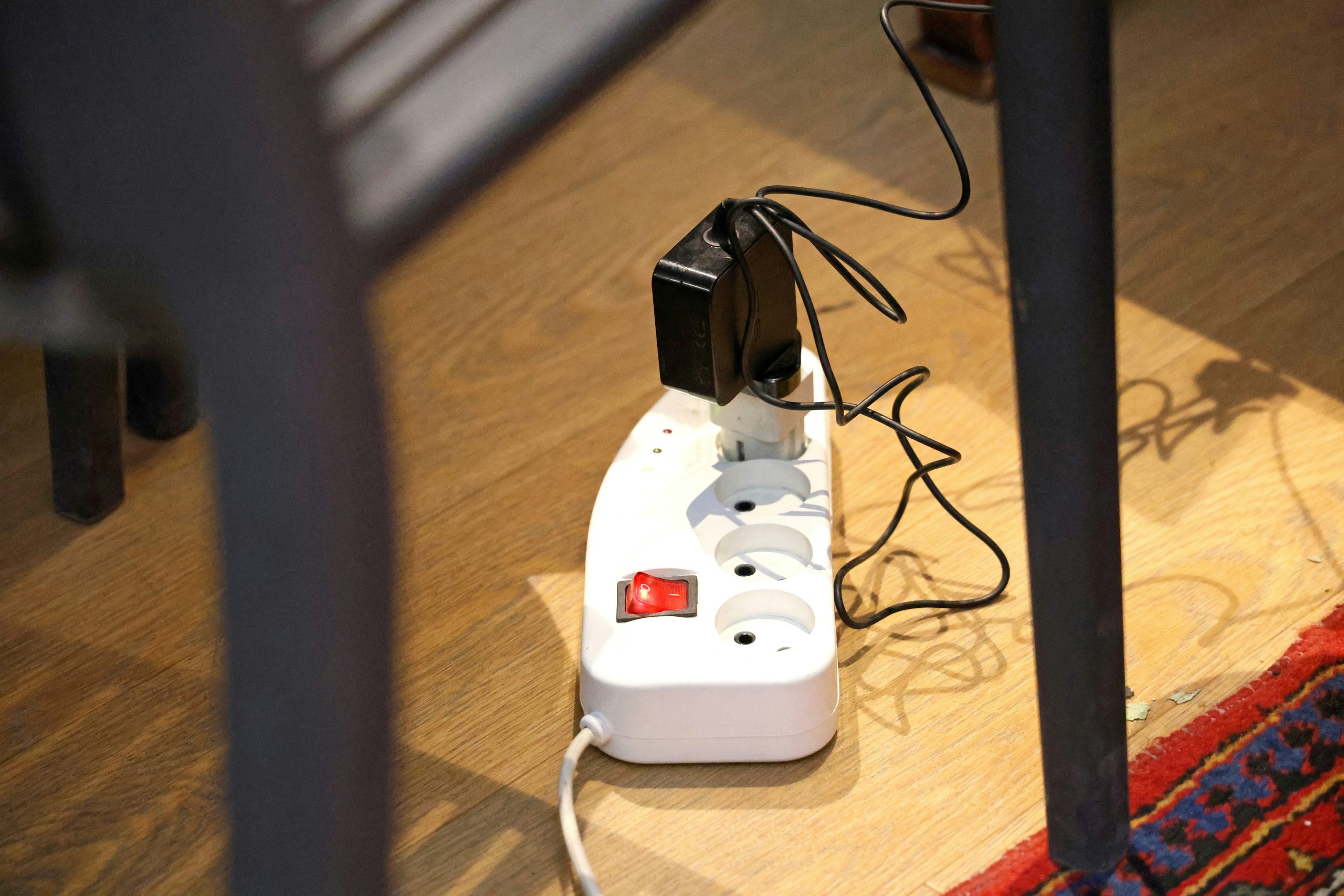
Use the electrical connection specified by the manufacturer.
If a dedicated or appropriately protected circuit is required, adding a multi-outlet strip does not change that requirement.
6. Air Conditioners
Portable and window air conditioners can place substantial demands on household electrical systems.
Again, check the manufacturer’s instructions.
If the unit is designed to connect directly to a wall receptacle, don’t place a generic power strip between the appliance and the outlet.
Large air-conditioning equipment may have more specific circuit requirements.
If you’re uncertain whether an outlet or circuit can safely handle the unit, that’s a question for a qualified electrician—not something to solve by adding another strip.
7. High-Powered Workshop Equipment
Power strips can be useful around a workbench for low-demand electronics.
But heavy-duty equipment is different.
Some saws, compressors, shop vacuums and other power tools can draw substantial current, particularly when motors start.
Don’t assume an ordinary household power strip is appropriate.
Check:
- the tool’s electrical requirements
- the strip’s rating
- the circuit capacity
- the manufacturer’s instructions
For equipment used outdoors or in damp locations, additional protection such as GFCI protection may also be important.
8. Laser Printers and Photocopiers
Printers aren’t all electrically equivalent.
A small inkjet printer and a large laser printer or office copier can have very different power requirements.
Laser printers use heating components during operation and may have relatively high peak demand.
Instead of applying a universal “never” rule to every printer, check the manufacturer’s instructions.
If the manufacturer recommends connecting the equipment directly to a wall outlet, do that.
A surge protector or power strip should only be used when it is suitable for the equipment and its electrical load.
9. Electric Blankets and Heating Pads
These are easy to overlook because they don’t look like powerful appliances.
But they’re designed to generate heat close to your body.
ESFI recommends that electric blankets not be plugged into extension cords or power strips because of overheating and fire concerns.
Damaged heating products should also be replaced.
Watch for:
- cracked cords
- frayed wiring
- dark or charred areas
- damaged plugs
Don’t fold or tightly bunch an electric blanket while it is operating unless its manufacturer specifically says that use is safe.
10. Medical Equipment Without Checking the Instructions
This category requires more nuance than many online lists provide.
It would be irresponsible to say that every medical device must never be connected to any power strip.
Different medical devices have different electrical requirements.
CPAP machines, oxygen concentrators, home dialysis equipment and other medical devices may have specific instructions for power, backup power and surge protection.
Follow the manufacturer’s instructions.
For equipment essential to someone’s health or safety, don’t improvise the electrical setup.
If you’re unsure, contact the device manufacturer, medical-equipment provider or an appropriately qualified professional.
11. Aquarium Equipment Needs Special Attention
Aquariums combine two things that require extra care:
Water and electricity.
But again, the answer isn’t necessarily “all aquarium equipment can never use a power strip.”
The correct setup depends on the equipment and manufacturer requirements.
Connections should be protected from water.
Drip loops can help prevent water traveling down a cord into an electrical connection.
Appropriate GFCI protection is also important where electricity and water may come into contact.
Never leave electrical connections where splashing, leaking or condensation can reach them.
12. Another Power Strip
This is one of the biggest mistakes to avoid.
You have a power strip with no sockets remaining.
So you plug another power strip into it.
Now you have more outlets.
But you haven’t created more electrical capacity.
You’ve simply created more opportunities to connect additional loads to the original connection.
