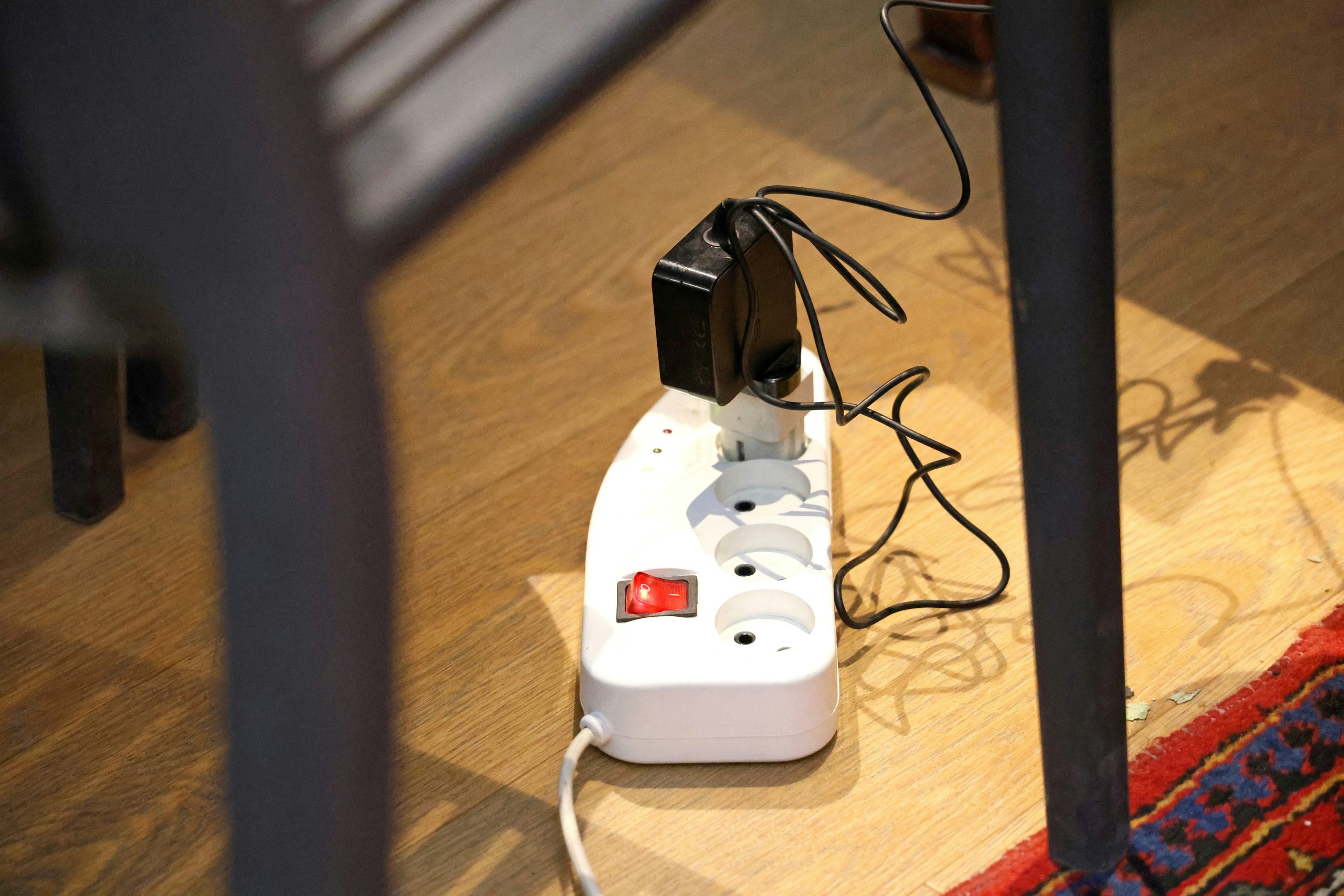
This practice is often called daisy chaining.
Electrical-safety guidance warns against connecting extension cords or power strips together in this manner.
If you routinely need far more outlets than the room provides, the safer long-term solution may be to have additional receptacles installed rather than building a chain of temporary connections.
More Outlets Do Not Mean More Available Power
This is the most important idea to remember.
Imagine a power strip with six outlets.
That doesn’t mean you can safely connect six high-powered appliances at the same time.
The strip has an electrical rating.
The circuit feeding the wall outlet also has a limit.
Everything connected contributes to the total load.
And there’s another complication.
Two separate wall outlets may still be connected to the same branch circuit.
So moving one appliance from one receptacle to another nearby receptacle doesn’t necessarily mean you’ve moved it to a different circuit.
Check the Rating on Your Power Strip
Look at the strip itself.
Quality power strips should provide electrical ratings.
Don’t exceed them.
Also remember that a surge protector and a basic power strip aren’t necessarily the same thing.
A surge protector is designed to provide protection against certain voltage surges.
That does not mean it can safely handle unlimited electrical load.
Surge protection doesn’t cancel the basic rules of electrical capacity.
Stop Using a Power Strip If You Notice These Warning Signs
Pay attention to the equipment around your home.
Stop using a strip if you notice:
- a damaged or frayed cord
- cracked plastic
- scorch marks
- melted areas
- loose receptacles
- unusual heat
- a burning smell
- buzzing or crackling
- plugs that don’t fit securely
A power strip becoming unusually hot is not something to ignore.
Disconnect the load safely and replace damaged equipment as appropriate.
Repeated breaker trips are another warning sign that deserves investigation.
Don’t repeatedly reset a breaker without understanding why it is tripping.
Don’t Hide Cords Under Rugs
It may look cleaner.
But hiding electrical cords beneath rugs or carpets can create problems.
Cords can become damaged by foot traffic or furniture.
Covering a cord can also interfere with heat dissipation.
Electrical cords should be kept where they won’t be crushed, pinched or damaged.
And never use nails or staples that can penetrate the cord.
Cheap or Defective Power Strips Can Add Another Risk
Not every strip sold online necessarily provides the protection consumers assume it does.
In 2026, the U.S. Consumer Product Safety Commission warned consumers about certain CCCEI-brand power strips that lacked supplementary overcurrent protection.
According to the CPSC, the defect created a fire risk if the strips became overloaded.
That is a useful reminder to buy electrical products from reputable sellers and look for certification from a recognized testing laboratory.
The Simple Rule to Remember
You don’t need to be an electrician to make safer choices around the house.
Remember this:
A power strip creates additional outlets. It does not create additional electrical capacity.
For phones, lamps, televisions and many low-demand electronics, an appropriately rated power strip may be useful.
For heaters, high-powered appliances, major household equipment and devices with special electrical requirements, don’t assume the same setup is appropriate.
Read the manufacturer’s instructions.
Check the electrical rating.
Never daisy-chain power strips.
Replace damaged equipment.
And if you don’t know whether your home’s circuit can safely handle an appliance, ask a qualified electrician.
That small precaution is far cheaper than dealing with an electrical fire.
How many power strips are you using around your home right now—and have you ever checked what is actually plugged into them?
