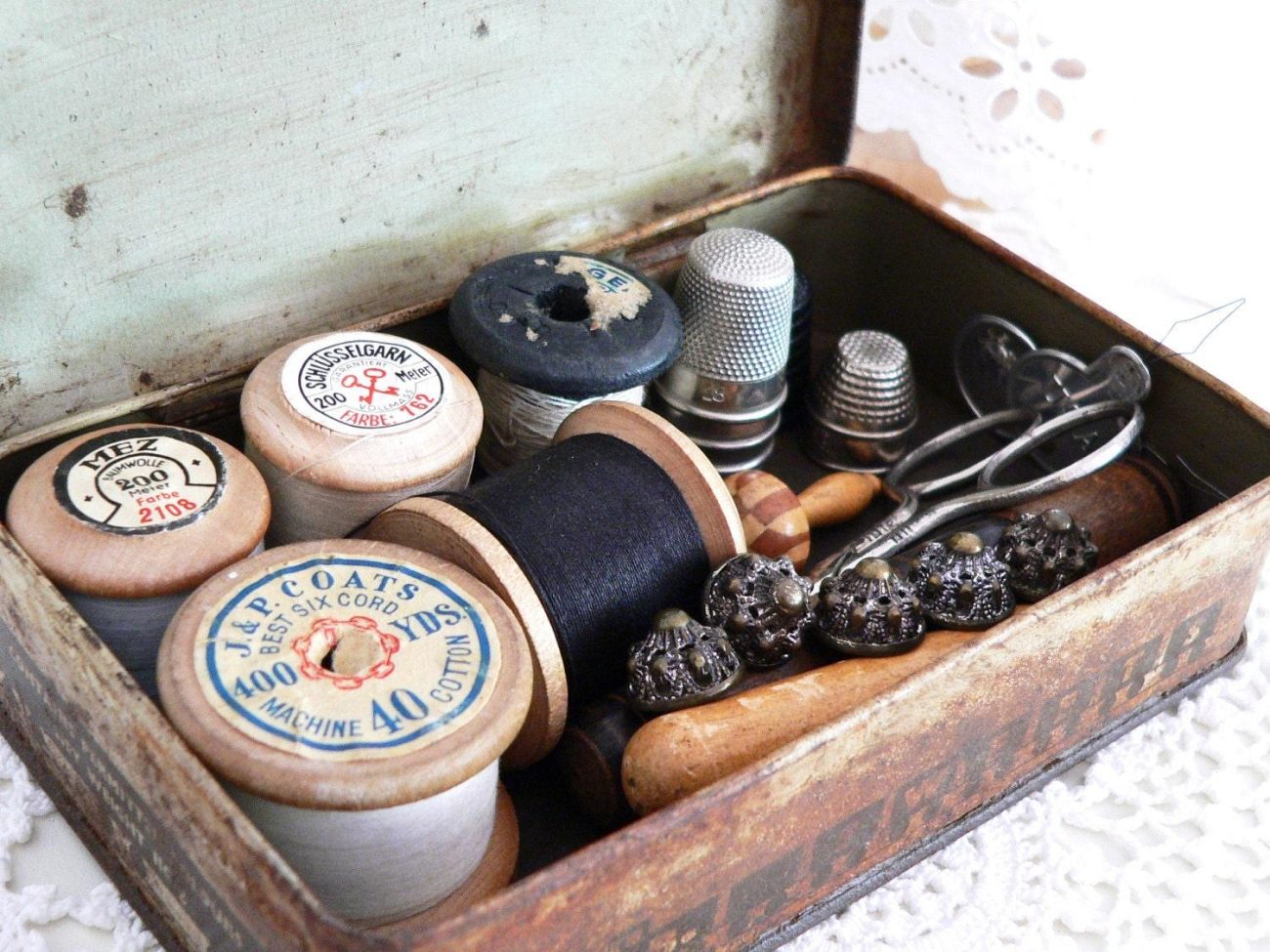
If you grew up watching your mother or grandmother sew, there’s a good chance you’ve seen one of these little metal objects.
It was small enough to disappear inside a sewing basket, usually surrounded by tangled thread, spare buttons, safety pins, and needles.
At first glance, it looked like a miniature metal cup covered in tiny dents.
Some children mistook it for a toy. Others wondered why anyone would keep such a strange little object.
But for generations, this simple tool served an important purpose.
It’s called a sewing thimble, and it helped protect the fingers of people who spent hours repairing clothing, making quilts, and sewing by hand.
Although thimbles are less familiar in many modern households, their practical design has changed remarkably little over the centuries.
And for anyone who remembers a grandmother sitting beside a window with her sewing basket, this tiny object may bring back a surprisingly vivid memory.
The Little Metal Cap That Protected Your Fingers
A sewing thimble is a protective cover worn over a finger while sewing by hand.
Its primary purpose is to help push a needle through fabric without pressing the needle’s blunt end directly into the skin.
Anyone who has tried sewing thick denim, canvas, or several layers of fabric knows that pushing a needle through resistant material can be uncomfortable.
The needle may require more pressure than the fingertips can comfortably provide.
That’s where the thimble comes in.
By placing a firm protective surface between the needle and the finger, it allows the sewer to apply controlled pressure.
The tiny indentations on a traditional metal thimble aren’t merely decorative.
They help keep the end of the needle from sliding across the metal surface.
Without those dents, the needle could slip sideways when pressure is applied.
It’s a remarkably straightforward solution to a problem that has existed for as long as people have sewn clothing by hand.
Why Are There So Many Tiny Dents?
One of the most recognizable features of an old-fashioned thimble is its dimpled surface.
Depending on the design, the indentations may cover the top, the sides, or both.
Each indentation provides a small resting point for the blunt end of a sewing needle.
When the user pushes the needle forward, the dimple helps hold it in position.
This reduces slipping and gives the user better control.
The pattern can also reveal something about the thimble’s intended use.
Some traditional designs have a closed top covered in indentations.
Others have an open top or place the working indentations mainly around the sides.
Experienced sewers often develop preferences based on how they hold their needles.
What looks like a decorative pattern is actually a practical feature refined through generations of use.
How Did People Use a Sewing Thimble?
For beginners, a thimble can feel awkward.
But once someone becomes accustomed to it, the tool can make hand sewing considerably more comfortable.
Many people wear a thimble on the middle finger of their dominant hand.
The thumb and index finger guide the needle, while the protected middle finger pushes its blunt end through the fabric.
The basic technique is simple:
- Choose a thimble that fits securely without squeezing the finger.
- Place it on the finger used to push the needle.
- Hold the sewing needle between the thumb and index finger.
- Rest the blunt end of the needle against one of the thimble’s indentations.
- Push the needle through the fabric using gentle, controlled pressure.
The goal is to guide the needle safely, not to force it through material that requires an unsuitable needle or excessive pressure.
For thicker fabrics, selecting the correct needle is just as important as wearing a thimble.
Why Almost Every Grandmother Had One
For much of the twentieth century, sewing was a regular part of household life.
