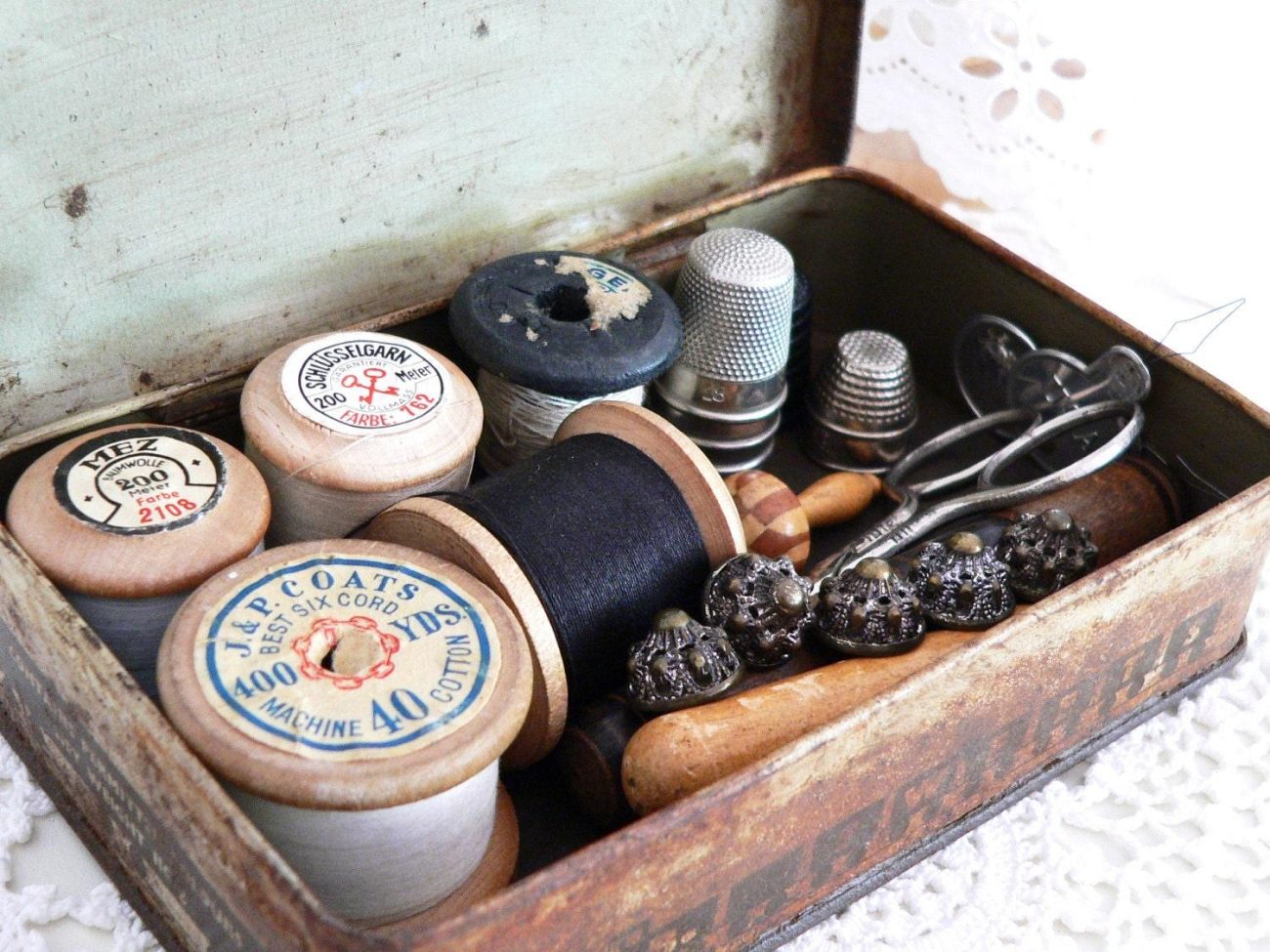
Clothing wasn’t always replaced when it developed a small tear or lost a button.
A worn shirt could be patched.
A loose hem could be repaired.
Children’s trousers could be shortened, lengthened, or reinforced at the knees.
And a favorite dress might be altered several times rather than discarded.
Many families kept a sewing basket or wooden sewing box somewhere in the house.
Inside were spools of thread, scissors, measuring tape, needles, pins, spare buttons, and a thimble.
For people who sewed frequently, the thimble wasn’t an unusual accessory.
It was simply part of the job.
A mother might use one while repairing school clothes.
A grandmother might wear one while piecing together a quilt.
Someone making curtains or mending heavy work clothing could rely on it to push a needle through multiple layers of fabric.
The tool was inexpensive, durable, and small enough to keep for decades.
That’s why so many old sewing boxes still contain one today.
The Memories Hidden Inside an Old Sewing Basket
For many people, a thimble represents more than a sewing accessory.
It recalls a time when household repairs were part of everyday life.
Perhaps you remember your grandmother sitting in her favorite chair, with a basket of fabric beside her.
She might have been repairing a shirt, sewing a button back onto a coat, or working on a quilt intended for someone in the family.
There was often a familiar rhythm to the process.
The needle passed through the fabric.
The thread followed.
The thimble pressed the needle forward.
Then the next stitch began.
Children sometimes watched closely, fascinated by how quickly an experienced sewer could work.
Others were given scraps of fabric and taught to make their first uneven stitches.
These ordinary moments often became lasting memories.
A sewing box might be passed from one generation to the next, complete with thread that had faded, buttons that no longer matched anything, and a thimble worn smooth from years of use.
Even when the original owner was gone, the objects remained.
And sometimes, finding that little metal cap was enough to bring back the memory of the person who had worn it.
Thimbles Have a Much Longer History Than You Might Think
Although many people associate thimbles with their grandmothers, the idea of protecting a finger while sewing is far older.
Finger guards and thimble-like sewing tools have existed in different cultures for centuries.
Archaeologists and historians have documented historical examples made from materials including metal, bone, and leather.
European metal thimbles became increasingly common as metalworking techniques developed.
Over time, manufacturers produced them in a wide range of shapes, sizes, and materials.
Some were plain working tools intended for everyday use.
Others were decorative objects made from precious metals.
In the nineteenth and twentieth centuries, thimbles were also sold as souvenirs and keepsakes.
They could feature the names of towns, commemorative designs, decorative engravings, or pictures of famous landmarks.
As a result, the thimble developed two identities.
It remained a practical sewing tool, but it also became an object people collected.
Are Old Thimbles Worth Money?
If you’ve discovered a thimble in an old sewing box, you might wonder whether it has any monetary value.
Some do.
However, age alone doesn’t make a thimble valuable.
Collectors often consider several factors, including its material, manufacturer, condition, rarity, and decorative design.
Thimbles made from silver or other precious metals may be of interest, particularly when they carry identifiable maker’s marks.
Unusual antique examples can also attract collectors.
But many ordinary twentieth-century metal thimbles were produced in large quantities.
Those examples may have modest resale value even if they’ve been in a family for decades.
