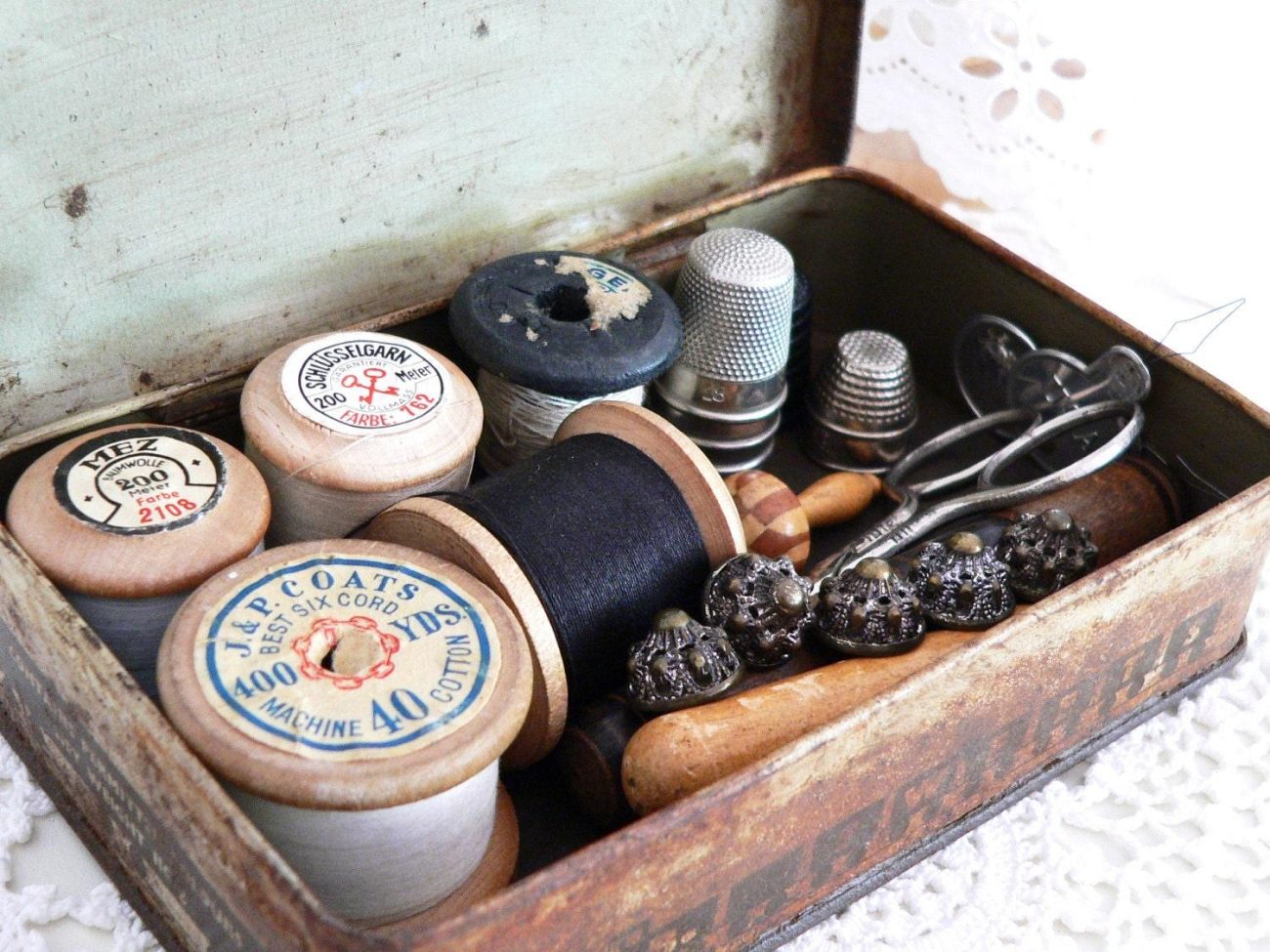
If you find one with unusual markings, avoid aggressive cleaning until you’ve identified the material and possible age.
Polishing can sometimes remove patina or other details that collectors consider important.
A specialist in antique sewing tools or silver objects may be able to help identify an unusual piece.
Of course, a thimble doesn’t need to be financially valuable to matter.
For some families, the one that belonged to Grandma is worth keeping simply because it was hers.
Metal, Leather, Plastic, and Modern Designs
Traditional metal thimbles are probably the most recognizable type, but they aren’t the only option.
Modern sewing enthusiasts use several different designs.
Metal thimbles are durable and provide a firm surface for pushing needles through fabric. They are especially familiar to people who learned traditional hand-sewing techniques.
Leather thimbles offer a softer, more flexible fit. Some hand quilters prefer them because they allow greater freedom of movement.
Plastic thimbles are lightweight and often inexpensive, making them useful for occasional sewing.
Silicone thimbles are flexible and can feel more comfortable to some users, although their suitability depends on the design and the type of needlework.
There are also specialized thimbles for quilting and other forms of hand sewing.
Some have open tops to accommodate longer fingernails.
Others are designed for people who prefer pushing the needle with the side of a finger.
The best choice depends on the task, the user’s technique, and how comfortably the thimble fits.
Why Thimbles Became Less Common in Everyday Homes
As ready-made clothing became more widely available and affordable, many households began sewing less frequently.
A damaged garment that once would have been carefully repaired might now be replaced.
Modern sewing machines also made certain tasks faster and easier.
Meanwhile, many younger people grew up without the same routine exposure to hand sewing that previous generations experienced.
As a result, the familiar sewing basket gradually disappeared from some homes.
And the thimble, once an ordinary household tool, became something people occasionally discovered without knowing its purpose.
But it hasn’t disappeared completely.
Quilters, embroiderers, tailors, costume makers, and people who enjoy repairing clothing still use thimbles today.
There has also been renewed interest in mending garments rather than throwing them away.
For those learning basic sewing skills, a thimble remains a useful accessory.
A Simple Invention That Still Works
The remarkable thing about a sewing thimble is how little its essential purpose has changed.
It doesn’t require electricity.
It has no moving parts.
It doesn’t need batteries, software, or maintenance beyond ordinary care.
It simply protects a finger and helps guide a needle through fabric.
That practical simplicity explains why the tool has remained useful across generations.
Even with modern sewing equipment, there are still moments when a small repair is easiest to complete by hand.
A loose button, a torn seam, or a small patch may take only a few minutes.
And when the fabric is difficult to work with, a thimble can make the job more comfortable.
The Tiny Object That Holds Generations of Memories
If you come across a small metal cap covered in tiny dents, don’t be too quick to dismiss it as an unfamiliar piece of hardware.
It may be a sewing thimble.
And if it came from an old family sewing box, it may have spent years protecting the fingers of someone who worked quietly to keep a household running.
Perhaps it helped repair school uniforms, mend work shirts, or finish quilts that kept children warm through the winter.
Perhaps it sat beside a grandmother’s favorite chair, waiting for the next small task.
Today, that little metal object may seem old-fashioned.
But its purpose remains easy to appreciate.
Sometimes the simplest inventions are the ones that serve people the longest.
And sometimes, the smallest things we find in an old drawer carry the biggest memories.
