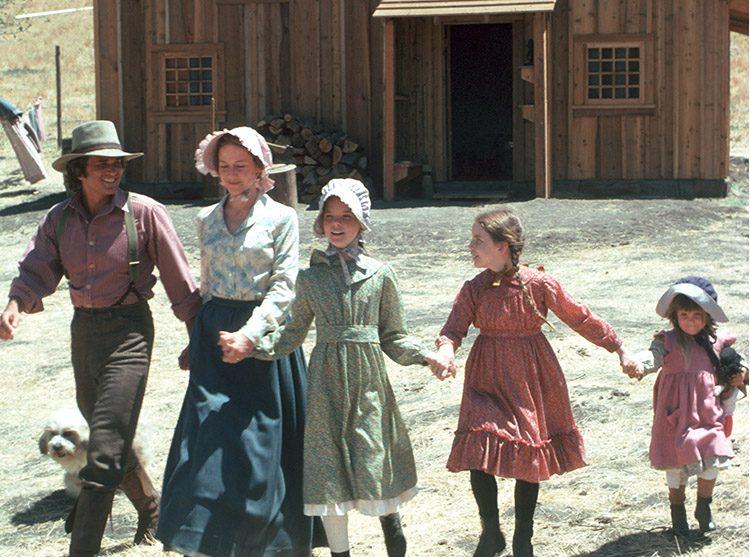
Viewers have pointed out hairstyles and clothing features that seem influenced by the 1970s, when the series was produced.
One often-repeated observation concerns a glimpse of what appears to be a modern-style bra beneath Caroline Ingalls’ clothing.
If the garment is indeed modern, it would be inconsistent with the period being portrayed.
Women’s undergarments in the nineteenth century were different from those familiar to twentieth-century audiences.
The modern brassiere developed later.
However, the specific wardrobe moment is not as well documented as some of the show’s clearer continuity errors, so it’s best treated as a viewer observation rather than a definitively established production mistake.
Even without that example, historical dramas regularly make compromises in clothing and grooming.
The goal is often to create an appearance that audiences recognize as historical, not to reproduce every detail exactly.
And sometimes those compromises become more obvious as the years pass.
6. A Train Stunt Revealed a Very Unconvincing Dummy
Action sequences are difficult to film safely.
That was especially true during the era when Little House on the Prairie was produced, long before digital visual effects became a standard part of television.
When a scene required someone to fall from a moving vehicle or tumble down a hillside, filmmakers often relied on stunt performers, careful editing, and physical props.
In the fifth-season episode “The Odyssey,” an exciting train sequence includes a moment in which Laura intervenes to protect Albert.
During the action, a man is thrown from the train.
But observant viewers have noticed something unusual.
A dummy appears in part of the fall, while a stunt performer can be seen continuing the action.
The difference between the prop and the moving person is noticeable when the sequence is examined closely.
It’s the sort of mistake that can pass unnoticed during a dramatic first viewing.
The scene moves quickly.
The audience is focused on whether Albert will be safe.
And the emotional stakes are much more important than the mechanics of the stunt.
But once someone points out the dummy, it’s difficult not to look for it during the next viewing.
It’s also a reminder of how much practical ingenuity went into creating television action before computer-generated effects.
7. A Cabinet Apparently Opened Itself
Not every television mistake involves elaborate costumes or dangerous stunts.
Sometimes the simplest household objects create the funniest continuity problems.
In the third-season episode “Little Girl Lost,” viewers have noticed an odd detail involving a cabinet.
During one shot, Mary closes it.
But when the camera angle changes, the cabinet appears open again.
There is no obvious reason for it to have changed.
It’s a classic continuity error.
Television scenes are rarely filmed in one uninterrupted take.
A conversation may be recorded from several angles, with actors repeating the same actions again and again.
If a prop is moved between takes and isn’t returned to the correct position, the resulting footage can contain a visible inconsistency.
A door that was closed becomes open.
A glass changes location.
A character’s hands suddenly move.
When the shots are edited together, the mistake can survive into the finished episode.
For a production with a demanding schedule, such errors were understandable.
But they’re still entertaining to spot.
And the next time you watch “Little Girl Lost,” the cabinet may briefly steal your attention from the characters.
8. Michael Landon Had a Very Strange Way of Surprising People
Michael Landon is remembered for his portrayal of Charles Ingalls, a father who could be firm, compassionate, and deeply emotional.
Behind the scenes, however, Landon also had a reputation for practical jokes.
One of the most unusual involved frogs.
