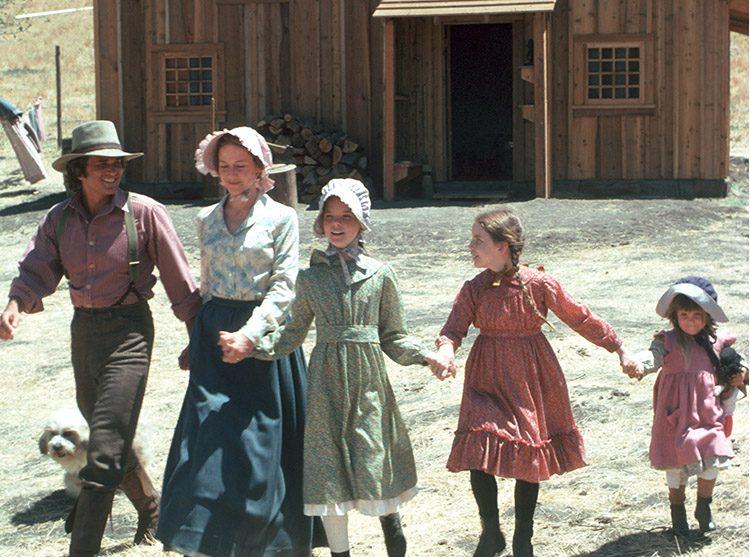
According to recollections from cast members, Landon sometimes placed small live frogs in his mouth before approaching unsuspecting people on the set.
He would begin an ordinary interaction.
Then open his mouth.
And the frog would suddenly emerge.
The startled reactions apparently delighted him.
Melissa Gilbert, who played Laura, later recalled helping collect frogs for these pranks.
Matthew Labyorteaux, who played Albert, also described the joke in an interview.
It’s an extraordinary image.
The same actor who delivered some of television’s most heartfelt fatherly speeches was apparently willing to walk around with a frog in his mouth just to make someone jump.
Of course, such a prank would raise obvious concerns about animal welfare and hygiene today.
But as a piece of cast recollection, it offers a glimpse of Landon’s mischievous personality.
It also shows how different the atmosphere behind the cameras could be from the serious scenes audiences watched at home.
9. The Show’s Timeline Could Move at Very Different Speeds
Laura’s pregnancy wasn’t the only storyline that made viewers question the passage of time.
Across the series, major developments sometimes occurred remarkably quickly.
A character might begin a new career, face a crisis, and experience a life-changing event within a relatively small number of episodes.
Meanwhile, other storylines seemed to unfold much more slowly.
Adam Kendall’s legal education is one example that has prompted discussion among viewers.
His transition toward a career in law happens at a pace that can feel surprisingly rapid when compared with the time such training would ordinarily require.
The issue is partly a consequence of episodic storytelling.
A family drama needs to move its characters forward while still producing individual stories with satisfying beginnings, conflicts, and resolutions.
That can lead to compressed timelines.
Events that would realistically take months or years may receive only a few episodes of attention.
Other developments are stretched out because they provide useful dramatic tension.
For viewers watching the series weekly during its original run, these inconsistencies may have been less noticeable.
But modern audiences can watch several episodes in succession.
That makes timeline irregularities much easier to recognize.
10. Albert’s Story Left Fans With a Difficult Question
Albert Ingalls became an important member of the television family after Charles and Caroline took him into their home.
His character brought new emotional stories to the series, including struggles with belonging, responsibility, and personal hardship.
But one of the most debated aspects of Albert’s story concerns his fate.
In the television movie “Look Back to Yesterday,” Albert is diagnosed with a serious illness, and the story strongly suggests that his remaining time is limited.
The episode is remembered for its emotional impact.
Yet other references within the broader series and its later productions have left some viewers uncertain about how Albert’s story fits together.
Part of the confusion involves dialogue that appears to suggest a future for Albert that doesn’t easily align with the illness storyline.
Fans have spent years discussing whether the writers changed their plans, whether the references were intended to be understood differently, or whether the series simply developed a continuity inconsistency.
What makes this example different from a misplaced prop is its emotional importance.
Albert was a beloved character.
His fate mattered to viewers.
When a story involves a serious illness and a family’s grief, uncertainty about the timeline becomes more than an amusing technical mistake.
It becomes a question about what the writers intended audiences to believe.
11. The Television Ingalls Family Was Not Exactly the Real Ingalls Family
One of the most important things to remember about Little House on the Prairie is that it was a historical family drama, not a documentary.
