The Tiny “Armored” Spider in My Garage Looked Dangerous—Until I Learned What It Really Was

The moment I switched on the garage light, I knew something unfamiliar was clinging to the wall.
It was small—much smaller than the fear it initially produced—but impossible to overlook.
Its broad yellow body was marked with dark spots, and six rigid projections extended from its sides like the points of a miniature crown.
For a few seconds, I remained near the doorway.
Was it an insect?
A spider?
Could it sting?
Was that bright coloring a warning to stay away?
The creature did not move.
It simply rested on the wall, looking less like an ordinary spider than something designed for a science-fiction movie.
I took a photograph without getting too close.
After comparing it with images published by entomologists, I found a likely answer: it appeared to be a spinybacked orb-weaver, scientifically known as
Gasteracantha cancriformis
.
That identification transformed the encounter.
The intimidating visitor was not an aggressive household pest.
It was a small, beneficial spider whose extraordinary appearance is far more threatening than its behavior.
Still, one correction is important: describing any spider as “completely harmless” is too absolute.
Spinybacked orb-weavers possess venom for subduing their tiny prey, as most spiders do.
However, they are not considered medically significant to people, rarely bite, and generally attempt to escape rather than confront us.
A Spider That Barely Looks Like a Spider
The spinybacked orb-weaver belongs to the family Araneidae, the group of spiders famous for constructing the circular webs many of us picture when we hear the words “spider web.”
Its appearance, however, is anything but conventional.
Adult females possess a wide, flattened abdomen covered by a hard, shell-like surface.
Six prominent spines project from its edges, producing the crablike or armored appearance that makes the species instantly recognizable.
The body can be white, yellow, orange or red, usually with contrasting black markings.
The exact combination varies among individuals and geographic areas.
A bright yellow spider with symmetrical black spots therefore fits the species—but color alone is not enough to confirm an identification.
Size can also be deceptive.
Although a female appears broad because of her spines, her body is usually only a fraction of an inch long.
Males are considerably smaller and do not have the same dramatic abdominal spines.
The University of Florida describes
Gasteracantha cancriformis
as one of Florida’s most conspicuous spiders because of its unusual combination of color, body shape and web characteristics.
Despite sometimes being called a “crab spider,” it is not closely related to the spiders formally placed in the crab-spider families.
What Are Those Spines For?
The original assumption that the spines are merely “structural adaptations” does not tell the whole story.
Scientists generally regard them as a defensive feature.
A small, soft-bodied spider can make an easy meal for a bird, lizard or predatory insect.
A hard abdomen surrounded by rigid points makes swallowing or carrying the spider considerably more difficult.
The dramatic shape may therefore function like natural armor.
Its bright coloration may also communicate that the spider is an inconvenient or undesirable target, although researchers continue to investigate exactly how predators and prey respond to its different color patterns.
It is safer to say that the spines likely discourage predators than to assign one proven purpose to every color and marking.
Whatever their precise evolutionary history, the spines are not used to attack people.
The spider does not shoot them, detach them or deliberately jab with them.
They are fixed parts of its abdomen.
They can nevertheless feel sharp if the animal is handled roughly, which is one good reason to observe rather than pick it up.
Is a Spinybacked Orb-Weaver Dangerous?
For most people, encountering one does not constitute an emergency.
Spinybacked orb-weavers are not aggressive toward humans.
Their venom and fangs are adapted for capturing small insects, not for defending territory against people.
A bite would be unusual and most likely to occur only if the spider were trapped against the skin or handled.
Texas A&M AgriLife notes that spiders are generally beneficial predators that help control flies and plant-feeding insects.
Its overview identifies
Gasteracantha
and
Micrathena
as distinctive spiny orb-weavers commonly associated with wooded environments.
That does not mean anyone should intentionally provoke one.
Reactions to arthropod bites can vary, and many unexplained skin lesions are incorrectly blamed on spiders without the animal ever being identified.
If someone develops intense pain, spreading swelling, difficulty breathing or another severe reaction after a suspected bite, medical help should be sought.
The spider—or a clear photograph—can be useful for identification, but it should not be captured in a way that risks another bite.
For ordinary garage or garden encounters, distance and calm observation are usually all that is required.
The Web Reveals Its Real Occupation
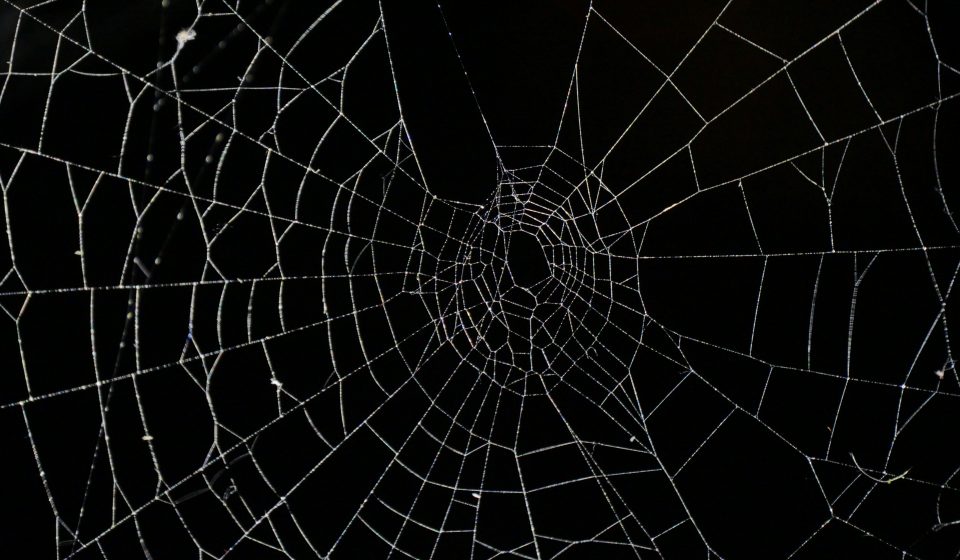
The name “orb-weaver” comes from the spider’s circular web.
These webs contain radial support lines extending from the center and spiraling strands designed to intercept flying insects.
The architecture may look delicate, but it is a remarkably efficient hunting system.
When a small fly, moth, mosquito, beetle or other insect strikes the web, vibrations alert the spider.
It moves toward the prey, restrains it with silk and uses venom to subdue it.
In other words, the alarming-looking spider is usually helping reduce the number of insects around the property.
A spinybacked orb-weaver may construct its web between shrubs, trees, porch supports, fences or other objects that provide suitable anchor points.
Garages, sheds and covered patios can offer shelter from wind and rain, especially when nearby lights attract insects after dark.
The spider seen on my wall may not have intended to live inside the garage.
It could have wandered in through an open door, arrived on a plant or rested temporarily after its web was disturbed.
University of Florida Extension describes the species as a familiar landscape spider rather than a typical indoor infestation pest.
Those White Silk Tufts Are Not Spider Eggs
Spinybacked orb-weaver webs sometimes contain conspicuous white silk tufts or short bands.
These decorations are known as stabilimenta.
Their exact function is still debated.
Depending on the spider and circumstances, visible silk may help stabilize part of the web, attract insects, camouflage the spider or warn birds away so they do not fly through and destroy the structure.
What appears to be debris or a cluster of eggs may therefore be an intentional part of the web.
The actual egg sac looks different.
A female produces eggs beneath a protective covering of silk, and the young later emerge as tiny spiderlings.
Like other spiders, they pass through a series of molts as they grow.
The adult spider does not establish a permanent colony inside a wall, travel in a swarm or create a large communal nest.
Finding one spider or web does not mean hundreds are secretly occupying the garage.
Why Bright Colors Do Not Automatically Mean Danger
Nature teaches us to associate vivid colors with warning.
That association is sometimes useful.
Certain venomous snakes, stinging insects and toxic amphibians advertise their defenses through conspicuous patterns.
But color is not a universal danger code.
Animals can use color for camouflage, courtship, species recognition, temperature regulation or predator deterrence.
Sometimes researchers do not yet know every function a pattern serves.
A yellow-and-black spider may look alarming because our minds connect those colors with wasps or caution signs.
The emotional reaction happens before careful reasoning begins.
That instinct is understandable.
It helped our ancestors respond quickly to unfamiliar animals.
But a fast reaction and an accurate conclusion are not the same thing.
The spinybacked orb-weaver is a good example of why observation should come before destruction.
Its appearance says “danger” to many human eyes, while its behavior says something quite different: remain still, maintain the web and wait for a small insect.
Should You Leave It Alone?
If the spider is outdoors or in an unused corner where its web does not obstruct a walkway, leaving it alone is usually the simplest option.
It may quietly catch insects without damaging the building, contaminating food or threatening pets.
Unlike termites, carpenter ants or certain beetles, it does not consume wood or weaken the structure.
Relocation is reasonable when the web crosses a doorway, hangs at face level or occupies a frequently used interior space.
A simple method is to place a transparent container over the spider, slide a stiff piece of paper or cardboard underneath and carry the container outside.
Release it near shrubs or low tree branches where it can find new web supports.
Wear gloves, avoid squeezing the animal and never handle an unidentified spider with bare hands.
If you are uncomfortable performing the relocation, ask someone experienced or contact a local pest-management professional.
Spraying an entire garage because of one orb-weaver is rarely necessary.
Broad pesticide use can kill other beneficial organisms and may not address whatever opening allowed the spider inside.
Instead, consider:
- Repairing damaged window or door screens.
- Replacing worn weather stripping.
- Sealing gaps around utility lines.
- Reducing clutter near doors and windows.
- Moving bright exterior lights away from entrances when practical.
- Checking potted plants before bringing them indoors.
These measures reduce accidental visitors without requiring the destruction of every small creature near the house.
Identification Still Depends on Location
Without the original photograph and the location of the sighting, no responsible identification can be completely certain.
Gasteracantha cancriformis
occurs in the Americas, especially in warmer regions.
Other countries have different members of the genus
Gasteracantha
, some with similarly bright colors and dramatic spines.
North America also has spiny orb-weavers belonging to the genus
Micrathena
.
They may share the armored appearance but differ in body shape, spine arrangement and markings.
A useful identification should therefore consider:
- The geographic location.
- The number and placement of spines.
- The color and pattern on both sides of the abdomen.
- The spider’s size.
- The design and position of its web.
- The season in which it was observed.
A local Cooperative Extension office, university entomology department or reputable natural-history organization can often identify a spider from clear photographs.
Images of the upper surface, underside and web are especially helpful, provided they can be taken safely.
From Fear to Fascination
Once I understood what the spider probably was, the garage changed again.
It had not become safer in any physical sense; the spider had been the same animal from the beginning.
What changed was my interpretation.
The rigid spines were no longer weapons aimed at me.
They were defenses against creatures that might eat the spider.
The yellow shell was no longer proof of toxicity.
It was one of several natural color forms.
Its motionless posture was not preparation for an attack.
It was simply the patience of an ambush hunter waiting near a web.
That does not mean every unfamiliar animal should be approached.
Caution around unidentified wildlife remains sensible.
What it means is that caution does not have to become panic, and uncertainty does not have to end in killing something.
A photograph, a few minutes of research and information from a reliable source can turn a frightening encounter into an opportunity to learn.
The Small Neighbors We Rarely Notice
A garage may seem separate from nature, but it is not.
Moths gather around its lights.
Beetles shelter beneath boxes.
Geckos or small frogs sometimes wait near the door for insects.
Spiders take advantage of corners where a web can remain undisturbed.
These animals are not making a judgment about whose space belongs to whom.
They are responding to shelter, moisture, temperature and food.
Most encounters pass unnoticed.
The unusual shape of the spinybacked orb-weaver simply makes its presence harder to ignore.
That night, I chose to leave the visitor alone.
By morning, it had moved, and the wall looked ordinary again.
Yet the experience stayed with me because it revealed how quickly appearances can control our judgment.
What looked like a miniature monster was a small insect predator wearing an extraordinary form of natural armor.
The next time something unfamiliar appears on a porch, in a garden or near the garage, I hope I remember that first moment beneath the light—and what happened when fear finally made room for curiosity.
Identification Note
The description is consistent with a female spinybacked orb-weaver,
Gasteracantha cancriformis
, but a confirmed species identification requires a photograph and the sighting location.
Several related orb-weavers have similar spines and coloration.
Safety Note
Do not handle an unidentified spider with bare hands.
Spinybacked orb-weavers are not considered medically significant and rarely bite, but individual reactions vary.
Seek medical assistance for severe or rapidly worsening symptoms after any suspected bite.
Source Transparency
Natural-history and safety details were checked against educational materials from the University of Florida’s Institute of Food and Agricultural Sciences, Texas A&M AgriLife Extension and North Carolina Cooperative Extension.
The personal encounter is presented as a narrative framework, not as a documented news event.