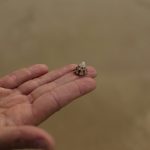

At first glance, it looked unsettling.
A pale, curved object with a darker tip was lying on the floor of a child’s bedroom.
Was it a claw?
A tooth?
A piece of bone?
Something brought inside from outdoors?
The father in this unusual story initially had no idea—and neither did his son.
That uncertainty was enough to send his imagination racing.
But the story eventually offered a far more interesting explanation: the mysterious object was supposedly identified as a fragment of a narwhal tusk.
That sounds almost unbelievable.
Narwhals are Arctic whales famous for the extraordinary spiral structure projecting from their heads.
But there’s something many people don’t realize about that structure.
It isn’t technically a horn.
It’s an enormous tooth.
And the real science behind it may be even more fascinating than the mystery story itself.
The Discovery Started With a Routine Cleaning
According to the account, the object was discovered while a father was cleaning his son’s room.
It was pale, curved and solid, with a darker area near one end.
The father initially wondered whether it might have come from an animal.
His son couldn’t identify it either.
That made the discovery more puzzling.
If it had been an ordinary toy or school item, the expectation was that the child would recognize it.
Instead, neither of them knew what they were looking at.
The father picked it up carefully and began trying to determine what it could be.
Searching Online Didn’t Immediately Solve the Mystery
Like many of us would probably do today, he turned to his phone.
He compared the object with images of animal claws, unusual seeds and other natural specimens.
Nothing seemed to provide an obvious answer.
According to the original story, the object also appeared to have markings along its surface.
That only added to the mystery.
But appearance alone is a poor way to identify an unknown biological object.
Bone, teeth, antler, shell, ivory-like materials, plastic and manufactured replicas can sometimes look surprisingly similar in photographs.
That means an unusual object shouldn’t be identified confidently from appearance alone.
Then Came the Unexpected Explanation
In the story, the father eventually took the object to a local natural-history museum.
There, a curator supposedly identified it as a fragment of a narwhal tusk.
That identification has not been independently verified.
There are no photographs, measurements, museum records or expert documentation supplied with the account that would allow us to confirm that the object really came from a narwhal.
So the safest way to treat the story is as an unverified human-interest account.
But the claimed identification raises a genuinely interesting question:
What exactly is a narwhal tusk?
A Narwhal’s “Horn” Is Actually a Tooth
This is where the real science becomes fascinating.
Narwhals are toothed whales that inhabit Arctic waters.
The long spiral tusk associated with the species isn’t a horn growing from the skull.
It’s an elongated tooth.
In the typical male narwhal, one tooth remains embedded while another grows outward through the upper lip and develops into the animal’s famous spiral tusk.
According to the Smithsonian, the tusk can grow to more than 8 feet, or approximately 2.4 meters, in length.
Most males have one.
Some rare narwhals can develop two.
Most females don’t have a visible elongated tusk, although some do.
It’s one of the most extraordinary dental structures found in any mammal.
And It Isn’t Just a Giant Piece of Ivory
Scientists have discovered that the narwhal tusk has remarkable sensory properties.
The Smithsonian describes millions of tiny channels extending through the tusk.
These structures connect the animal’s nervous system with the external environment.
Research indicates that the tusk may allow a narwhal to detect changes in its surroundings, including differences in the water.
That makes the tusk much more sophisticated than the inert spear-like structure it may appear to be.
For centuries, people proposed all kinds of explanations for its purpose.
Some ideas turned out to be poorly supported.
Modern research suggests the answer is complex.
Scientists Are Still Studying What the Tusk Does
The narwhal tusk is so visually dramatic that you might assume scientists have understood its purpose for centuries.
They haven’t.
Researchers have investigated several possibilities.
The tusk appears to have sensory capabilities.
Its strong association with males also suggests a role connected to sexual selection.
Male narwhals have also been observed crossing tusks.
And observations have documented narwhals using their tusks in interactions with fish.
The tusk may therefore serve more than one function.
Scientists continue studying exactly how narwhals use it.
That’s an important distinction because older popular explanations sometimes present one proposed function as though it has been definitively established.
Nature is often more complicated.
Narwhals Live in the Arctic
Part of the mystery surrounding narwhals comes from where they live.
These whales inhabit Arctic waters, including areas around Canada and Greenland.
They spend portions of the year around sea ice and can dive to extraordinary depths.
That environment makes them much harder to observe than many animals living closer to densely populated regions.
Their relative isolation also contributed to centuries of mythology surrounding their tusks.
Long before people understood narwhals well, tusks could reach people who had never seen the living animal they came from.
And that helped create one of history’s most memorable misunderstandings.
Narwhal Tusks Helped Fuel Unicorn Legends
Imagine living centuries ago and being shown a long, beautifully spiraled object.
You have never seen a narwhal.
You don’t know about Arctic whales.
There is no photography.
No internet.
No wildlife documentary explaining where the object originated.
Then someone tells you it came from a unicorn.
The story suddenly doesn’t sound quite as ridiculous.
Narwhal tusks were historically associated with unicorn mythology, and their unusual spiral appearance made the connection easy to understand.
An actual biological structure from an Arctic whale became intertwined with stories about a mythical land animal.
Today we know the truth.
But in some ways, the real animal is stranger.
Could a Small Fragment Really End Up in Someone’s Home?
It isn’t impossible for animal-derived artifacts or old biological specimens to exist in private collections.
Museums, universities and collectors have historically maintained natural-history materials from many species.
But that does not mean an unidentified object should automatically be assumed to be genuine narwhal ivory simply because it resembles a tooth or tusk.
Provenance matters.
Documentation matters.
Expert examination matters.
And wildlife products can also be subject to national and international regulations governing possession, transport, import, export and commercial trade.
Anyone who genuinely discovers what appears to be a piece of protected wildlife shouldn’t immediately attempt to sell it online.
Determining what the object actually is—and how it was acquired—is the sensible first step.
Don’t Destroy an Unknown Object Before Identifying It
There’s another practical lesson hidden inside the story.
When people find something unfamiliar in their homes, the first instinct may be to throw it away.
Usually that’s harmless.
Occasionally, though, an unidentified object may have scientific, historical, sentimental or monetary significance.
That doesn’t mean every strange piece of bone discovered in an attic is a priceless artifact.
Most aren’t.
But if something genuinely appears unusual, photographing it and asking an appropriate expert can be more useful than immediately discarding it.
A natural-history museum, university department or other qualified specialist may be able to point you in the right direction.
Photographs Can Help—but They Have Limits
Online identification communities have made it remarkably easy to obtain preliminary opinions about unusual objects.
A clear photograph can sometimes quickly identify an ordinary insect, shell, seed or manufactured item.
But difficult cases require more.
Scale matters.
Texture matters.
Weight matters.
Internal structure can matter.
Provenance can be critical.
Sometimes laboratory examination is necessary.
That’s why someone claiming, “I know exactly what this is from one blurry picture,” should be treated cautiously.
The more unusual the claimed identification, the stronger the evidence should be.
The Story Became a Science Lesson
According to the account, once the father and son received the supposed identification, their fear turned into curiosity.
They began researching narwhals together.
That’s arguably the most worthwhile part of the story.
An unfamiliar object became a reason to learn about an animal they might otherwise never have discussed.
The child could ask why narwhals have tusks.
Where they live.
How large they become.
Why the tusk spirals.
Why some have one and rare individuals have two.
One question naturally leads to another.
That’s how curiosity works.
Fear Often Fills the Space Left by Missing Information
There’s also a broader lesson here.
When humans don’t recognize something, our brains are very good at imagining explanations.
Sometimes those explanations become increasingly frightening.
An unknown noise at night sounds more threatening than the same noise after we discover it’s a loose window.
An unfamiliar insect looks more dangerous before we know what species it is.
And an unidentified curved object can become almost anything in our imagination.
The uncertainty itself creates much of the fear.
Information changes that.
But Curiosity Should Come Before Certainty
The best response to something strange isn’t necessarily panic.
It also isn’t immediately declaring that you’ve solved the mystery.
It’s curiosity.
Look carefully.
Document what you found.
Ask questions.
Consult reliable information.
And when necessary, find someone qualified to identify it.
Sometimes the answer will be completely ordinary.
Sometimes it will be more interesting than anything you imagined.
And sometimes there won’t be enough evidence to reach a definite conclusion.
That’s okay too.
The Real Narwhal Is Remarkable Enough
Whether the object in this particular story was truly part of a narwhal tusk cannot be confirmed from the information provided.
But narwhal tusks themselves don’t need fictional embellishment to be extraordinary.
They’re elongated teeth growing from Arctic whales.
They can reach remarkable lengths.
They contain millions of microscopic channels associated with sensory function.
Their exact biological roles continue to interest scientists.
And their appearance helped inspire stories of unicorns centuries ago.
That’s a better mystery than any supernatural explanation.
The next time you encounter an object you don’t recognize, resist the temptation to decide what it is immediately.
Sometimes the difference between something frightening and something fascinating is simply taking the time to investigate.
What would you have guessed this strange curved object was before hearing the narwhal explanation?
Editor’s note: The discovery story and the claimed museum identification are presented as an unverified human-interest account. Without photographs, provenance or expert documentation, the object cannot independently be confirmed as a narwhal tusk fragment.