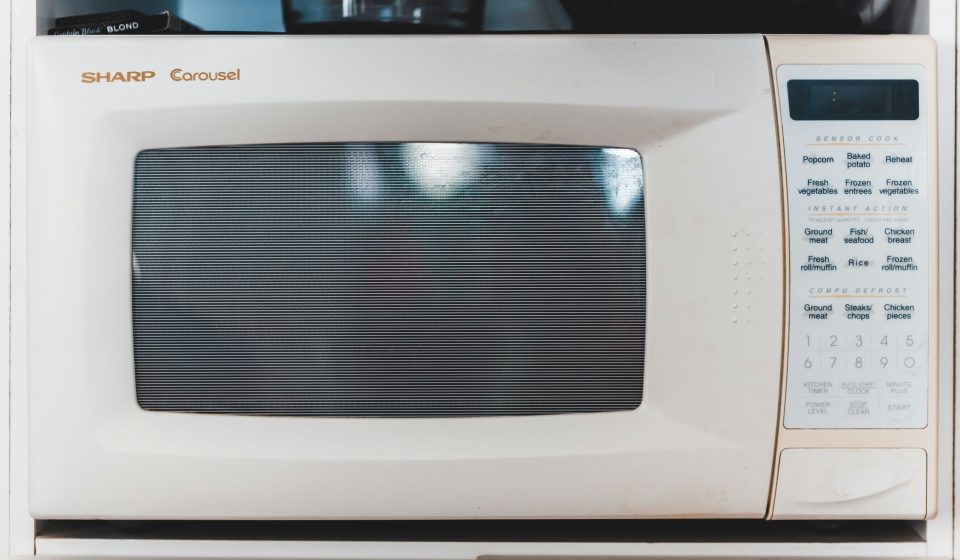

If you’ve ever removed the glass plate from your microwave to clean underneath it, you’ve probably noticed a strange-looking plastic ring sitting on the bottom.
It usually has three or more tiny wheels attached to it.
It looks simple enough that you might assume it’s just packaging, an optional accessory, or a piece that can be removed once the microwave is installed.
But in microwaves designed to use it, that small component has an important job.
It’s commonly called the turntable support, turntable support ring, or roller ring.
And without it, your microwave’s glass tray may not rotate properly.
What Does the Microwave Support Ring Actually Do?
The support ring sits underneath the round glass turntable.
Its small wheels allow the glass plate to move smoothly while supporting its weight.
Most turntable-style microwaves use several components working together:
- the glass turntable,
- the support or roller ring underneath it,
- a center hub or coupler,
- and a motor-driven shaft below.
The motor provides the movement through the center mechanism, while the support ring helps keep the large glass tray stable as it rotates.
In other words, those little wheels aren’t there to power the microwave plate themselves.
They help support and guide it.
Manufacturer documentation from Whirlpool identifies the removable support as a normal part of the turntable assembly and instructs users to place the support on the bottom of the microwave cavity before positioning the glass turntable above it.
Why Does the Glass Plate Need to Rotate?
A microwave doesn’t heat food in exactly the same way as a conventional oven.
Microwave energy interacts with food as it travels through and reflects around the cooking cavity.
Heating can therefore be uneven.
That’s one reason turntable-equipped microwaves rotate the food during operation.
The movement continually changes the food’s position inside the microwave cavity, helping promote more even heating.
Whirlpool’s documentation specifically states that the turntable can rotate in either direction to help food cook more evenly.
So when your dinner slowly circles inside the microwave, that movement isn’t merely cosmetic.
It’s part of how that particular appliance is designed to perform.
Does Rotation Guarantee Perfectly Even Heating?
No.
This is an important distinction.
The turntable can help produce more even results, but it cannot guarantee that every part of a meal reaches exactly the same temperature.
The size, shape, density and composition of food all influence how it heats.
That’s why microwave instructions frequently recommend additional steps such as stirring, turning or rearranging food.
Whirlpool, for example, advises that stirring and turning can redistribute heat and help prevent excessive heating around the outside of food. Standing time after the microwave stops can matter as well because heat continues moving through the food by conduction.
So think of the turntable as one part of the heating process—not a guarantee of uniform temperature.
What Happens If You Remove the Ring?
If your microwave was designed to operate with a support ring, removing it can cause problems.
The glass tray may:
- wobble,
- tilt,
- drag against the microwave floor,
- make unusual noises,
- or have difficulty rotating.
The plate may appear to be sitting correctly at first, especially when it’s empty.
Add a heavy bowl or dinner plate, however, and the missing support becomes much more noticeable.
The glass tray needs support around its underside as it rotates.
That’s exactly what the wheeled ring provides.
GE advises against operating its applicable microwave models without both the turntable and support in place.
What If the Ring Is Installed Incorrectly?
That can cause problems too.
A support ring generally needs to sit flat in its intended position.
The glass turntable then sits on top, with the center properly engaged with the hub or drive mechanism.
Whirlpool notes that an incorrectly installed turntable or a problem with the support roller assembly may produce thumping or rumbling sounds.
So if your microwave suddenly starts making a repetitive bumping sound while the plate rotates, don’t immediately assume the motor has failed.
First check the simple things.
Check Under the Glass Plate
Wait until the microwave and tray are cool.
Remove the glass turntable carefully.
Then inspect underneath it.
Look for:
- crumbs,
- dried food,
- grease,
- sticky residue,
- objects blocking the wheels,
- a support ring sitting crooked,
- damaged rollers,
- or a glass tray that isn’t seated properly.
Even something as small as dried food beneath one wheel can interfere with smooth movement.
GE specifically recommends checking beneath the wheels because food or debris can prevent the turntable ring from moving correctly.
That means a microwave that sounds broken may occasionally need nothing more complicated than cleaning and correct reassembly.
Make Sure the Glass Tray Is Properly Seated
After cleaning, place the support ring back in its normal position.
Then reinstall the glass tray according to your microwave’s manual.
The center of the tray typically needs to engage correctly with the hub.
The rollers should also travel beneath the appropriate part of the glass tray.
If the plate isn’t centered correctly, it may drag or move unevenly.
GE recommends checking that the turntable is centered, properly seated and positioned right side up.
Can the Glass Plate Rotate in Either Direction?
Yes, on many microwaves.
You may notice that the plate rotates clockwise one time and counterclockwise another.
That doesn’t necessarily indicate a problem.
GE says its microwave turntables may start in either direction and may also change direction after a cooking or defrost cycle is interrupted.
Whirlpool similarly notes that a turntable can rotate in either direction.
So don’t use direction alone as a sign that something is wrong.
What If the Turntable Doesn’t Move at All?
Start with the easiest possibilities.
Make sure the glass tray is seated correctly.
Check the support ring.
Clean away anything obstructing the rollers.
Confirm the microwave isn’t using a setting on which the turntable is intentionally disabled.
Some microwave models allow users to turn the rotating tray off for certain types of manual cooking or oversized dishes.
If your model has that feature, the stationary plate may be completely normal.
Consult the owner’s manual for the specific model before assuming there’s a mechanical failure.
What If Everything Is Installed Correctly but It Still Won’t Turn?
Then the problem may involve another component.
The drive hub, coupler, shaft or turntable motor could potentially require attention.
At that point, repeatedly forcing the glass tray by hand isn’t a good troubleshooting strategy.
Check the manufacturer’s instructions for your specific microwave.
If basic cleaning and correct installation don’t solve the problem, professional service may be appropriate.
GE recommends service when its basic turntable troubleshooting steps don’t restore operation.
Should You Throw Away a Damaged Support Ring?
If the plastic ring is cracked, badly warped or has damaged/missing wheels, replacing it is generally preferable to trying to improvise a repair.
The correct replacement should match your microwave model.
Don’t assume every support ring is universal simply because several look similar.
Dimensions, wheel position and tray design can vary.
Your microwave’s model number and owner’s manual are the safest references for identifying the correct replacement part.
The Glass Tray and Ring Can Usually Be Removed for Cleaning
That’s why many people first discover this part.
They lift the glass tray to clean a spill and suddenly find a plastic ring with wheels underneath.
It isn’t loose because somebody forgot to attach it.
It’s supposed to be removable on many models.
GE notes that the turntable is designed to be removed for cleaning and cautions against putting a hot glass tray directly into water immediately after cooking because the sudden temperature change can risk breakage.
Allow the components to cool before cleaning them.
Then follow the cleaning instructions provided for your model.
Don’t Forget the Area Under the Wheels
This small area can collect more debris than people realize.
Sauce can boil over.
Crumbs can fall underneath the plate.
Grease can accumulate.
Once residue gets into the path of the rollers, the ring may no longer move smoothly.
You might then hear:
click… click… click…
or
thump… thump… thump…
as the plate turns.
Cleaning underneath the support can sometimes solve the problem immediately.
And Don’t Confuse the Ring With the Drive Mechanism
The support ring doesn’t usually provide the rotational force itself.
Its purpose is primarily mechanical support.
The center hub or coupler connects the glass tray to the drive system.
Think of it this way:
The center mechanism drives the turntable.
The wheeled ring supports it.
Both need to work together for smooth rotation.
Why Such a Simple Part Matters
It’s easy to overlook because there’s almost no technology in it.
A plastic ring.
A few wheels.
That’s essentially it.
But good appliance design often relies on simple components.
Without the support ring, the large glass plate would have much less stability as it rotates with a bowl or plate sitting on top.
The ring distributes support around the tray while allowing it to move with minimal resistance.
Small component.
Useful job.
Should You Use the Microwave Without It?
For a microwave designed to use a turntable support, follow the manufacturer’s instructions rather than simply leaving the ring out.
Both GE and Whirlpool advise having the appropriate turntable assembly correctly installed for normal operation on applicable models.
There are microwave designs that work differently, and some models have settings that stop turntable rotation.
That’s why your specific owner’s manual remains the final authority.
But if you lift the glass plate and find a wheeled plastic ring underneath, don’t assume it’s unnecessary.
It almost certainly has a job.
A Quick Check Can Prevent Annoying Problems
If your microwave plate starts wobbling, dragging or making strange noises, you don’t necessarily need to assume the entire appliance is failing.
Let everything cool.
Remove the glass plate carefully.
Clean underneath it.
Inspect the support ring and its wheels.
Reinstall everything in the correct position.
Then check the owner’s manual if the problem continues.
Sometimes the difference between a noisy, wobbling microwave tray and a smoothly rotating one is simply that this small forgotten part isn’t sitting where it belongs.
Final Thoughts
That little wheeled plastic piece beneath your microwave’s glass tray is commonly called the turntable support ring, roller ring, or simply the turntable support.
Its job is straightforward:
It supports the glass plate and allows it to move smoothly as the microwave’s drive system rotates the tray.
That rotation helps promote more even cooking, although stirring, turning and appropriate standing time can still be important depending on what you’re heating.
So the next time you remove the glass plate for cleaning and see that seemingly insignificant plastic ring underneath, don’t toss it aside.
In a microwave designed to use one, it’s exactly where it belongs.
Editor’s note: Microwave designs vary by manufacturer and model. Installation, cleaning and replacement instructions should always be checked against the owner’s manual for the specific appliance.