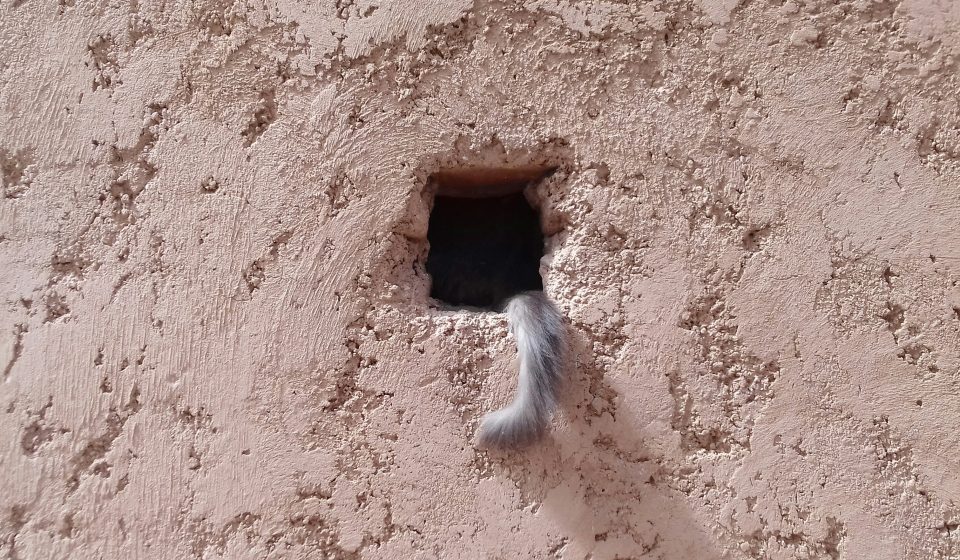
We Found Something Strange Above Our Hotel Bed—Then We Realized What Had Been Hiding in Plain Sight

For the first two days of our vacation, the hotel room seemed almost perfect.
The bed was covered in crisp white sheets. Polished wooden furniture gave the room a warm, clean appearance. Through the wide windows, we could see the ocean stretching toward the horizon.
It was exactly the kind of place we’d imagined during the months we’d spent planning the trip.
Quiet.
Comfortable.
Far removed from the routines we’d left behind.
Then, on the third afternoon, I happened to look toward the upper corner of the room.
And suddenly, I couldn’t stop looking.
There was something attached to the wall.
It was small enough that we’d somehow missed it for days, but once I noticed it, it seemed impossible that we hadn’t seen it sooner.
At first, I thought it was part of an old repair.
Then we moved closer.
And realized it wasn’t part of the hotel room at all.
Something Was Attached Near the Ceiling
The object was tucked close to the molding where the wall met the upper part of the room.
From a distance, it looked like a small tube or an unusual lump of dried material.
Maybe plaster.
Maybe some leftover construction material.
Perhaps someone had repaired the wall and forgotten to clean it properly.
None of those explanations seemed particularly concerning.
Still, curiosity got the better of us.
We stepped closer.
That’s when its unusual construction became much easier to see.
This wasn’t a random patch of material.
It looked deliberately built.
Layer by layer.
Out of mud.
It Appeared to Be a Mud Dauber Wasp Nest
The structure appeared to be the kind of nest associated with mud dauber wasps.
These solitary wasps are known for constructing nests from mud, often creating tube-like or cell-like structures attached to protected surfaces.
The realization immediately changed the way we looked at the room.
Only a few moments earlier, we’d been sitting comfortably on the bed.
Now we were staring upward and wondering how long the structure had been there.
Had it been there before we arrived?
Was anything still inside?
Were there more nests somewhere we hadn’t noticed?
The room itself hadn’t changed.
But our perception of it certainly had.
We Had Been Sleeping Just a Few Feet Away
That was the strangest part.
For two nights, we’d slept beneath it without noticing anything unusual.
We’d unpacked.
Relaxed.
Walked around the room countless times.
We’d looked through the windows.
Checked our phones.
Planned where we’d go the following morning.
Yet neither of us had paid much attention to that particular corner.
Now it was the only thing we could see.
It’s remarkable how quickly a comfortable space can feel different once you notice something unexpected.
What Exactly Are Mud Daubers?
“Mud dauber” is a common name used for several kinds of solitary wasps known for building nests from mud.
Unlike the large communal nests many people associate with wasps, mud daubers generally work alone.
The female collects mud and uses it to construct protected cells.
These cells aren’t simply places for an adult wasp to sleep.
They’re part of the insect’s reproductive cycle.
What Can Be Inside the Nest Is Even More Interesting
Depending on the species, a female mud dauber may hunt spiders, sting and paralyze them, and place them inside the nest.
She then lays an egg within the prepared cell.
When the larva develops, the stored prey provides food.
From a biological perspective, it’s an effective survival strategy.
From the perspective of hotel guests discovering one near their bed?
It can feel considerably less fascinating in the moment.
Knowing that such a tiny structure can contain an entire miniature life cycle makes it difficult to look at it as simply a spot of dried mud.
The Discovery Made Us Inspect Everything
Once we’d identified what the structure appeared to be, we began looking around.
Not frantically.
But carefully.
The other corners.
Behind curtains.
Around the window.
Along the ceiling.
Places we’d completely ignored during our first two days suddenly seemed worthy of inspection.
Nothing else immediately stood out.
Still, our sense of the room had changed.
The hotel hadn’t become dirty or dangerous simply because we’d discovered one unusual structure.
But the illusion that the room was completely isolated from the natural environment outside had disappeared.
We Called the Front Desk
We decided there was no reason to handle it ourselves.
Instead, we contacted the hotel.
A staff member arrived shortly afterward.
They examined the structure and dealt with it calmly.
There was no dramatic emergency.
No frantic evacuation.
No chaotic scene.
The nest was carefully removed, and the area was left looking much as it had before.
Within minutes, the visible problem was gone.
If someone had entered the room afterward, they probably never would have known anything unusual had been there.
But we knew.
Should You Remove a Wasp Nest Yourself?
Finding something that appears to be a wasp nest indoors can create an understandable urge to knock it down immediately.
That’s not always the best response.
If you’re staying in a hotel, rental property or another building you don’t own, notifying staff or the property manager is usually the more sensible approach.
They can inspect the structure and determine how it should be handled.
It’s also worth remembering that not every nest-like object belongs to the same insect.
Identification matters.
And anyone with a known severe allergy to insect stings has additional reason to avoid unnecessary contact.
Mud Daubers Aren’t the Same as Every Other Wasp
The word “wasp” alone can make people nervous.
But wasps don’t all behave the same way.
Mud daubers are generally solitary rather than social colony-building wasps.
They’re also generally considered less aggressive toward people than some social wasps that vigorously defend their nests.
That doesn’t mean someone should grab or disturb an unidentified nest with bare hands.
It simply means discovering a mud structure shouldn’t automatically be treated as evidence that a room is filled with aggressive wasps.
The sensible response is inspection and appropriate removal when necessary.
There Was Another Side to the Discovery
Once the immediate discomfort passed, curiosity returned.
The nest itself was surprisingly precise.
An insect had gathered tiny amounts of mud and transported them to this protected location.
Then it had constructed a structure suited to a specific biological purpose.
No measuring tape.
No blueprint.
No construction tools.
Just instinct and repeated work.
Something we’d initially viewed as an ugly flaw on the wall was actually a small piece of natural engineering.
We still didn’t want it above the hotel bed.
But we could appreciate what it represented.
How Did We Miss It?
That question stayed with us.
The nest wasn’t invisible.
It hadn’t suddenly appeared the moment I noticed it.
It had apparently been sitting there while we went about our vacation.
The explanation was probably simple.
We hadn’t been looking for it.
When you enter a hotel room, you tend to notice the things that matter immediately.
The bed.
Bathroom.
Windows.
View.
Luggage space.
Electrical outlets.
Maybe the thermostat.
You don’t necessarily inspect every inch of molding near the ceiling.
Our brains decide what deserves attention.
Everything else becomes background.
Until something makes us look.
The Room Felt Different Afterward
After the nest was removed, nothing obvious remained.
The bed was still comfortable.
The ocean was still outside the window.
The sunlight still filled the room.
Yet for a while, we found ourselves glancing toward that corner.
It had become a reminder that the boundaries humans create aren’t always meaningful to the natural world.
We call something a hotel room.
To an insect, it may simply look like shelter.
We see walls designed to keep nature outside.
A wasp may see a dry, protected surface perfect for building.
Nature Doesn’t Recognize Our Boundaries
That became the larger lesson of the experience.
Humans spend enormous effort creating controlled environments.
We build walls.
Install windows.
Regulate temperature.
Clean surfaces.
Seal doors.
And create spaces specifically designed to separate us from rain, wind, insects and other elements of the outdoors.
Most of the time, those systems work remarkably well.
But nature continually finds tiny opportunities.
An open window.
A small gap.
A sheltered corner.
A quiet place nobody regularly checks.
Sometimes that’s all it takes.
The Vacation Didn’t End There
We didn’t pack our bags.
We didn’t abandon the hotel.
And we didn’t spend the rest of the trip worrying about wasps.
Once the structure had been removed and the situation addressed, we went back to what we’d come to do.
We walked along the coast.
Enjoyed the warm air.
Watched the water.
And appreciated being away from our normal routine.
But we noticed our surroundings a little differently.
A Small Discovery Changed Our Perspective
The most memorable part of the experience wasn’t fear.
It was awareness.
Something small had been sitting in plain sight.
We’d walked beneath it repeatedly.
Slept nearby.
Never noticed it.
Then one glance changed the entire room.
That’s probably why discoveries like this fascinate people.
They remind us how much of our surroundings we don’t actually see.
We see what we expect to see.
Everything else waits quietly in the background.
What Would You Have Done?
Finding an apparent mud dauber nest in a hotel room isn’t necessarily a reason to panic.
But it’s certainly something most guests would want addressed.
Calling hotel staff allowed the structure to be inspected and removed without us having to disturb something we couldn’t confidently identify ourselves.
And after that, our vacation continued.
The room returned to normal.
Almost.
Because every now and then, one of us would still look toward that empty corner near the ceiling.
Not because anything was there anymore.
But because we’d learned something surprisingly easy to forget:
Even in a room designed to keep the outside world out, nature can sometimes find its way in—and remain unnoticed until someone finally looks up.
Editor’s note: This article is based on a personal-style narrative. Without examination of the actual specimen, a nest cannot be conclusively identified from the written description alone. Mud dauber species and behavior vary, and unidentified wasp or insect nests should be approached cautiously.