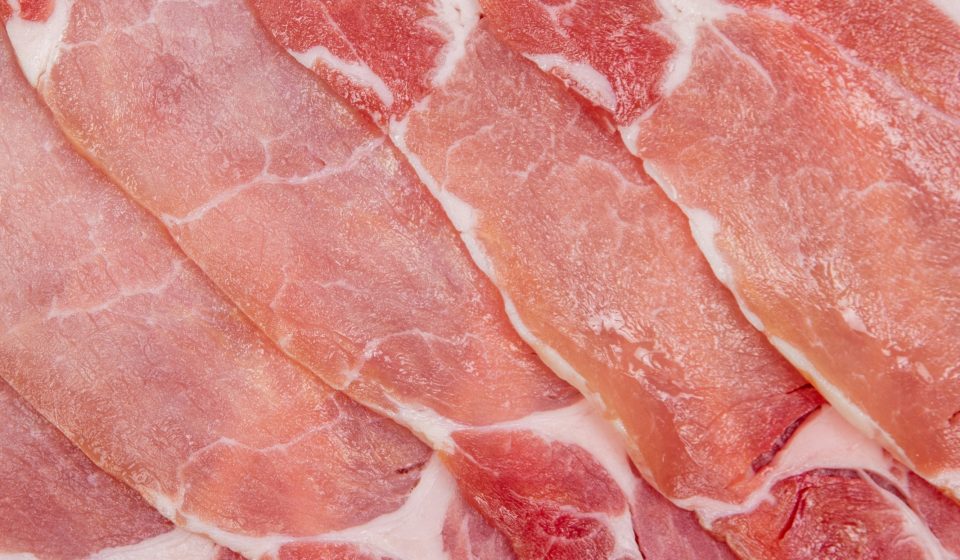
I Opened a Regular Package of Bacon—Then I Found Something Inside That Didn’t Look Like Meat

It was supposed to be an ordinary breakfast.
Coffee was brewing. The pan was ready. I had just returned from the grocery store with a standard package of bacon—the same kind of product millions of people buy without giving it much thought.
I opened the package and reached for the first strip.
Then I stopped.
Something about it felt wrong.
Part of the bacon was unusually firm. Instead of the soft, flexible texture I expected, there was a dense section that felt almost rubbery beneath my fingers.
I lifted it toward the kitchen window.
That’s when breakfast suddenly became the last thing on my mind.
Something Inside the Bacon Looked Strange
The unusual section seemed much more rigid than the surrounding meat and fat.
Its edge looked surprisingly straight.
Its texture didn’t resemble what I expected to find in an ordinary slice of bacon.
For a moment, I wondered whether something that didn’t belong in the package had somehow made its way inside.
Plastic?
Packaging material?
Some kind of foreign object from processing equipment?
I didn’t know.
And because I didn’t know, I decided not to eat it.
That turned out to be the most important decision I could make in the moment.
The Internet Made Everything Worse
Like many people confronted with something unfamiliar, I reached for my phone.
That wasn’t particularly helpful.
Search for almost any strange object found in food and you’ll quickly encounter dramatic photographs, alarming stories and confident explanations from people who have never examined the object in question.
One post says it’s harmless.
Another insists it’s dangerous.
Someone else offers an explanation that sounds scientific but provides no evidence.
Within minutes, an unusual breakfast can begin to feel like a major food-safety emergency.
That’s exactly what happened.
The more I searched, the less certain I became.
Then a Much Simpler Possibility Emerged
After comparing what I was seeing with information about pork anatomy and meat processing, one explanation seemed far less dramatic than the theories circulating online.
The firm material could have been cartilage or another type of connective tissue.
That would make considerably more sense than many of the frightening explanations I’d encountered.
Bacon comes from an animal.
And animals aren’t composed exclusively of the perfectly alternating layers of meat and fat that consumers expect to see inside supermarket packaging.
They also contain connective tissues and other anatomical structures.
Commercial processing is designed to produce a consistent product, but natural variation doesn’t disappear simply because meat has been sliced and packaged.
But There Was an Important Catch
Without actually having the material examined, I couldn’t prove exactly what it was.
That’s worth emphasizing.
A photograph—or a description on social media—isn’t necessarily enough to identify an unusual object found in food.
Something that resembles cartilage could potentially be something else.
So the sensible conclusion isn’t:
“Don’t worry. It’s definitely harmless.”
It’s:
If you can’t identify something unusual in packaged food, don’t eat it until you know what it is.
That approach avoids both extremes.
There’s no reason to immediately assume something terrifying has happened.
But there’s also no reason to consume an unidentified material simply because someone online says it’s probably fine.
What Is Cartilage?
Cartilage is a type of connective tissue found naturally in animals, including pigs.
It’s firmer and more rubbery than muscle or fat, which can make it stand out dramatically when encountered unexpectedly in a food product.
Anyone accustomed to highly uniform supermarket bacon might understandably mistake an unusual piece of biological tissue for something artificial.
The visual difference can be especially striking because packaged bacon is normally presented in carefully arranged slices.
We expect consistency.
Anything that breaks that pattern immediately gets our attention.
Bacon Doesn’t Begin as Perfect Strips
The supermarket package creates a very particular impression.
Every slice is lined up.
The plastic is sealed.
The label lists ingredients and storage information.
The product looks standardized.
But before bacon becomes a row of neat slices, it comes from pork belly or another cut specified for the product.
That means natural differences in fat, muscle and connective tissue can exist.
Processing can make food more consistent.
It cannot transform biological material into something that is naturally identical from one piece to another.
Why the Strange Texture Felt So Alarming
Part of the reaction came from expectation.
If you bite into a soft food and unexpectedly encounter something hard, your brain immediately recognizes that something has changed.
The same thing happens visually.
When every strip of bacon looks familiar except one section, the unusual part becomes impossible to ignore.
That doesn’t automatically mean it’s dangerous.
But it does mean it’s worth examining before eating.
And that’s an important distinction.
Unusual doesn’t automatically mean unsafe.
But unidentified doesn’t automatically mean safe either.
What Should You Do If You Find Something Strange in Packaged Meat?
The first step is simple:
Don’t eat the unidentified material.
Set the product aside.
Avoid repeatedly handling the object unnecessarily, particularly if you don’t know what it is.
Then keep the original packaging.
That packaging can contain information that may become important if you contact the manufacturer or retailer.
Depending on the product, that may include a lot or batch code, establishment information, sell-by or use-by date, and other identifying details.
Take Clear Photos Before Throwing Anything Away
If you’re going to report the problem, photographs can help document what you found.
Take a picture of the unusual material.
Then photograph the complete package.
Make sure the product label and identifying codes are readable.
Don’t rely only on a close-up image of the object.
Without information about the product it came from, investigating a complaint may become more difficult.
Contact the Retailer or Manufacturer
If something genuinely appears abnormal, the company responsible for the product may be able to provide additional guidance.
Explain what you found.
Provide the identifying information from the package.
If requested, provide photographs.
They may be able to explain whether the material is a normal part of the product, investigate a processing issue or advise you on what to do next.
If there’s reason to suspect a genuine food-safety problem, appropriate food-safety authorities can also provide guidance.
Don’t Let Social Media Identify It for You
Posting a photograph online can produce hundreds of responses.
That doesn’t mean you’ll receive hundreds of informed answers.
People may identify the same object as completely different things.
Some explanations will sound frightening precisely because frightening explanations attract attention.
A stranger looking at a compressed photograph usually cannot provide the same level of certainty as someone who can examine the actual material or investigate the product.
That’s especially important with food.
Not Every Strange Piece of Meat Is Evidence of Contamination
Modern consumers are accustomed to extremely standardized food.
Carrots are expected to be straight.
Apples are expected to look nearly identical.
Chicken breasts are trimmed.
Fish is filleted.
Meat is sliced and arranged.
The less the final product resembles the original animal, the easier it becomes to forget how much natural variation exists.
So encountering an unusual piece of tissue can be startling even when the explanation is biological rather than industrial.
The Experience Changed the Way I Looked at Packaged Meat
Once the initial alarm faded, something else remained.
Awareness.
I’d bought bacon hundreds of times without thinking about its anatomy.
It was simply bacon.
A product.
A package.
Something to put in a pan.
Finding an unfamiliar piece of tissue interrupted that abstraction.
Whatever the material ultimately was, the experience reminded me of something obvious that supermarket packaging makes remarkably easy to overlook:
Meat is biological tissue.
It doesn’t originate as perfectly uniform slices inside a plastic package.
There’s Nothing Wrong With Wanting Answers
None of this means consumers should ignore something unusual in their food.
Quite the opposite.
Food producers are expected to follow safety and quality-control procedures.
Consumers have every reason to question something that looks genuinely abnormal.
But questioning doesn’t require jumping immediately to the most frightening explanation.
There is a large difference between saying:
“I don’t recognize this.”
and
“This must be dangerous.”
The first is an observation.
The second requires evidence.
A Better Response Than Panic
If I encountered the same situation again, I wouldn’t spend hours reading increasingly disturbing theories online.
I’d take a much simpler approach.
Stop eating the product.
Keep the packaging.
Take photographs.
Check for any relevant product information or recalls.
Contact the retailer or manufacturer if necessary.
And seek authoritative food-safety guidance if there were genuine signs of contamination or illness.
That’s much more useful than trying to diagnose an unidentified object from a blurry photograph.
The Bigger Lesson Wasn’t About Bacon
What stayed with me wasn’t simply the strange texture.
It was how quickly uncertainty turned into fear.
I went from preparing breakfast to imagining extraordinary explanations because something didn’t match my expectations.
The internet made that reaction easier.
But the most plausible answer may have been far more ordinary:
Natural tissue from the animal itself.
Even so, without direct examination, certainty would be inappropriate.
And perhaps that’s the most useful lesson.
We don’t need to choose between panic and blind reassurance.
Sometimes the responsible answer is simply:
“I don’t know what this is yet, so I’m not going to eat it until I have better information.”
That’s not paranoia.
That’s ordinary caution.
The bacon package that morning reminded me that food doesn’t always look as perfect as supermarket shelves teach us to expect.
Natural variation exists.
Processing imperfections can occur.
And occasionally, something unfamiliar can make its way into a package.
The right response isn’t to assume the worst.
It’s to stop, document what you found, and find out what you’re actually looking at before drawing conclusions.
Because when something unexpected appears on your plate, evidence is far more useful than fear.
Editor’s note: The material described in this story cannot be conclusively identified from the written account alone. Cartilage or connective tissue is one possible explanation, not a confirmed identification. If you find an unidentified object or tissue in packaged meat, avoid consuming it and retain the product and packaging while seeking guidance from the retailer, manufacturer or appropriate food-safety authority.