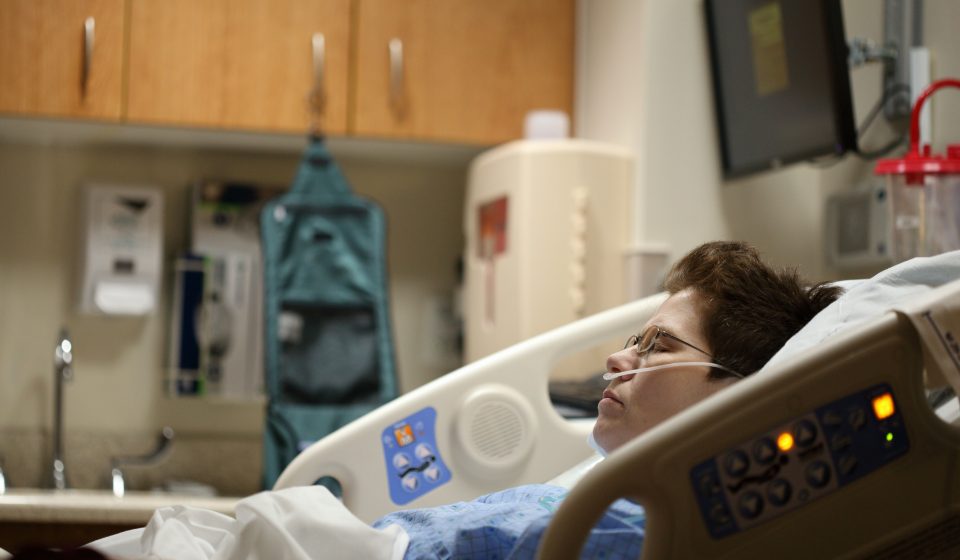
At 80, I Went to the Hospital for a Mysterious Swelling—Then I Found a File My Late Husband Had Hidden for 12 Years

At 80 years old, I thought life’s biggest surprises were behind me.
I had raised three children.
Welcomed seven grandchildren.
Spent five decades married to the man I loved.
And survived the grief of losing him.
Then my stomach began to swell.
At first, I dismissed it as another ordinary change that comes with age.
But month after month, it grew larger.
My clothes stopped fitting.
The pressure became uncomfortable.
And sometimes, late at night, I felt strange sensations in my abdomen that I couldn’t explain.
Eventually, my family convinced me to see a doctor.
I expected tests.
Perhaps surgery.
Maybe a difficult diagnosis.
What I didn’t expect was for a doctor to uncover an old medical record connected to my husband.
It was 12 years old.
And beside his name were two words I’d never seen before:
PROJECT MARGARET.
That was my name.
And my husband had been dead for 12 years.
I Thought I Knew Everything About My Husband
My name is Margaret Whitmore.
For most of my adult life, Robert was beside me.
We raised our family together.
We argued.
We celebrated.
We watched our children become adults and eventually build families of their own.
After Robert died, I stayed in the house we’d shared.
His favorite chair remained beside the window.
His photograph stayed on the mantel.
Sometimes I still instinctively reached for a second coffee mug in the morning.
My children thought the house had become too large for me.
I disagreed.
It wasn’t simply a house.
It contained 50 years of my life.
And until recently, I believed I understood the man who had shared those years with me.
Then My Body Started Changing
The swelling began gradually.
My skirts became tight around the waist.
I assumed I’d gained weight.
But the change continued.
After about three months, I stopped wearing fitted clothing.
By six months, my abdomen had become noticeably round and firm.
After meals, I sometimes experienced uncomfortable pressure.
Still, I avoided the doctor.
Perhaps I didn’t want an answer.
Perhaps I had simply become too comfortable dismissing things as part of getting older.
Then my daughter-in-law, Sarah, noticed.
She asked whether I’d spoken to a physician.
I told her it was probably nothing.
She didn’t accept that answer.
“Please get it checked.”
I finally promised I would.
That Night, I Remembered an Envelope
After my family left, I went upstairs and opened my bedside drawer.
There it was.
An old envelope Robert had given me shortly before his death.
Across the front, in his handwriting, were words I’d read countless times but never fully understood:
MARGARET — ONLY IF NECESSARY.
Robert had told me to keep it somewhere safe.
If something ever happened that I didn’t understand, he’d said, perhaps the answers would be inside.
For 12 years, I never opened it.
I assumed it contained financial instructions or information about one of his business affairs.
But that night, another memory returned.
During Robert’s final hospitalization, a woman had visited him.
Her name was Dr. Evelyn Carter.
She carried a silver briefcase.
She and Robert spoke privately.
Afterward, my husband seemed unusually unsettled.
He told me that if I ever needed answers concerning his work, I should remember Evelyn’s name.
I’d nearly forgotten the conversation.
Now I couldn’t stop thinking about it.
The Hospital Found a Large Mass
The following morning, my youngest son, Daniel, drove me to the hospital.
Doctors began examining the swelling.
An ultrasound led to additional testing.
Eventually, my physician explained that imaging had revealed a large fluid-filled mass in my abdomen.
At that stage, its exact nature hadn’t been established.
Further evaluation was necessary.
I asked the obvious question:
Was it serious?
The doctor couldn’t answer yet.
Then she asked me something completely unexpected.
Had I ever received treatment through a private research facility?
I told her I didn’t remember anything like that.
She had found a reference in an archived record.
It was approximately 12 years old.
And it was connected with an organization called Carter Biomedical.
Carter.
I immediately remembered Evelyn.
Then I looked at Daniel.
His expression changed.
“Mom,” he said, “there’s something I need to tell you.”
My Husband Had Another Safe
Daniel told me there was a safe hidden in the basement of my own house.
I had lived there for half a century.
I never knew it existed.
Daniel had discovered it after Robert died.
Inside were contracts, insurance documents and research records.
Then he admitted something else.
One folder had my name on it.
PROJECT MARGARET.
I couldn’t understand what I was hearing.
I’d always known Robert as an insurance executive.
Why would he possess medical-research records bearing my name?
And why hadn’t my son told me?
Daniel said he’d assumed they were simply documents connected with one of his father’s old investments.
Now neither of us was so sure.
Then Daniel Brought Me the Files
The next day, he returned to the hospital carrying the documents.
One photograph immediately caught my attention.
Robert was standing outside a laboratory beside a woman.
Dr. Evelyn Carter.
On the back was another reference to Project Margaret.
Other records discussed medical testing, patient observation and long-term health research.
Then we found a document containing my name.
The date stopped me.
It came from the same period as Robert’s final hospitalization.
I had no memory of voluntarily joining a research study.
That was when my doctor made an important distinction.
Whatever these old records represented, there was no established evidence that the historical research had caused my current abdominal condition.
My swelling and the old project needed to be treated as separate questions unless evidence demonstrated otherwise.
That mattered.
The mystery was disturbing enough without turning suspicion into medical fact.
Then We Found Daniel’s Name
Among the old documents was a participant list.
Daniel was on it.
This time, he remembered something.
Years earlier, his father had asked him to participate in medical evaluations connected with research into hereditary health conditions.
He remembered blood samples.
Questions about family medical history.
But he hadn’t understood the larger project.
And he hadn’t realized my name was connected to it.
Then I remembered something else.
During Robert’s final hospital stay, I had once become dizzy and weak while visiting him.
Hospital staff checked me.
At the time, Robert assured me everything was fine.
I’d believed him.
Now I couldn’t help wondering whether that examination had somehow become connected with his research records.
I needed answers.
And I knew where I had to start.
The unopened envelope.
I Finally Read Robert’s Letter
Daniel retrieved it from my bedroom.
After 12 years, I opened it.
Robert began by admitting that there had been a part of his professional life he’d kept separate from our family.
He had helped finance a clinical research initiative led by Evelyn Carter.
The program was intended to study certain long-term health conditions.
Family medical information had been incorporated into the research.
Robert admitted that my name had been included.
Then came the sentence that hurt most.
He acknowledged that he should have explained everything to me.
He should have asked what I wanted.
Instead, he avoided the conversation.
He called that a mistake.
This Wasn’t About Whether He Loved Me
Robert’s letter made clear that Daniel had undergone basic testing without understanding the broader project.
He told me not to blame our son.
Then Robert instructed me to contact Evelyn if questions ever arose.
I lowered the letter.
I wasn’t questioning whether my husband had loved me.
I was questioning something different.
Why hadn’t he trusted me with a decision involving my own information?
For 50 years, I’d thought our marriage was built on complete openness.
Now I was discovering an entire part of his life that he’d kept behind a locked door.
Then We Found a Form With My Signature
Another document appeared to contain my signature.
I stared at it.
Something seemed wrong.
The way my surname ended looked like handwriting I hadn’t used in years.
Sarah wondered whether it might have been copied from an older document.
I couldn’t prove that.
None of us could.
And that was precisely the problem.
We had spent enough time making assumptions.
If the document mattered, it needed to be examined properly.
Then we found something even more revealing.
A letter from Evelyn to Robert.
She had warned him that family members needed to understand the scope of the research and provide appropriate authorization.
She specifically said I deserved to understand how my medical information might be used.
That settled it.
I wanted to speak to her.
The Woman With the Silver Case Returned
The following afternoon, Evelyn Carter walked into my hospital room.
She was older now.
Her hair had turned silver.
But I recognized her immediately.
She explained that Robert had helped finance a research program involving biological samples, medical information and hereditary conditions.
Daniel had participated in testing.
Robert had also supplied family medical records.
Then I asked the only question that mattered:
Had I personally consented?
Evelyn couldn’t give me the certainty I wanted.
The surviving records indicated that my information had been included.
But she couldn’t establish from those records whether I’d personally authorized every use of it.
Robert had apparently insisted that he would discuss the matter with me.
He never did.
Evelyn acknowledged that this should have been addressed.
My Medical Problem Was a Separate Issue
My doctor then asked Evelyn directly whether the old research appeared connected to the mass in my abdomen.
The answer was important.
There was no evidence in the available medical findings showing that the historical research had caused my current condition.
My doctors agreed.
The abdominal mass required its own diagnosis and treatment.
That distinction gave me some relief.
I’d discovered a serious issue involving secrecy, consent and trust.
But that didn’t mean the research had physically caused what was happening inside my body.
Those were two different matters.
For Once, the Decision Was Mine
My doctors explained that the mass was large enough to be pressing on surrounding organs.
A surgical team recommended removing it after appropriate evaluation.
There were risks.
I was 80 years old.
I listened carefully.
Asked questions.
Reviewed the options.
Then I looked at the consent documents.
Robert had spent years making assumptions about what I should or shouldn’t know.
This decision would be different.
This one belonged to me.
I consented to surgery.
The Operation Was Successful
When I opened my eyes afterward, Daniel was sitting beside me.
The procedure had gone well.
The surgical team had removed the fluid-filled mass.
Further laboratory analysis and follow-up would still be needed, but the initial findings were reassuring.
For the first time in months, I felt something I hadn’t allowed myself to feel.
Hope.
But the story with Robert wasn’t finished.
There were more letters.
Robert Had Known He Needed to Tell Me
Among the remaining correspondence was another message from Evelyn.
She had again urged Robert to resolve the authorization questions surrounding the family research.
I deserved to know, she wrote.
Robert’s response finally revealed why he’d delayed.
He knew I’d be angry that he hadn’t explained the project earlier.
He wanted to wait until the research produced something positive before telling me.
In other words, the longer he avoided one uncomfortable conversation, the harder it became to have it.
Eventually, he ran out of time.
His Final Letter Changed How I Remembered Him
There was one more message from Robert.
This one wasn’t about research.
It was about us.
He admitted that he’d spent too much energy trying to build something important outside our home.
He had wanted to accomplish something meaningful.
Something lasting.
But in doing so, he sometimes overlooked what he already had.
Our life together.
Our family.
Our marriage.
I pressed the letter against my chest.
For weeks, I’d been angry.
I still had every right to be.
But something had changed.
I no longer needed Robert to be either a wonderful husband or a deeply flawed man.
He could have been both.
Fifty Years of Love Didn’t Disappear
The secret mattered.
The failure to communicate mattered.
Questions about the use of my medical information mattered.
But those truths didn’t erase five decades of shared life.
Our children’s births.
Family dinners.
Anniversaries.
Arguments.
Vacations.
Ordinary mornings.
Private jokes.
The hundreds of tiny things that make up a marriage.
Robert had failed me in an important way.
That didn’t mean every good memory had suddenly become false.
The truth was more complicated than that.
Six Weeks Later, I Went Home
My children had prepared the house for me.
The refrigerator was stocked.
Flowers waited in the kitchen.
Family photographs appeared everywhere.
The house was noisy again.
Grandchildren visited.
My great-granddaughter asked whether I felt better.
I told her I did.
And I meant it.
Later, when everyone had gone home, I stood in the living room.
Robert’s chair remained beside the window.
His photograph was still on the mantel.
I picked it up.
For years, I’d remembered my husband as though he had always known what to do.
Now I saw him differently.
Loving.
Ambitious.
Flawed.
Sometimes wise.
Sometimes terribly wrong.
Human.
I returned the photograph to its place.
I Wanted the Records Investigated
I didn’t simply forget about the research.
I arranged for an independent review of the old records.
I wanted to understand exactly how my information had been used and what documentation existed.
That mattered to me.
Not because I wanted revenge.
Because I finally understood the importance of asking questions about decisions made in my name.
At 80, I wasn’t too old to demand answers.
The Lesson Was Bigger Than My Husband’s Secret
Later, I spoke at a local community seminar about older adults making informed healthcare decisions.
I talked about how easily I’d dismissed my abdominal swelling.
Sarah’s insistence that I see a doctor had pushed me to seek medical care.
Then I spoke about something else.
Documents.
Consent.
Questions.
Understanding what you’re agreeing to.
I had spent much of my life trusting other people to manage complicated matters.
There is nothing inherently wrong with trust.
But trust doesn’t require surrendering your voice.
My Life Was Still Mine
Months passed.
My strength returned.
I went back to gardening.
Church.
Sunday meals with my family.
One day, Daniel brought me a small box of his father’s belongings.
Inside were photographs from our marriage.
Our honeymoon.
Robert holding our newborn daughter.
Our 40th anniversary.
At the bottom was an old card.
It contained a simple message from Robert telling me that of everything he’d accomplished, being my husband had been his greatest privilege.
I cried.
But this time, the tears weren’t only from anger.
I’d finally learned how to remember him as he really was.
Not perfect.
Not terrible.
A man who loved me and still made choices that hurt me.
Both things could be true.
At 80, I Started Another Chapter
One morning, I woke early and made coffee.
Sunlight came through the curtains.
Birds were calling outside.
The house felt peaceful again.
Months earlier, I’d entered a hospital because my stomach wouldn’t stop swelling.
I expected doctors to tell me what was happening to my body.
Instead, the experience also uncovered a part of my husband’s life I’d never known existed.
But the biggest discovery wasn’t inside a medical file.
It wasn’t inside Robert’s safe.
And it wasn’t inside one of his letters.
It was something I’d nearly forgotten.
My life still belonged to me.
I could ask questions.
I could demand explanations.
I could make my own medical decisions.
I could love someone while acknowledging that he’d hurt me.
And I could decide what the next chapter of my life would look like.
My name is Margaret Whitmore.
I’m 80 years old.
I spent decades believing age brought certainty.
Instead, I’ve learned that life can still surprise you.
And when it does, you don’t have to surrender your voice.
It’s never too late to ask questions, face difficult truths, and decide for yourself what comes next.
Editor’s note: This is a dramatized narrative, not a verified medical case report. The characters, research program and events described should not be interpreted as evidence that medical research caused the abdominal condition in the story. Persistent or unexplained abdominal swelling warrants evaluation by a qualified healthcare professional.