Hundreds of Tiny Praying Mantises Just Hatched by the Front Door—Here’s What to Do If You See This

Imagine opening your front door one morning and discovering dozens—or even hundreds—of tiny insects crawling across the wall, porch and nearby plants.
At first, the sight can be startling.
They seem to have appeared overnight.
Some cling to the brickwork. Others move across the doorway. More disappear into nearby vegetation.
Look closely, however, and you may recognize their unmistakable shape.
They’re baby praying mantises.
And if a large number suddenly appear in one small area, there’s a good chance an egg case nearby has just hatched.
The strange-looking structure they emerged from is called an ootheca, and what looks like an insect invasion is actually a normal—and fascinating—part of the praying mantis life cycle.
Here’s what you’re seeing, why so many can appear at once, and what you should do if it happens near your home.
First, Don’t Panic
Finding a large group of baby mantises near a doorway can look alarming.
Fortunately, seeing them outdoors generally isn’t a reason to panic.
Praying mantises don’t establish household colonies in the way people might imagine when they see dozens of insects appearing together.
Instead, the youngsters have emerged from an egg case and will begin dispersing into the surrounding environment.
The gathering can look enormous immediately after hatching.
Give them time, however, and the scene can change quickly as the tiny mantises spread into nearby plants and other sheltered areas.
That’s why a porch can appear covered with them one morning and look almost completely normal later.
What Is That Strange Foam-Like Case?
The structure the mantises emerge from is called an ootheca.
Female praying mantises produce a foamy material around their eggs. It hardens into a protective case that can remain attached to vegetation or other sturdy surfaces.
Depending on the species, an ootheca might be found on:
- Twigs
- Plant stems
- Tall grasses
- Fences
- Walls
- Rocks
- Other protected outdoor surfaces
Some species produce egg cases that look rounded and foamy.
Others are flatter or more elongated.
That means you shouldn’t assume every mantis egg case will look exactly like the ones you’ve seen online.
The species matters.
One Egg Case Can Produce a Surprising Number of Babies
This is the part that catches many homeowners off guard.
A single ootheca can contain dozens or even hundreds of eggs, depending on the species.
That explains why it can feel as though the tiny insects appeared from nowhere.
You may not have noticed the egg case sitting quietly on a branch, wall or fence for months.
Then conditions become favorable.
The nymphs emerge.
Suddenly, there are tiny mantises everywhere.
What looks like a major infestation may have come from one small structure.
Baby Mantises Already Look Like Mantises
Newly emerged mantises are called nymphs.
They resemble miniature versions of the adults they’ll eventually become, although they aren’t fully developed.
Their bodies can appear remarkably delicate immediately after emergence.
But the familiar mantis design is already visible.
There’s the distinctive head.
The long body.
And, most noticeably, the specialized front legs that will eventually make them formidable hunters.
They don’t need a parent to teach them how to hunt.
Those behaviors are instinctive.
Then They Begin to Spread Out
A newly hatched group doesn’t remain together like a social insect colony.
The nymphs begin dispersing.
Some climb vegetation.
Others move across nearby surfaces.
And many will disappear from sight remarkably quickly.
There’s a practical reason for spreading out.
Food and survival become immediate concerns.
Young mantises are predators from the beginning, feeding on appropriately sized prey.
They may also prey on one another.
So the huge gathering you see immediately after hatching isn’t necessarily going to remain a huge gathering.
Nature starts thinning the group almost immediately.
Are Praying Mantises Good for Your Garden?
This question needs a little nuance.
Praying mantises certainly eat many insects people consider garden pests.
They can prey on flies, aphids, caterpillars, grasshoppers and many other small creatures.
That has given them a reputation as beneficial garden predators.
But there’s an important catch.
Mantises aren’t particularly interested in whether an insect is “good” or “bad” from a gardener’s perspective.
They’re generalist predators.
If suitable prey comes within striking distance, a mantis may attempt to catch it.
That means their diet can also include beneficial insects such as bees and butterflies.
They can even eat other mantises.
So describing them simply as environmentally friendly pest-control machines is misleading.
They’re predators occupying their own place in the food web.
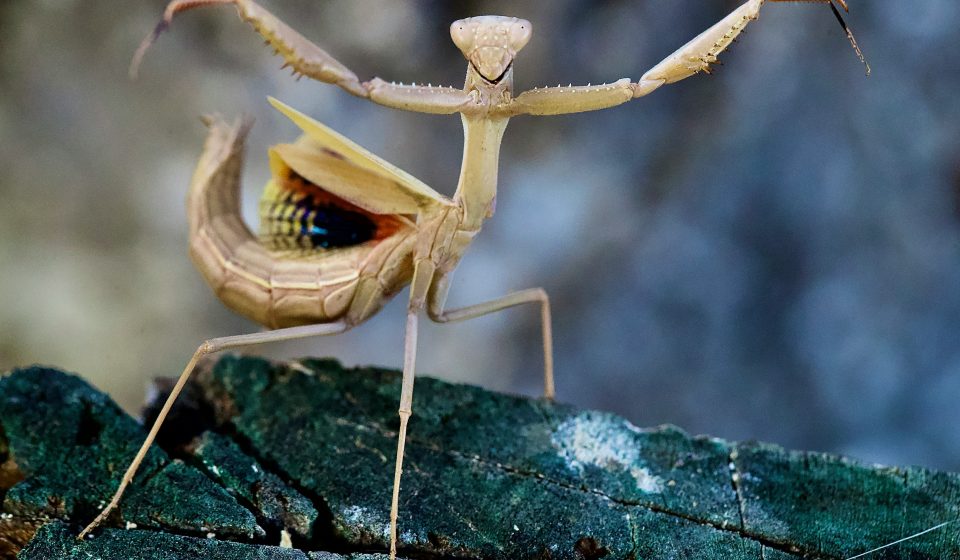
Their Front Legs Explain Their Name—and Their Hunting Style
One of the most recognizable things about a mantis is the way it holds its front legs.
Folded in front of the body, they can resemble hands held in prayer.
That’s where the familiar name comes from.
But those legs aren’t designed for meditation.
They’re hunting equipment.
Mantises are ambush predators.
Rather than constantly chasing prey, they can remain extremely still and wait.
When an appropriate insect moves within range, the mantis rapidly extends its specialized forelegs and grabs it.
Those legs are lined with structures that help secure struggling prey.
It’s one reason even a tiny mantis can already look surprisingly formidable.
They Have Remarkable Vision
A praying mantis’s head is another reason the insect looks so unusual.
Its large compound eyes provide a wide field of view and are particularly useful for detecting movement.
Mantises rely heavily on vision when hunting.
Anyone who has watched an adult mantis closely may have noticed another strange behavior:
It appears to watch you back.
The head can turn considerably as the insect follows movement around it.
Combined with its patient hunting posture, that gives the mantis an almost strangely attentive appearance.
What Should You Do If They Hatch by Your Door?
Usually, the simplest answer is:
Give them space.
If the mantises have hatched outdoors and aren’t creating an immediate problem, there’s generally no reason to start spraying chemicals or crushing them.
Let them disperse naturally.
Nearby vegetation provides places to climb, hide and search for prey.
If possible, avoid unnecessary insecticide applications directly around the hatch site.
Broad-spectrum insecticides don’t distinguish between an insect you want to remove and other insects occupying the same area.
In many cases, doing nothing is the easiest response.
Be Careful Where You Step
Immediately after hatching, the nymphs can be extremely small.
That creates a more mundane danger than predators or weather:
People.
If they’re scattered across a walkway, porch or doorstep, simply watch where you place your feet for a while.
Give them an opportunity to move toward vegetation.
There’s rarely a need to pick up every individual mantis and relocate it manually.
They’re already programmed to disperse.
What If You Find an Unhatched Egg Case?
If you discover an ootheca outdoors, leaving it where it is may be appropriate if the location is safe.
If an egg case has to be moved from an inconvenient surface, don’t simply drop it onto the ground.
University of Illinois Extension advises placing a removed egg case in a sheltered location rather than leaving it on the soil, where ants may consume the eggs.
The appropriate decision can also depend on the species.
In parts of North America, for example, homeowners may encounter both native and introduced mantis species.
The Carolina mantis is native to the United States, while Chinese and European mantises were introduced.
Their egg cases also look different.
If species identification matters where you live, a local extension service or knowledgeable entomologist can help identify the ootheca.
Don’t Assume Every Mantis Is the Same Species
This is another detail often lost in viral posts.
“Praying mantis” doesn’t describe just one species.
Different mantids can vary considerably in size, coloration and egg-case appearance.
In the United States, commonly encountered examples include the Carolina mantis, Chinese mantis and European mantis.
The Chinese mantis can become substantially larger than the native Carolina mantis.
Their oothecae also have noticeably different shapes.
So a photograph showing hundreds of tiny mantises doesn’t necessarily tell you exactly which species you’re seeing.
Identification requires looking at more than the fact that they’re mantises.
Not Every Hatchling Will Become an Adult
Seeing hundreds of nymphs can create another understandable question:
Does this mean I’ll eventually have hundreds of giant mantises around my house?
No.
Young mantises face significant mortality.
They must find food while avoiding predators and environmental hazards.
They can also prey upon each other.
Only a fraction of the original hatchlings are likely to survive to adulthood.
The large number of young emerging from an ootheca is part of the species’ reproductive strategy.
Many begin the journey.
Far fewer complete it.
They Must Molt as They Grow
A young mantis can’t simply expand inside the same outer covering forever.
Like other insects with an exoskeleton, it must molt.
The old exoskeleton is shed, allowing the mantis to continue growing.
This process occurs repeatedly as the nymph develops toward adulthood.
After successive molts, the tiny creature that emerged from the egg case becomes increasingly recognizable as the much larger mantis people commonly encounter later in the season.
It’s an extraordinary transformation to consider when you’re looking at a hatchling barely larger than a fingernail.
Why the Sight Can Be So Memorable
Most of the praying mantis life cycle happens without us noticing.
An adult deposits an egg case.
Months pass.
Weather changes.
The ootheca remains attached to its surface.
Then, within a relatively brief window, a new generation emerges.
If that happens on a distant branch, you’ll probably never see it.
If it happens beside your front door, however, you suddenly get a front-row seat.
For a short period, a completely ordinary wall or porch can become covered with tiny predators beginning their lives.
Then they disappear into the landscape.
By afternoon, there may be little evidence anything unusual happened at all.
So If You Open the Door and See This, Remember What You’re Looking At
It can be startling.
It might even look a little creepy.
But hundreds of tiny praying mantises appearing around an outdoor egg case aren’t necessarily a sign that something has gone wrong.
You may simply have opened the door at exactly the right moment to witness something most people never notice.
A mantis ootheca has hatched.
The nymphs are dispersing.
And within a short time, that enormous gathering of miniature mantises will begin disappearing into the plants and landscape around your home.
Sometimes the strangest-looking discoveries around the house aren’t problems at all.
They’re simply nature happening close enough for us to notice.
Would you leave them alone if this happened beside your front door—or would seeing hundreds of tiny mantises make you nervous?