I Spotted Something Strange on the Shore During a Walk With My Dog—Getting Closer Would Have Been a Mistake

The morning had started like countless other walks along the beach.
The tide was low. The shoreline was quiet. Waves rolled across the sand and retreated again, leaving behind scattered seaweed and the small pieces of ocean debris that rarely deserve a second look.
My dog ran a short distance ahead of me, stopping every few steps to investigate something new.
There was no reason to think this walk would be memorable.
Then I noticed something near the waterline.
From a distance, it looked like trash.
Perhaps a plastic bag.
Maybe a piece of fishing material that had washed ashore overnight.
I kept walking toward it.
Then I realized it didn’t look artificial at all.
Whatever was lying on the wet sand appeared organic.
And suddenly, getting closer didn’t seem like such a good idea.
Something About It Made Me Stop
The object was partially translucent and spread across the sand close enough to the water that the incoming waves occasionally reached it.
I couldn’t immediately understand what I was seeing.
It didn’t resemble the ordinary shells, seaweed or driftwood scattered around the beach.
There was something unsettling about it.
Not because it was charging toward me.
It wasn’t.
Not because it was obviously threatening.
It wasn’t doing that either.
It was simply unfamiliar.
My dog apparently noticed my hesitation.
He had been exploring freely a moment earlier, but now I became much more aware of how close he was to whatever had washed ashore.
I shortened his leash.
Curiosity told me to investigate.
Common sense told me to keep my distance.
Thankfully, common sense won.
The Most Dangerous Decision Would Have Been to Touch It
Finding something strange on a beach naturally creates questions.
What is it?
Is it alive?
Did it come from deep water?
Can I move it?
Should I turn it over?
Would touching it help me identify it?
That final question is where curiosity can become a problem.
Marine animals don’t become automatically harmless simply because they’re lying on sand.
Jellyfish are an especially important example.
Some jellyfish can still sting after washing ashore, and detached tentacles may also retain the ability to sting.
That means an apparently motionless animal should never be treated as safe simply because it isn’t swimming.
I didn’t know any of that with certainty while standing there.
I just knew I didn’t want my dog—or my hands—anywhere near it.
My Dog Wanted to Investigate
Dogs experience beaches very differently from humans.
To us, something unfamiliar may look suspicious.
To a dog, it may smell fascinating.
That creates another reason to be careful around unidentified marine life.
A curious dog may sniff, lick, paw at or even attempt to pick up something that has washed onto the shore.
So I pulled my dog closer and gave the object plenty of room.
There was no need to determine what it was while standing a few inches away.
Whatever information I wanted could wait.
I Walked Around It Instead
I eventually made a wide circle around the strange form.
For several moments, I continued looking back.
The waves kept reaching it.
Water moved around it and then withdrew.
From a distance, the entire scene looked strangely peaceful.
That’s what made it so deceptive.
We often associate danger with obvious movement.
Teeth.
Claws.
Noise.
Aggression.
Something that actively comes toward us.
But nature doesn’t always provide warnings that clearly.
Sometimes the safest-looking thing is simply something we don’t understand.
And when you don’t know what you’re looking at, distance is often the smartest response.
At Home, I Started Searching
The encounter stayed in my mind after I left the beach.
So when I returned home, I started comparing what I’d seen with photographs of marine animals.
One possibility seemed especially similar:
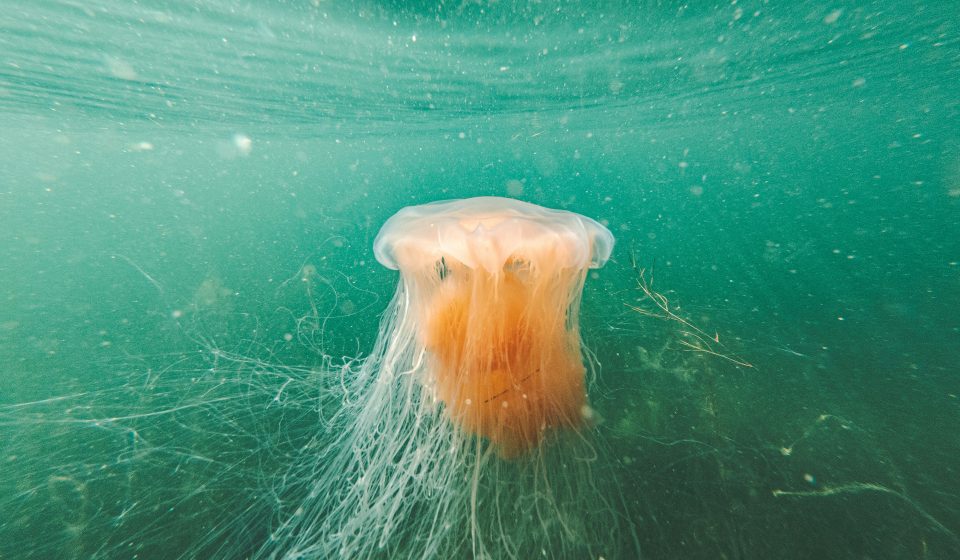
the lion’s mane jellyfish.
The resemblance immediately caught my attention.
But there’s an important distinction here.
Finding a similar photograph online isn’t the same thing as scientifically identifying an animal.
Without a clear photograph of the actual specimen, its location and expert confirmation, I can’t say with certainty that what I saw was a lion’s mane jellyfish.
It may have been.
It may also have been another jellyfish species or marine organism with a similar appearance.
What I learned while searching was more useful than assigning the encounter a definite name.
Lion’s Mane Jellyfish Really Are Remarkable Animals
The lion’s mane jellyfish (Cyanea capillata) is a genuine species, and its reputation for extraordinary size isn’t an internet invention.
It’s considered one of the largest jellyfish species.
Its appearance can be dramatic, particularly because of the enormous mass of tentacles trailing beneath the bell.
Those tentacles are part of the reason encounters require caution.
Like other jellyfish, lion’s mane jellyfish possess specialized stinging cells used in capturing prey and for defense.
For humans, contact with the tentacles can cause a painful sting.
That was enough information to make me very glad I’d chosen not to investigate my beach discovery with my hands.
A Washed-Up Jellyfish Can Still Sting
This was the detail that surprised me most.
It’s easy to imagine that a jellyfish stranded on the beach is no longer a concern.
After all, it may appear motionless.
It may look damaged.
It may even be dead.
But that doesn’t necessarily make touching it safe.
Jellyfish tentacles can remain capable of stinging after the animal has washed ashore.
Even separated tentacles can potentially cause a sting.
That’s why the sensible rule is remarkably simple:
Don’t touch an unidentified jellyfish on the beach.
You don’t need to determine whether it’s alive first.
You don’t need to poke it with your shoe.
You don’t need to pick it up for a photograph.
Just give it space.
Keep Children and Pets Away Too
Adults aren’t the only ones attracted by unusual beach discoveries.
Children are naturally curious.
So are dogs.
A translucent object lying on wet sand may look interesting rather than dangerous.
If you encounter a jellyfish or another unidentified marine organism, keep children and pets from touching it.
With dogs, shortening the leash before approaching is much easier than trying to stop contact after the animal has already begun sniffing or licking something.
That’s exactly what I was grateful I’d done.
Not Every Jellyfish Is Equally Dangerous
It’s also important not to exaggerate the risk.
The word “jellyfish” can make people imagine the most dangerous species on Earth.
That’s misleading.
There are many jellyfish species, and their effects on humans vary considerably.
Some stings produce relatively mild irritation.
Others can cause substantial pain.
Certain species in particular parts of the world can cause severe or potentially life-threatening reactions.
So an unidentified jellyfish shouldn’t automatically be described as deadly.
But you don’t need to know whether a species is extremely dangerous before deciding not to touch it.
Avoiding unnecessary contact is a simple precaution.
Location Is an Important Clue
Where something was found can help narrow down its identity.
Lion’s mane jellyfish are associated particularly with colder waters.
Their range includes northern parts of the Atlantic and Pacific and Arctic waters.
That’s why geographic information matters when identifying a supposed lion’s mane jellyfish.
A photograph might look similar.
But if the animal was found far outside the expected range, identification becomes less straightforward.
In the original encounter, the exact beach location isn’t provided.
For that reason alone, it would be irresponsible to state with certainty that the animal was a lion’s mane jellyfish.
The better conclusion is:
It resembled one enough to prompt further research, and the research revealed a useful beach-safety lesson.
Identification Apps and Image Searches Have Limits
Modern technology makes amateur identification remarkably easy.
Take a photograph.
Upload it.
Compare it with image results.
Within seconds, you may receive a species name.
But visual similarity isn’t proof.
Animals can vary in size, color and condition.
A specimen washed ashore may look very different from one photographed alive underwater.
Damage can distort its shape.
Lighting can alter color.
And closely related species may resemble one another.
Online tools are useful for generating possibilities.
They’re less reliable for declaring certainty.
For a meaningful identification, clear photographs, geographic location and knowledgeable expertise are far more useful.
The Encounter Changed How I Looked at the Shoreline
Before that morning, I thought of the shoreline mostly as the edge of the ocean.
A place where water meets land.
A place for walking.
A place where waves deposit shells and seaweed.
Afterward, it felt different.
The shoreline is also where two environments collide.
Things living offshore can suddenly appear at our feet.
Some arrive intact.
Some arrive damaged.
Some are familiar.
Others look almost alien.
And many are easy to misunderstand if we’ve never encountered them before.
The Ocean Doesn’t End Where the Water Ends
That may have been the biggest lesson.
When we stand on the sand, we tend to think we’re outside the ocean.
But biologically, the boundary isn’t so clean.
The tide constantly transports organisms and material between sea and shore.
A beach can contain shells, crabs, fish, jellyfish, seaweed, egg cases and countless other traces of marine life.
Some are harmless to handle.
Some should be left alone.
Unless you know the difference, observing without touching is usually the better approach.
What Should You Do If You Find a Jellyfish?
If something on the beach appears to be a jellyfish, the first step is simple:
Leave it alone.
Don’t pick it up.
Don’t encourage children to touch it.
Keep pets away.
Avoid stepping on tentacles, including pieces that appear separated from the main body.
If the beach is supervised and the animal is in a heavily used area, alerting a lifeguard or local beach authority may also be appropriate.
They may know whether that species is common locally and whether any additional action is necessary.
What If Someone Is Stung?
Jellyfish first aid depends partly on the species and location, which is another reason universal internet remedies can be problematic.
If someone is stung, get them out of the water and follow guidance from local lifeguards or medical authorities.
Avoid rubbing the affected area, since manipulating remaining stinging material can worsen the exposure.
If the person develops severe symptoms—such as difficulty breathing, loss of consciousness, significant chest symptoms or another serious reaction—seek emergency medical assistance immediately.
For anything more than a minor reaction, professional medical advice is appropriate.
Don’t Rely on Famous Home Remedies
Jellyfish stings have accumulated a surprising number of folk treatments.
Some have been repeated in television shows, movies and beach conversations for years.
But first aid varies by species, and a treatment recommended for one type of jellyfish may not be appropriate for another.
That’s why local medical guidance matters.
When the species isn’t known, improvising based on a viral tip isn’t a particularly good strategy.
Photograph It From a Safe Distance
If you’re curious about an unusual marine animal, you don’t have to abandon that curiosity.
Just change how you investigate.
Take a photograph from a safe distance.
Capture several angles if doing so doesn’t require approaching dangerously close.
Note the beach or general location.
Record approximately how large the animal appeared.
Then compare the photographs later or send them to a local marine organization, aquarium, university or wildlife authority.
That’s far more useful than touching the animal.
And considerably safer.
There Is Something Humbling About Not Knowing
Modern life makes us accustomed to instant answers.
We see something.
We search.
We label it.
Mystery solved.
Nature doesn’t always cooperate.
Sometimes the correct answer is:
“I don’t know exactly what that was.”
That’s not a failure.
In fact, uncertainty can be useful.
It encourages caution.
It reminds us that recognizing something from a photograph isn’t the same as understanding it.
And it leaves room for experts to provide a better answer.
Fear Wasn’t What Stayed With Me
After reading about lion’s mane jellyfish and other marine animals, I could easily have come away frightened of the ocean.
I didn’t.
If anything, I became more fascinated by it.
The object on the beach hadn’t attacked me.
It hadn’t chased my dog.
It hadn’t done anything at all.
It was simply there.
The potentially dangerous part would have been my decision to interfere with something I didn’t understand.
That distinction matters.
Wild animals aren’t villains because they can hurt us.
Jellyfish aren’t malicious.
Their stinging cells are part of their biology.
Respecting wildlife means understanding that not everything in nature exists for us to touch.
Beauty and Danger Can Exist Together
The ocean has always contained both.
A wave can be beautiful and powerful enough to knock someone down.
A brightly colored marine animal can be stunning and unsafe to handle.
A jellyfish can look delicate while carrying thousands of microscopic stinging cells.
Nature doesn’t divide itself neatly into beautiful things and dangerous things.
Sometimes they’re the same thing.
The lesson isn’t to fear everything.
It’s to pay attention.
When I Returned, It Was Gone
Later that day, I returned to the beach.
I looked for the spot where I’d seen the strange form.
Nothing was there.
The tide had changed.
The water had erased the scene.
Maybe the animal had been carried back out.
Maybe it had been moved farther down the shoreline.
I don’t know.
The beach looked ordinary again.
But it didn’t feel quite as ordinary.
I Started Looking More Carefully
I noticed the seaweed.
The shells.
The patterns left by retreating water.
I watched the boundary between ocean and sand differently.
Not because I expected something dangerous to appear.
Because I had been reminded that an enormous living world existed beyond what I normally noticed.
We visit beaches for relaxation and scenery.
The organisms living there aren’t scenery.
They’re inhabitants.
We are the visitors.
A Simple Rule Can Prevent a Bad Encounter
Looking back, I’m glad I didn’t need to know exactly what the animal was in order to make the right decision.
That’s the practical lesson I took from the experience.
When you encounter unfamiliar marine life:
Look, but don’t touch.
Keep pets and children back.
Photograph it from a reasonable distance if you’re curious.
And identify it afterward.
You can satisfy curiosity without putting your hands—or your dog’s nose—on something potentially capable of stinging.
Final Thoughts
I still can’t say with certainty that the creature I saw was a lion’s mane jellyfish.
Based on the photographs I later found, it appeared similar.
But similarity isn’t enough for a definitive identification, particularly without expert confirmation and geographic information.
What I can say is that the encounter changed how I think about finding unfamiliar marine life on the shore.
Something doesn’t have to be moving to deserve caution.
Something doesn’t have to look frightening to be capable of causing pain.
And we don’t have to touch something simply because we’re curious about it.
That morning, I went to the beach expecting nothing more than a walk with my dog.
I came home with a reminder.
The ocean isn’t merely a beautiful background for our lives.
It’s an enormous living ecosystem filled with creatures we may rarely see and don’t always understand.
Sometimes one of them washes ashore.
When it does, perhaps the most respectful response is also the simplest:
Give it space.
Observe it.
And let the ocean keep some of its mystery.
Editor’s note: The supplied first-person narrative describes a marine animal that the narrator later believed resembled a lion’s mane jellyfish. The species identification has not been independently confirmed. This article therefore does not present the animal as definitively identified. General safety information is provided for educational purposes and is not a substitute for local medical or emergency guidance.