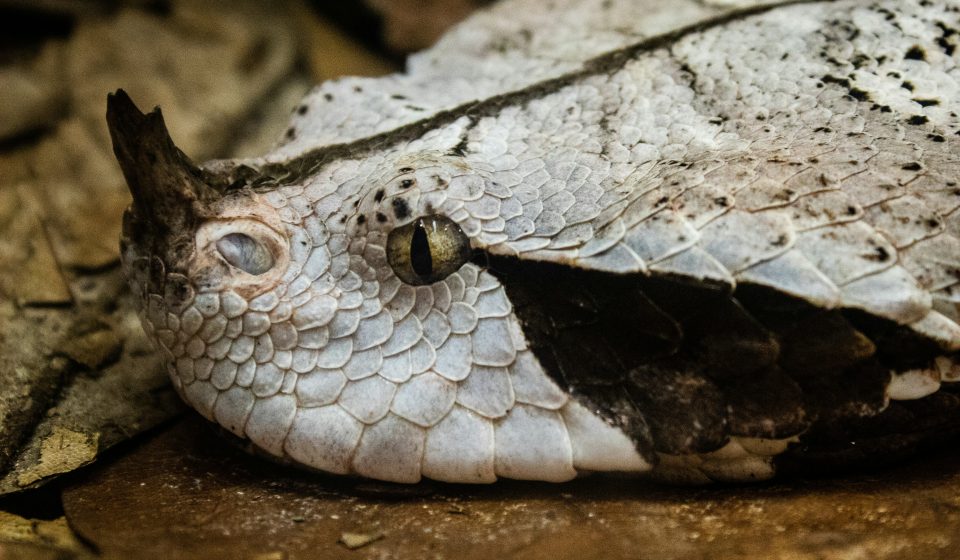

It looked like nothing more than a patch of dead leaves.
That was the frightening part.
There was no dramatic movement.
No snake racing across the yard.
No obvious warning that something potentially dangerous was lying almost perfectly concealed near the vegetation.
According to the account, the discovery happened during an otherwise ordinary morning.
A strange shape near the edge of the yard caught the observer’s attention. At first, it seemed like a branch, dried vegetation or garden debris.
Then the pattern began to look different.
And after taking a closer look, the observer believed the animal was a Gaboon viper.
If that identification was correct, keeping a safe distance was exactly the right response.
The Gaboon viper (Bitis gabonica) is a large venomous snake native to parts of Africa, famous for extraordinary camouflage and exceptionally long fangs.
Yet there’s another fact worth knowing:
Despite its formidable appearance and potentially dangerous bite, the Gaboon viper isn’t generally described as an animal that goes looking for trouble.
Its most remarkable defense may be its ability to avoid being noticed at all.
At First, It Barely Looked Like a Snake
Imagine looking down at a forest floor covered in dried leaves.
Brown.
Tan.
Dark patches.
Irregular shapes.
Now imagine an animal whose body carries many of those same visual patterns.
That’s one of the Gaboon viper’s most impressive adaptations.
The Smithsonian’s National Zoo describes its coloration as an intricate mixture of light and dark shades arranged in geometric patterns.
Even its broad head contributes to the disguise, resembling a fallen leaf.
Against the forest floor, the effect can be remarkably convincing.
From several feet away, your brain may register “leaves” before it registers “snake.”
And that’s precisely why an accidental close encounter can be concerning.
The Camouflage Isn’t Just Beautiful—It’s Functional
Gaboon vipers are ambush predators.
Rather than racing after prey over long distances, they can remain concealed and wait for an animal to move within striking range.
Their patterned bodies allow them to disappear visually into leaf litter.
Small mammals and birds may approach without recognizing the predator nearby.
The snake can then strike rapidly when an opportunity appears.
For the snake, camouflage saves energy.
For a person walking through suitable habitat, however, that same camouflage means watching where you step becomes especially important.
Where Do Gaboon Vipers Actually Live?
This detail matters enormously whenever a photograph of an unusual snake begins circulating online.
Gaboon vipers are African snakes.
The Smithsonian describes their natural habitat as rainforests and other wet areas across parts of Central, East and West Africa, where they spend much of their time on the forest floor.
Animal Diversity Web similarly places them in sub-Saharan Africa, particularly rainforest and other moist tropical habitats where leaf litter provides ideal cover.
So if someone claims to have casually discovered a wild Gaboon viper in a backyard far outside its native range, location becomes an essential piece of information.
Without knowing where a photograph or encounter occurred, the species identification shouldn’t automatically be treated as confirmed.
An escaped or illegally kept exotic animal is theoretically possible in some places, but that would require separate evidence.
That’s Why Photographs Alone Can Be Misleading
Snake identification from a single photograph can be surprisingly difficult.
Lighting changes colors.
Camera angles distort proportions.
Patterns vary among individuals.
Parts of the animal may be hidden.
And several snakes can appear superficially similar to people without herpetological experience.
So while the source describes the animal as a Gaboon viper, the encounter itself isn’t independently verified here.
The biological information about Bitis gabonica, however, can be checked against authoritative zoological sources.
That’s an important distinction.
How Large Can a Gaboon Viper Become?
These are substantial snakes.
The Smithsonian describes the Gaboon viper as Africa’s largest viper and reports that large individuals can exceed 6 feet, or about 1.8 meters, in length.
Other zoological references report specimens exceeding 2 meters.
But length alone doesn’t communicate their appearance.
Gaboon vipers have heavy, thick bodies.
They can look extraordinarily substantial compared with many other snakes of similar length.
That combination of body mass, broad head and intricate pattern makes a fully grown specimen unmistakably impressive once you’ve actually spotted it.
The challenge is spotting it in the first place.
Then There Are the Fangs
This is one of the species’ most famous features.
Gaboon vipers possess extraordinarily long fangs.
According to the Smithsonian, they can reach approximately 2 inches, or 5 centimeters, making them the longest fangs of any venomous snake.
Like other vipers, the fangs are specialized for delivering venom during a strike.
That makes a confirmed bite a medical emergency.
But the existence of huge fangs shouldn’t be confused with a tendency to attack people.
Those are separate questions.
Is the Gaboon Viper Aggressive?
Generally, no.
That’s one of the most important corrections to the frightening image people may have after seeing the snake.
The Smithsonian characterizes Gaboon vipers as placid and notes that they rarely bite humans.
Many dangerous encounters occur when a snake is stepped on or otherwise disturbed before it can avoid the interaction.
If harassed, a Gaboon viper may raise the front of its body and hiss as a warning before striking.
The safest interpretation isn’t:
“It’s calm, so it’s safe.”
A venomous snake should never be handled casually.
Instead:
Its preference for avoiding confrontation is another reason to leave it alone and give it space.
Staying Still Doesn’t Mean the Snake Can’t Strike
A motionless snake can create a dangerous misunderstanding.
People sometimes assume an animal that isn’t moving must be harmless, sleeping or incapable of reacting quickly.
That’s not a safe assumption.
Ambush predators specialize in stillness.
Remaining motionless is part of the strategy.
A Gaboon viper doesn’t need to spend the morning moving around to be capable of a rapid defensive or predatory strike.
So if you suspect you’ve encountered a venomous snake, don’t approach it simply because it appears calm.
What Should You Do If You See an Unknown Snake?
The safest first response is usually simple:
Give it space.
Don’t touch it.
Don’t poke it with a stick.
Don’t try to pick it up.
Don’t attempt to get close enough for a dramatic photograph.
Keep children and pets away.
If the snake is somewhere that creates an immediate safety concern around a home or public area, contact the appropriate local wildlife authority, animal-control service or qualified snake professional.
The Smithsonian likewise advises leaving wild snakes alone rather than attacking or unnecessarily disturbing them.
Don’t Try to Kill It
Trying to kill a snake can require getting dangerously close to the animal.
That’s exactly what you should be trying to avoid.
Even if you’re convinced the snake is venomous, distance is generally safer than confrontation.
A professional who understands local species and appropriate removal techniques is better equipped to handle a situation where relocation is necessary.
And if you’re uncertain about the species, don’t let confidence from an online image comparison tempt you into handling it.
What If Someone Is Bitten?
A suspected venomous snakebite requires urgent medical attention.
Don’t wait for symptoms to become severe before seeking help.
Move away from the snake so another bite doesn’t occur and contact emergency medical services or proceed according to local emergency guidance.
Avoid folk remedies.
Don’t cut the bite.
Don’t attempt to suck venom out.
And don’t deliberately risk another encounter trying to capture the snake for identification.
If a photograph can be taken safely from a substantial distance without delaying medical care, it may sometimes assist identification—but getting treatment is the priority.
The Venom Makes Bites Potentially Serious
Gaboon viper venom can cause severe effects, and bites can be fatal.
The Smithsonian notes that the snake can control whether and how much venom it injects, meaning outcomes can vary substantially.
That variability is not a reason to wait and see what happens.
A person cannot reliably determine the seriousness of a bite simply by looking at the wound immediately afterward.
Prompt professional medical evaluation is essential.
Why Would Such a Dangerous Animal Be So Reluctant to Bite?
Venom is valuable to a snake.
Its primary biological purpose is connected to obtaining prey.
Picking unnecessary fights with animals far larger than itself offers little advantage.
Humans aren’t normal prey for Gaboon vipers.
A snake that remains camouflaged and avoids being noticed may survive an encounter without expending energy or risking injury.
That’s one reason “venomous” and “aggressive” should never automatically be treated as synonyms.
An animal can possess a dangerous defensive capability without actively seeking opportunities to use it against people.
How Does a Gaboon Viper Hunt?
Patience is central to its hunting strategy.
The snake can remain concealed on the forest floor waiting for prey to come close.
Its diet includes small and medium-sized mammals and birds.
The Smithsonian describes Gaboon vipers as passive hunters that wait under cover and strike animals passing within range.
Animal Diversity Web also reports a diet centered on small mammals, including rodents, along with ground-associated birds and amphibians such as frogs and toads.
That makes the animal an effective predator without requiring constant movement.
Camouflage Works in Both Directions
It’s tempting to think camouflage exists only so a predator can surprise its prey.
But concealment can provide protection too.
If potential threats don’t notice the snake, the snake doesn’t have to confront them.
The same adaptation therefore supports both hunting and survival.
For humans, it creates a simple lesson:
In regions where venomous snakes live, pay attention when walking through dense vegetation, leaf litter or other areas where animals can remain concealed.
Gaboon Vipers Also Have an Ecological Role
Fear often makes people forget that venomous snakes aren’t ecological mistakes.
Predators occupy roles in food webs.
Gaboon vipers consume rodents and other animals.
The Smithsonian notes that they contribute to controlling rodent populations in rainforest ecosystems.
Animal Diversity Web makes the same general point about their role as predators of small mammals.
That doesn’t mean you should tolerate a dangerous snake inside your house.
It means that encountering a venomous species in its natural habitat isn’t evidence that the animal shouldn’t be there.
It’s part of that environment.
“Dangerous” Needs Context
The Gaboon viper is undeniably a snake that deserves respect.
It is venomous.
Its fangs are exceptionally long.
A bite can have severe consequences.
But calling it a creature constantly waiting to attack humans creates the wrong picture.
The more accurate description is fascinating precisely because of the contrast:
It possesses formidable defensive and hunting equipment while generally relying on camouflage and stillness.
That combination may be more unsettling than an obviously aggressive animal.
You can walk surprisingly close without noticing it.
The Real Lesson From a Backyard Scare
Whether the original encounter happened exactly as described cannot be established from the narrative alone.
But the situation illustrates a genuinely useful safety principle.
Don’t handle an unidentified wild snake.
You don’t need to know the exact species before deciding to keep your distance.
Trying to become an instant snake expert while standing a few feet away provides little benefit.
Back away.
Keep others away.
And if removal is necessary, contact someone qualified to do it.
Nature Doesn’t Always Announce Danger
Many people imagine dangerous wildlife as obvious.
Loud.
Aggressive.
Moving toward you.
Nature doesn’t work that way.
Sometimes an animal’s survival depends on doing exactly the opposite.
Remaining silent.
Remaining still.
Looking like part of the ground.
The Gaboon viper is an extraordinary example.
Its camouflage can transform one of Africa’s largest vipers into something surprisingly easy to overlook among fallen leaves.
Once You See the Pattern, It’s Hard to Unsee It
Look closely at a clear photograph of a Gaboon viper.
The geometric markings are remarkable.
What appears ornate against a plain background becomes highly effective camouflage against the broken visual texture of a forest floor.
The broad head contributes to the illusion.
So do the contrasting shapes running along the body.
It’s an example of how something visually spectacular in one environment can almost disappear in another.
Fear and Respect Aren’t the Same Thing
Fear may make someone want to kill every snake they encounter.
Respect produces a different response.
Recognize that you may not know the species.
Recognize that some snakes can be medically significant.
Give the animal distance.
Allow qualified professionals to intervene when necessary.
And remember that snakes play ecological roles, including controlling populations of rodents and other prey.
The goal isn’t to pretend venomous snakes are harmless.
It’s to respond intelligently rather than impulsively.
Final Thoughts
What looked like a pile of leaves in the source narrative was identified as a Gaboon viper, one of Africa’s most visually remarkable venomous snakes.
And several facts about the species are genuinely impressive.
Gaboon vipers are among Africa’s largest vipers.
Their bodies are superbly camouflaged against leaf litter.
Their fangs can reach roughly 2 inches in length—the longest documented among venomous snakes.
Yet they are also generally described as calm snakes that rarely bite people unless disturbed, harassed or accidentally stepped on.
That’s why the right lesson isn’t panic.
It’s caution.
If you see an unfamiliar snake, especially one you suspect may be venomous, don’t approach it simply to identify it.
Step away.
Keep children and pets clear.
Call an appropriate professional if removal is needed.
Sometimes the safest wildlife encounter is the one where both you and the animal are allowed to leave each other alone.
Would you have noticed this snake among the leaves, or would its camouflage have fooled you?
Editor’s note: The original narrative identifies the animal encountered in the yard as a Gaboon viper, but it does not provide enough independently verifiable information to confirm the specific encounter or identification. Biological information about Gaboon vipers in this article is based on zoological sources. Never attempt to handle an unknown snake based on an online identification.